
SONORA Products Are the Ultimate Sustainable Solution
06/09/2026
MFAC / MSAC
Creating Long-Lasting Acoustic Spaces Designed for Relocation, Modification, and Reuse
In recent years, sustainability has become an important theme in manufacturing.
In addition to initial performance, products and facilities are now expected to support lower CO₂ emissions, waste reduction, resource circulation, long service life, repairability, modification, relocation, and efficient long-term use.
Anechoic rooms, soundproof rooms, anechoic boxes, and sound-absorbing materials are no exception.
To achieve the required acoustic performance, various materials and structures are necessary, including sound-insulating materials, sound-absorbing materials, structural components, doors, floors, ventilation systems, and wiring. For this reason, it is important to design acoustic spaces that satisfy the required performance while minimizing material waste and allowing relocation, modification, reuse, and maintenance.
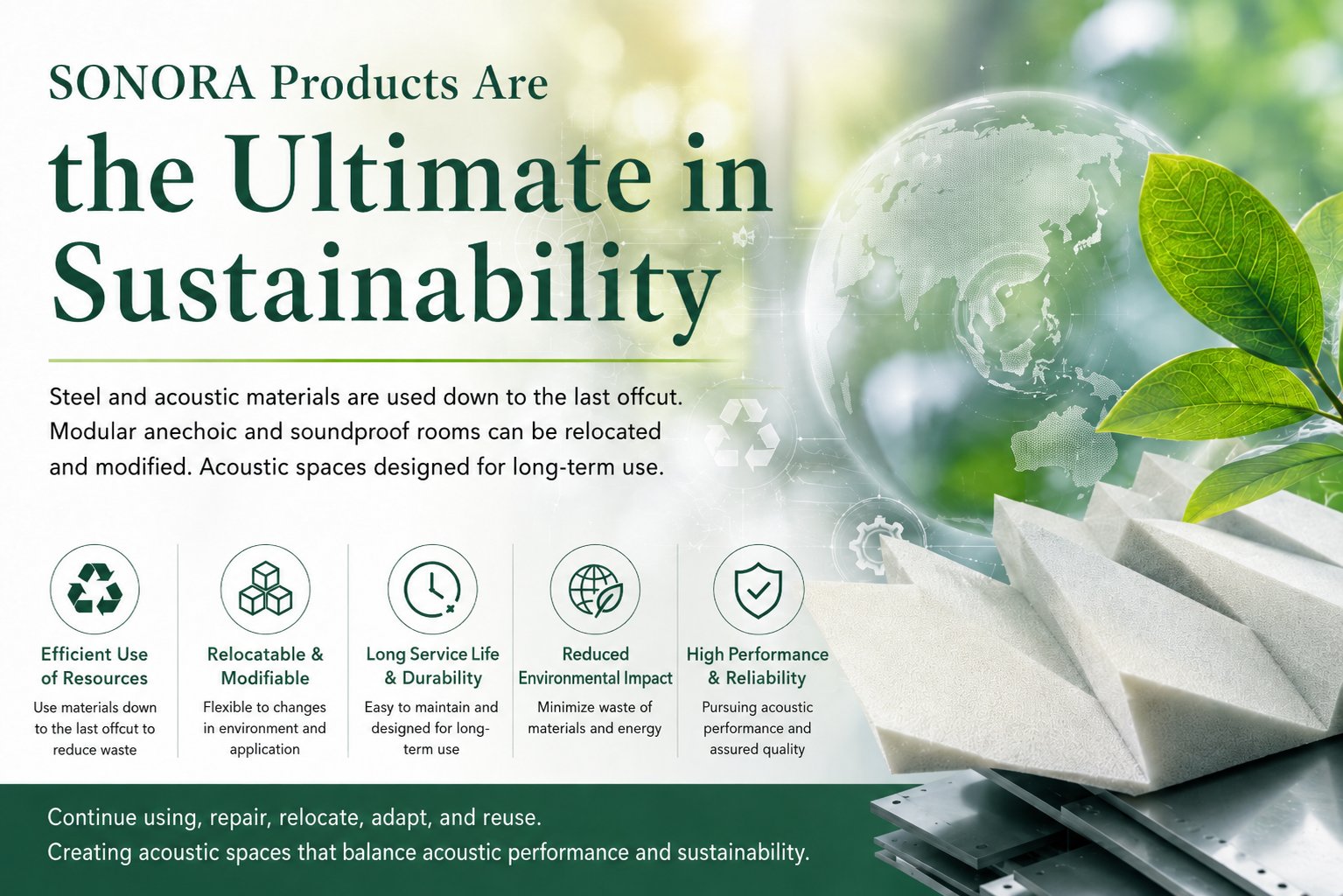
SONORA products aim to provide acoustic spaces that can be used for a long time through steel-based sound insulation structures, sound-absorbing material designs that make use of offcuts, modular structures that can be relocated and modified, and manufacturing and quality control at our own factory.
Steel Is Actually a Sustainable Material
Soundproof rooms and anechoic rooms require sound-insulating structures with sufficient mass in order to achieve high sound insulation performance.
One of the most representative materials for this purpose is steel.
Steel has the mass required for sound insulation, while also being a material that can be collected and recycled relatively easily. For long-term facilities such as soundproof rooms and anechoic rooms, the durability, workability, and reusability of steel are major advantages.
The JFE Group uses the expression “SUS-TETSU-NABLE!” to communicate the sustainable value of steel. On the special website of JFE Holdings, Inc., the sustainability of steel is introduced from the perspectives of “making,” “using,” and “recycling” steel.
“SUS-TETSU-NABLE” is a registered trademark of JFE Holdings, Inc. It is mentioned in this article for the purpose of introducing the company’s initiative and expression.
SONORA’s modular anechoic rooms and modular soundproof rooms are also based on steel sound-insulating panels and frames. This is not only to secure sound insulation performance. By using steel as the main structural material, it becomes easier to support long service life, relocation, modification, component-level maintenance, and future resource circulation.
| Perspective | Sustainable Benefit |
|---|---|
| Long service life | High rigidity and durability support long-term use |
| Sound insulation performance | The mass law can be effectively used in sound insulation design |
| Maintainability | Inspection, replacement, and modification can be performed at the panel level |
| Relocatability | Disassembly and reassembly can be considered |
| Resource circulation | Steel components can be reused as metal resources after use |
Rather than simply assuming that “using steel means high environmental impact,” it is important to consider the full picture: long-term use, reusability, and ease of maintaining performance.
In some cases, using equipment that satisfies the required performance for a long period, while relocating or modifying it as needed, can reduce resource waste more effectively than repeatedly replacing lightweight equipment with a short service life.
Sound-Absorbing Materials Are Used Down to the Offcuts
Sound-absorbing materials are essential for the interior of anechoic rooms and soundproof rooms.
They are important materials for reducing internal reflections and creating suitable measurement or working environments. At the same time, because they must be fabricated and installed according to room dimensions, openings, doors, lighting, ventilation, wiring, and equipment interfaces, offcuts are likely to be generated during manufacturing and processing.
At SONORA, sound-absorbing materials are not treated simply as materials to be cut and installed. We place importance on making effective use of offcuts as well.
For example, by designing sound-absorbing panels, wedges, pipes, and local sound-absorbing components according to the application, material loss can be reduced while maintaining the required absorption performance.
| Perspective | Effect |
|---|---|
| Waste reduction | Reduces the amount of discarded sound-absorbing material |
| Cost reduction | Improves material yield |
| Design flexibility | Enables reuse as small components or local sound-absorbing elements |
| Performance optimization | Allows absorption to be added where it is needed |
| Environmental responsibility | Supports a design philosophy of using materials as completely as possible |
Sustainability is not only about using special new materials.
Using existing materials efficiently and incorporating offcuts into the design is also a highly practical form of sustainable engineering.
Modular Structures Enable Relocation and Modification
Anechoic rooms and soundproof rooms are not finished products that simply remain unchanged after installation.
In business operations, product development themes change, test objects become larger, factory layouts are revised, sites are relocated, overseas deployment is required, and facilities are updated. If anechoic rooms and soundproof rooms had to be completely demolished and newly constructed each time, the cost and environmental burden would be significant.
This is why modular construction is important.
SONORA’s modular anechoic rooms and modular soundproof rooms are based on steel sound-insulating panels and frames. Depending on the application, disassembly, relocation, reassembly, dimensional modification, additional openings, and changes to sound absorption specifications can be considered.
| Change | Possible Response |
|---|---|
| The test object becomes larger | Consider room expansion or partial modification |
| The measurement method changes | Modify absorption specifications, floor structure, or openings |
| The factory layout changes | Disassemble and relocate the room to another area |
| The facility needs to be used at another site | Disassemble, transport, and reassemble |
| The facility needs to be updated | Reuse part of the existing panels and components |
| HVAC or wiring needs to be added | Modify the utility section |
Sustainable equipment is not simply equipment made from environmentally friendly materials.
It is equipment that can continue to be used without being destroyed or discarded, even when business conditions change.
The Ability to Modify Extends Equipment Life
After soundproof rooms or anechoic rooms are introduced, the following types of changes may become necessary:
- Adding openings because the test object has changed
- Changing the door to improve loading and unloading
- Adjusting sound absorption performance
- Adding air conditioning or ventilation
- Increasing cable or piping penetrations
- Changing the internal layout
- Relocating the existing facility to another area
If the structure cannot be modified, the entire facility may need to be rebuilt.
On the other hand, with a panel-based or modular structure, only the necessary sections can be modified while existing components are retained and reused.
Acoustic facilities have characteristics of both buildings and production equipment.
They require architectural stability, but they must also adapt to operational changes like production facilities. Therefore, modifiability, relocatability, and maintainability are important performance factors that extend equipment life.
Choosing Not to Paint Can Also Be Part of Sustainable Design
Soundproof rooms and anechoic rooms are sometimes painted as an exterior finish.
However, painting also involves procurement of paint and thinner, coating processes, drying time, solvent management, repair work, and repainting.
Depending on the application and installation environment, painting may be necessary. However, not every soundproof room or anechoic room necessarily requires painting.
For example, when hot-dip galvanized steel sheets or surface-treated steel sheets can provide both appearance and durability, eliminating the painting process may become a practical option.
| Perspective | Benefit |
|---|---|
| Procurement stability | Less affected by price fluctuations and lead-time issues for paint and thinner |
| Shorter process | Reduces painting, drying, and repair processes |
| Lower environmental burden | Helps reduce solvent use and paint-related waste |
| Maintainability | Simplifies handling of scratches and coating deterioration |
| Cost stability | Makes the design less vulnerable to raw material market fluctuations |
This does not mean that “not painting is always the correct choice.”
The important point is to compare performance, durability, appearance, cost, and procurement risk, and then select the appropriate finish only where it is truly needed.
In-House Manufacturing Makes Material Management Easier
Sustainable product development requires not only good design, but also an appropriate manufacturing system.
SONORA manufactures anechoic rooms, soundproof rooms, anechoic boxes, sound-insulating panels, and sound-absorbing materials at its own factory.
In-house manufacturing has value not only for quality control, but also for resource management.
- Steel processing dimensions can be optimized more easily
- Offcuts of sound-absorbing materials can be managed and reused more effectively
- Standardized components can help reduce manufacturing loss
- Trial assembly and inspection can reduce rework at the installation site
- Component compatibility can be considered for future modification and relocation
High-precision processing contributes not only to acoustic performance, but also to reducing adjustment loss and rework during installation.
Acoustic Performance Verification Also Supports Sustainability by Reducing Rework
For sustainable facilities, long service life is not the only important factor.
It is also important to satisfy the required performance from the beginning and reduce rework or additional construction.
If additional construction, component replacement, reinstallation, retransportation, or remeasurement becomes necessary due to insufficient performance, additional materials, energy, labor, and time are required.
SONORA places emphasis on acoustic performance and designs sound insulation and sound absorption according to the intended purpose. Performance verification after installation and adjustment support when necessary are also important processes for reducing unnecessary rework.
Designing the facility to meet the required purpose from the beginning and confirming performance after installation are important not only for reliability, but also from the perspective of sustainability.
What SONORA Means by “The Ultimate Sustainable Solution”
For SONORA, sustainability is not simply a matter of saying that something is environmentally friendly.
It means creating acoustic spaces that maintain acoustic performance while being used for a long time.
It means enabling relocation and modification when business conditions change.
It means using materials efficiently and making use of offcuts.
It means managing quality and materials through in-house manufacturing.
It means securing the required performance and reducing rework.
It also means designing structures that can return to the resource cycle after use.
Together, these ideas form SONORA’s approach to sustainable design.
| SONORA’s Approach | Sustainable Value |
|---|---|
| Steel panel structure | Long service life, high durability, and resource circulation |
| Use of sound-absorbing material offcuts | Waste reduction and improved material yield |
| Modular structure | Relocation, reassembly, and reuse |
| Modification support | Extension of equipment life |
| Paint-free design option | Reduction of procurement risk, process load, and environmental burden |
| In-house manufacturing | Quality control, material management, and loss reduction |
| Acoustic performance verification | Reduction of rework and additional construction |
Instead of “build once and finish,” the concept is to continue using, repair, relocate, modify, and reuse.
This is the core of sustainability in SONORA products.
Summary
Anechoic rooms, soundproof rooms, anechoic boxes, and sound-absorbing materials require materials and structures in order to achieve acoustic performance.
For this reason, it is important to consider what materials are used, how they are manufactured, how long they can be used, whether relocation and modification are possible, and how much waste can be reduced.
SONORA products provide long-lasting acoustic spaces through steel panel structures, sound-absorbing material designs that use offcuts, modular structures that can be relocated and modified, in-house manufacturing, and acoustic-performance-oriented design.
Sustainable acoustic equipment is not simply equipment made from low-impact materials.
It is equipment that satisfies the required performance and can continue to be used as business needs change.
SONORA will continue to develop products that combine acoustic performance with sustainability.