
How to Add Decibels: Why 50 dB + 50 dB Is 53 dB
07/28/2026
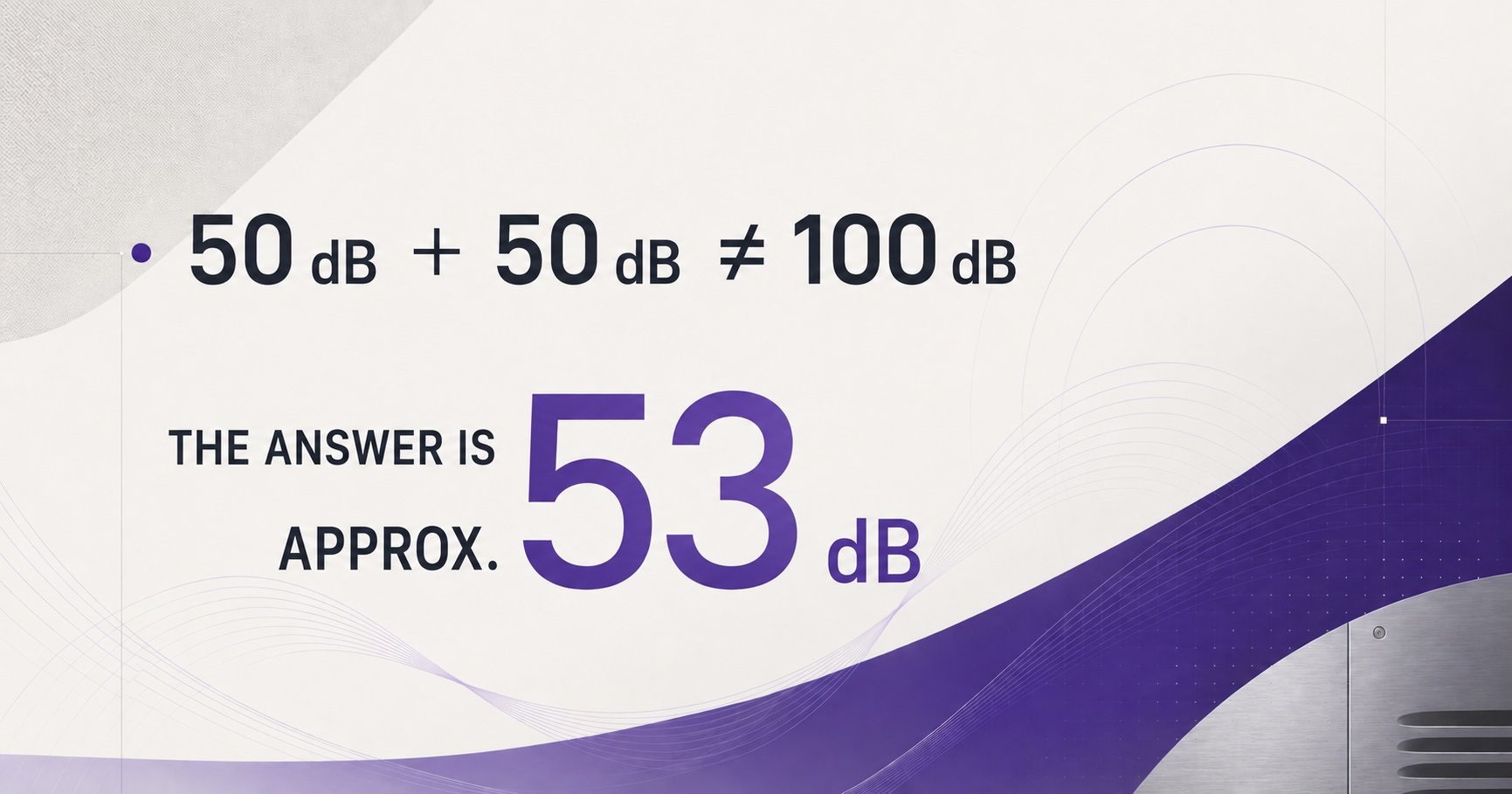
How to Add Decibels: Why 50 dB + 50 dB Is About 53 dB
If one machine produces a sound level of 50 dB at a measurement point, what happens when an identical machine is added?
The answer is not 100 dB.
Under the same measurement conditions, if each machine independently produces 50 dB at the same receiver position, their combined sound level is approximately 53 dB.
50 dB + 50 dB ≈ 53 dB
This result may appear unusual, but it follows directly from the logarithmic nature of the decibel scale.
Decibels Cannot Be Added Using Ordinary Arithmetic
The decibel is a logarithmic unit used to express ratios of acoustic quantities over a very wide range.
When acoustic energy changes, the corresponding change in level is:
- Twice the acoustic energy: approximately +3 dB
- Ten times the acoustic energy: +10 dB
- One hundred times the acoustic energy: +20 dB
Two equal and independent sound sources produce twice the acoustic energy of one source. Therefore, the resulting increase is approximately 3 dB—not 50 dB.
For two 50 dB sources:
50 + 10 log10(2) = 53.01 dB
The combined level is therefore approximately 53 dB.
The Formula for Adding Two Sound Levels
When two independent sound levels are combined, the total level is calculated as follows:
L_total = 10 log10(10^(L1/10) + 10^(L2/10))
Where:
- L_total is the combined sound level
- L1 is the level of the first sound source
- L2 is the level of the second sound source
For two 50 dB sources:
L_total = 10 log10(10^(50/10) + 10^(50/10))
L_total = 53.01 dB
This formula can be extended to three or more independent sound sources by adding another energy term for each source.
Adding Multiple Equal Sound Sources
For N independent sound sources that produce the same level at the measurement point, the following simplified formula can be used:
L_total = L_single + 10 log10(N)
For example, if each machine individually produces 50 dB:
| Number of Machines | Combined Level | Increase |
|---|---|---|
| 1 | 50.0 dB | 0 dB |
| 2 | 53.0 dB | +3.0 dB |
| 4 | 56.0 dB | +6.0 dB |
| 5 | 57.0 dB | +7.0 dB |
| 10 | 60.0 dB | +10.0 dB |
| 100 | 70.0 dB | +20.0 dB |
It takes ten equal and independent 50 dB sources to produce a combined level of approximately 60 dB.
Quick-Reference Table for Two Different Sound Levels
When two sound sources have different levels, calculate the difference between them and add the corresponding correction to the higher level.
| Difference Between the Two Levels | Add to the Higher Level |
|---|---|
| 0 dB | +3.0 dB |
| 1 dB | +2.5 dB |
| 2 dB | +2.1 dB |
| 3 dB | +1.8 dB |
| 4 dB | +1.5 dB |
| 5 dB | +1.2 dB |
| 6 dB | +1.0 dB |
| 7 dB | +0.8 dB |
| 8 dB | +0.6 dB |
| 9 dB | +0.5 dB |
| 10 dB | +0.4 dB |
| 15 dB | +0.1 dB |
For example, when a 70 dB source and a 60 dB source operate simultaneously, the difference is 10 dB.
The correction is approximately 0.4 dB:
70 dB + 60 dB ≈ 70.4 dB
The lower-level source still contributes acoustic energy, but its effect on the total is small.
A 10 dB Difference Does Not Always Mean the Lower Source Can Be Ignored
A single source that is 10 dB below the dominant source adds only about 0.4 dB to the total. In many practical assessments, this change may be small compared with normal operating fluctuations or measurement uncertainty.
However, the number of lower-level sources must also be considered.
For example, ten independent sources that each produce 65 dB combine to approximately 75 dB. If this group operates alongside an 80 dB source, the result is:
80 dB + 75 dB ≈ 81.2 dB
A single quieter source may have little influence, but many quieter sources can become significant when combined.
Why Stopping Half the Machines Reduces the Level by Only 3 dB
Consider ten identical machines operating under the same conditions. If five machines are stopped, the total acoustic energy is reduced by half.
A 50% reduction in acoustic energy corresponds to:
10 log10(1/2) ≈ −3 dB
The same principle applies when reducing two equal machines to one.
This explains why stopping half of the operating equipment may not create a dramatic subjective change, even though the acoustic energy has been reduced substantially.
Start Noise Control with the Dominant Source
Decibel addition has an important practical consequence: treating a minor source may produce little change in the overall measured level if another source remains dominant.
For example:
80 dB + 65 dB ≈ 80.1 dB
Reducing the 65 dB source alone will barely change the total. In this situation, the 80 dB source should normally be investigated first.
This does not mean that every lower-level source can be ignored. The correct procedure is to:
- 1. Measure each significant source under controlled conditions.
- 2. Compare the levels at the same receiver position.
- 3. Identify the dominant frequency bands as well as the overall level.
- 4. Estimate the total reduction expected from each proposed measure.
- 5. Prioritize the measures that will produce a meaningful reduction in the combined level.
Information about installation-site noise and frequency characteristics is also necessary when determining the required performance of an anechoic chamber or soundproof room. See Setting Indoor Background Noise Levels for further details.
What Does a 3 dB Change Sound Like?
A 3 dB increase represents twice the acoustic energy, but it does not sound twice as loud.
Under practical listening conditions, a 3 dB change may be noticeable, but it is usually not perceived as a dramatic difference.
As a general psychoacoustic rule of thumb:
- Approximately +3 dB: a small but potentially noticeable increase
- Approximately +5 dB: a clearly noticeable increase
- Approximately +10 dB: often perceived as roughly twice as loud
These are approximate perceptual guidelines. Actual perception depends on frequency, duration, background noise, sound character, and the listener.
Therefore, reducing acoustic energy by half produces a 3 dB reduction, while making a sound seem approximately half as loud generally requires a reduction closer to 10 dB.
A 10 dB reduction corresponds to reducing the acoustic energy to approximately one-tenth of its original value.
Conditions Required for the 53 dB Result
The statement “50 dB + 50 dB ≈ 53 dB” applies when several important conditions are satisfied.
The sources are independent
The calculation assumes that the sound sources are statistically uncorrelated. This is usually a reasonable approximation for separate machines producing broadband noise.
If two sources are coherent or phase-related, such as synchronized pure tones, interference may cause the measured result to be higher or lower depending on phase and position.
The levels are evaluated at the same position
Each 50 dB value must represent the level produced at the same receiver or microphone position.
If the machines are located at different distances, have different directional characteristics, or are affected differently by reflections, their individual levels at the receiver may not be equal.
For more information about the relationship between distance and sound pressure level, see What Is the Inverse Square Law in Sound Power Measurements?.
The measurement settings are consistent
The values being combined must use the same:
- Frequency weighting, such as A-weighting
- Time weighting or averaging period
- Frequency range
- Measurement quantity
- Operating conditions
A-weighted levels should not be directly combined with unweighted sound pressure levels or values measured under different operating conditions.
Frequency-band analysis may still be necessary
Overall dB or dB(A) values can be useful for estimating the total level, but they do not reveal which frequencies dominate.
For noise-control design, octave-band or one-third-octave-band calculations are often more useful. The levels should be combined separately within each frequency band before selecting absorbers, enclosures, silencers, or vibration-control measures.
Sound Pressure Level and Sound Power Level Are Different
Sound pressure level depends on the measurement position, distance, room reflections, and surrounding environment.
Sound power level represents the acoustic energy emitted by the source itself and is determined through specified measurement procedures.
Although both are expressed in decibels, they should not be treated as interchangeable quantities.
For further information, see:
- What Is a Dry Source in Acoustics? Understanding Sound Power and Its Applications
- Understanding ISO 3745 in 5 Minutes
Frequently Asked Questions
Why does doubling the number of equal sound sources add only 3 dB?
Doubling the number of equal and independent sources doubles the acoustic energy. Because the decibel scale is logarithmic, twice the energy corresponds to approximately +3.01 dB.
How many equal sources are required to increase the level by 10 dB?
Ten equal and independent sources produce ten times the acoustic energy of one source. This results in a 10 dB increase.
Can I simply add two dB values together?
No. The values must first be converted from logarithmic levels into linear energy quantities. The linear quantities are added, and the result is then converted back into decibels.
Does a 10 dB increase sound twice as loud?
A 10 dB increase is often perceived as roughly twice as loud, but this is only a general rule. Perception depends on the frequency spectrum, duration, background conditions, and the individual listener.
Can two 50 dB sources produce a result other than 53 dB?
Yes. Approximately 53 dB is expected for independent sources measured under consistent conditions. Coherent sources, phase interference, room reflections, different source positions, or fluctuating operating conditions may produce a different result.
Summary
Sound levels expressed in decibels cannot be added using ordinary arithmetic.
For independent sources measured under the same conditions:
- Two equal sources produce approximately +3 dB.
- Ten equal sources produce +10 dB.
- A source 10 dB below another source adds approximately 0.4 dB.
- Halving the number of equal sources reduces the total by approximately 3 dB.
- Multiple lower-level sources may still become significant when combined.
- Effective noise control normally begins by identifying the dominant source and dominant frequency bands.
Understanding decibel addition makes it easier to predict the effect of adding equipment, stopping machines, or applying noise-control measures.
Sonora Technology provides acoustic measurement environments and customized solutions for product noise evaluation, including fully anechoic chambers, semi-anechoic chambers, anechoic boxes, and soundproof rooms.
Learn more about our Acoustic Measurement Solutions or contact Sonora Technology to discuss your measurement requirements.
Sources and Related Technical Articles
- What Is a Dry Source in Acoustics? Understanding Sound Power and Its Applications
- Understanding ISO 3745 in 5 Minutes: Essential for Acoustic Testing and Quiet Product Design
- Setting Indoor Background Noise Levels
- What Is the Inverse Square Law in Sound Power Measurements?
- Can a Truly Silent Space Be Created on Earth?