
Airborne vs. Structure-Borne Noise: Why Soundproof Walls May Not Solve the Problem
08/03/2026
Others
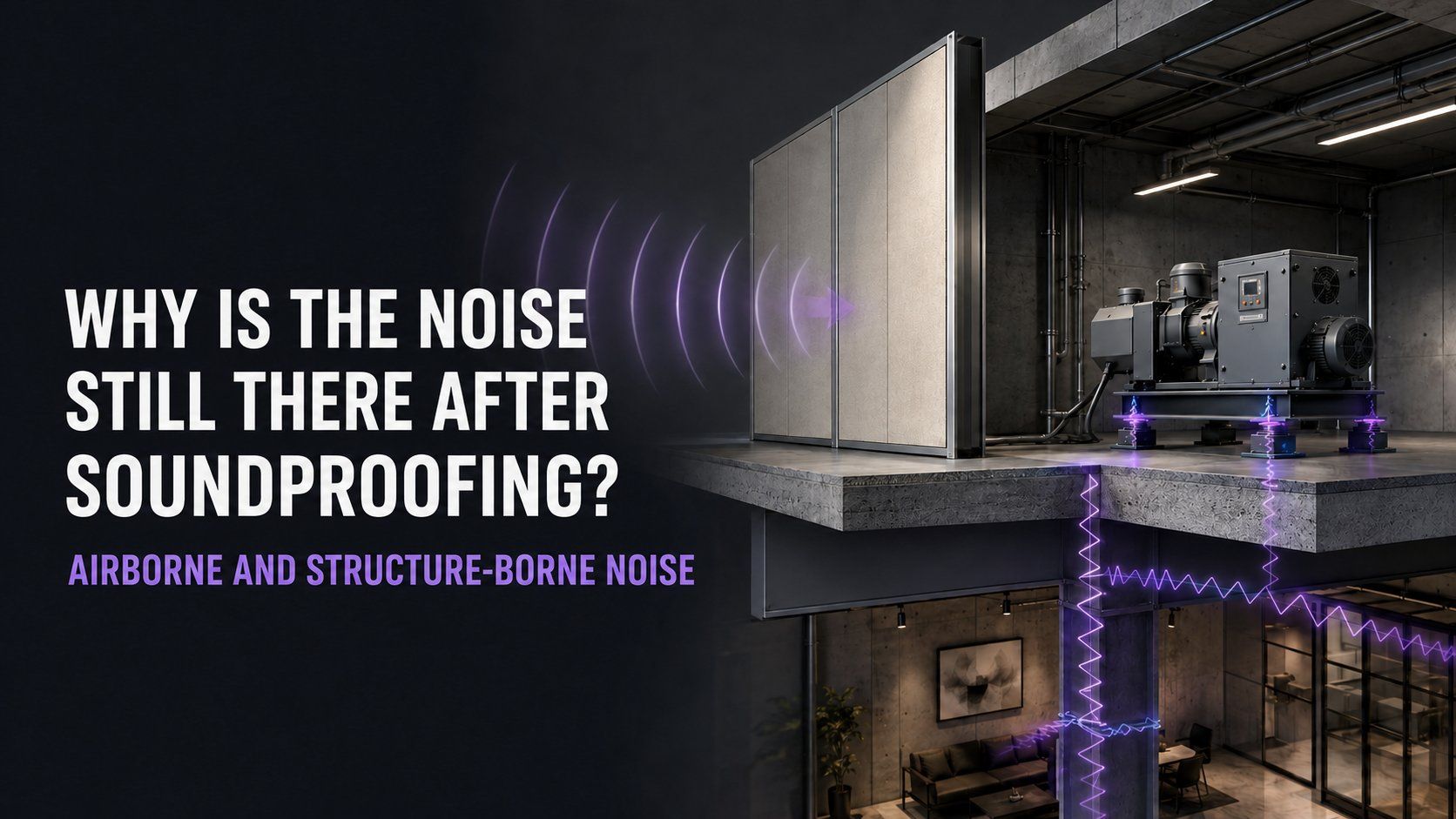
Why Is the Noise Still There After Soundproofing? Airborne and Structure-Borne Noise Explained
A question we sometimes hear during noise-control consultations is:
“We enclosed the machine with a soundproof wall, but the office downstairs still says it is noisy.”
When we inspect the site, the enclosure itself may be reasonably well built. Yet the noise remains. In many cases, a different transmission path has become dominant.
Vibration may travel through the floor, columns, beams, pipework, or ducts, then re-enter the air as sound from a remote surface. This is structure-borne sound.
If a wall appears not to work, that does not automatically mean its sound-insulation performance is poor. The wall may be treating one path while the troublesome energy is using another.
This article explains the difference between airborne and structure-borne noise, why barriers sometimes fail to solve the problem, and how to select an effective control strategy.
Airborne Noise vs. Structure-Borne Noise
For practical noise-control work, transmission is commonly divided into airborne sound and structure-borne sound.
| Transmission type | How it reaches the receiver | Typical examples | Control direction |
|---|---|---|---|
| Airborne noise | Travels as pressure fluctuations in air | Speech, loudspeakers, fan noise, sound radiated by machinery | Walls, acoustic enclosures, doors, opening treatments, absorption |
| Structure-borne noise | Travels as vibration through floors, walls, columns, beams, pipes, or frames, then radiates back into air | Footsteps, machinery vibration, door impacts, pumps, rail vibration | Resilient mounts, floating floors, independent structures, flexible connectors, path treatment |
What Is Airborne Noise?
Airborne noise reaches the receiver through pressure fluctuations in the air. Speech, television and loudspeaker sound, fan aerodynamic noise, and sound radiated directly from a machine casing are common examples.
In an outdoor free field, sound pressure level generally falls as distance from the source increases. A sufficiently massive, airtight barrier can also reduce the sound transmitted to the other side.
However, rooms contain reflections, ducts guide sound, and openings can bypass a barrier. Airborne sound does not always decrease in a simple way based on distance alone.
What Is Structure-Borne Noise?
Structure-borne noise begins as mechanical vibration. The vibration travels through a building or machine structure and causes another surface to move. That surface then radiates airborne sound into the receiving room.
For example, a pump can transmit vibration from its base into a concrete slab. The vibration may reach the ceiling or wall of the room below, where the surface acts like a large loudspeaker diaphragm.
The listener may feel that the sound is coming from the ceiling even though the original injection point is a machine foot or pipe support on the floor above.
One Machine Can Produce Both Types at the Same Time
Airborne and structure-borne noise do not necessarily come from separate sources. A single machine commonly produces both.
A motor or fan radiates airborne sound directly from its casing and airflow. At the same time, mechanical vibration can enter the floor through the machine feet. Pipework, ducts, cable trays, and rigid service connections may provide additional structural paths.
Railway noise is another example. Rolling noise may enter through windows and facades as airborne sound, while wheel-rail vibration can travel through the ground and building foundation. The dominant contribution depends on distance, ground conditions, building construction, and frequency.
The right question is therefore not simply whether the problem is airborne or structure-borne. The task is to determine the contribution of each path and identify which one controls the result at the receiver.
Why a Soundproof Wall May Not Solve the Problem
Soundproof walls and acoustic enclosures are primarily designed to reduce sound traveling through air.
If a machine is rigidly bolted to the floor, vibration can pass beneath the enclosure and enter the building. If a pipe or duct penetrates the enclosure and is rigidly connected, that service can become a bypass path.
Possible remaining paths include:
- Vibration from machine feet, frames, or foundations into the floor
- Transmission from floors into columns, beams, walls, and the ceiling below
- Vibration traveling through pipes, ducts, conduits, and cable trays
- Airborne leakage through doors, ventilation openings, access panels, and penetrations
- Flanking transmission around the target wall through floors, ceilings, or adjoining structures
If one of these paths is dominant, adding more mass to the wall may produce little change in the overall noise. The wall may be doing its job, but it is not treating the controlling path.
For a source-by-source overview, see Noise Control Measures for Factory Equipment.
Why Structure-Borne Noise Is Difficult to Control
1. The Transmission Path Is Hard to See
Airborne paths are often easier to visualize because the source, receiver, wall, and opening can be seen. Structure-borne vibration can divide among floors, columns, beams, walls, and connected services.
Junctions create multiple paths, and a remote surface may radiate more effectively than a nearby one. The location where the sound is loudest does not necessarily match the point where vibration entered the building.
2. Waves in Solids Are Faster, but Speed Is Not the Main Problem
At 20 degrees C, the speed of sound in air is about 343 m/s. Typical longitudinal-wave speeds are roughly 3,000-4,000 m/s in concrete and about 5,900 m/s in steel.
Real building vibration also includes shear waves and flexural waves. Their behavior depends on material properties, structural geometry, boundary conditions, and frequency.
Structural vibration does not travel forever without loss. It decays through internal damping, joints, changes in section, and radiation of acoustic energy.
The practical difficulty is that a stiff, continuous structure or service can distribute vibration to several locations, where large surfaces may radiate the energy back into air.
3. Airborne-Sound Treatments Do Not Automatically Isolate Vibration
Increasing the transmission loss of a wall does not necessarily reduce vibration already traveling through the floor or foundation.
When airborne sound is dominant, the design focus is wall mass, airtightness, doors, windows, and ventilation paths. When structure-borne sound is dominant, the focus shifts to machinery support, foundations, pipework, floor systems, and independent wall or ceiling construction.
The complaint may sound the same, but the correct treatment can be completely different.
Why Footstep Noise from the Floor Above Can Persist
Floor impact sound is one of the most familiar examples of structure-borne noise. Different impact characteristics require different test methods and control strategies.
| Impact type | Typical examples | Representative source | Main design focus |
|---|---|---|---|
| Light, hard impacts | Hard-heeled footsteps, small dropped objects, chair movement | Standard tapping machine | Reduce impact force with carpet or resilient flooring; floor finish has a strong influence |
| Heavy, soft impacts | Barefoot walking, running, or children jumping | Rubber ball or other specified heavy/soft impact source, depending on the standard | Consider slab mass and stiffness, span and supports, resilient floor systems, floating floors, and ceiling construction |
A light object produces a short, hard impact that can often be reduced by softening the floor surface. A heavy low-frequency thump excites the floor system more broadly, so a thin carpet alone usually provides limited improvement.
ISO 16283-2:2020 specifies field measurement procedures for impact sound insulation. ISO 10140-3:2021 covers laboratory measurement and includes tapping-machine methods as well as alternative heavy/soft impact-source methods. ISO 717-2:2020 provides rating procedures for impact sound insulation.
The Basic Principle: Weaken the Vibration Path
Structure-borne noise control is often described as “breaking the connection” or “decoupling.” In practice, the structure is rarely separated completely.
Resilient supports, independent linings, floating structures, and flexible connectors are used to reduce the vibration transmitted to the next element while maintaining required load capacity, alignment, and safety.
Reduce Vibration at the Source
- Correct imbalance, wear, looseness, misalignment, and poor installation
- Support the machine resiliently with elastomeric mounts, metal springs, or air springs
- Use an isolation base or inertia block where required
- Install flexible connectors in pipework and ducts to avoid rigid vibration bridges
If abnormal machine vibration is left untreated, adding soft mounts alone may create excessive movement or transfer loads into connected components. Source condition should be checked first.
Reduce Vibration Along the Transmission Path
- A floating floor supported resiliently from the base structure
- Independent wall or ceiling frames separated from the main structure
- Vibration-isolation hangers for suspended ceilings
- Resilient pipe supports and flexible equipment connections
- Details that prevent rigid vibration bridges at penetrations and perimeter joints
For a practical example, see What Is a Floating Floor in Anechoic Chambers?
Reduce Re-Radiated Sound at the Receiver
When source or path treatment is difficult, an independent lining or vibration-isolated ceiling may reduce sound radiated from the vibrating building surface into the receiving room.
However, rigidly fixing the new lining back to the same vibrating structure can create a new bridge. Receiver-side treatment must therefore include the support and perimeter details, not just the visible board layers.
Vibration-Isolation Pads Are Not a Drop-In Solution
It is tempting to assume that placing rubber under a machine will “break the path.” In reality, an isolation system must be designed for the operating conditions.
Key inputs include:
- Machine mass, center of gravity, and load at each support point
- Excitation frequency and speed range during start-up, operation, and shutdown
- Allowable movement and alignment requirements
- Dynamic stiffness and damping of the isolator
- Natural frequency of the supported system
- Forces introduced by connected pipes, ducts, cables, and guards
The machine and its isolators form a dynamic system with a natural frequency. Near resonance, motion can increase rather than decrease. In an ideal single-degree-of-freedom model, transmissibility first falls below 1 only after the operating frequency exceeds approximately the square root of 2 times the natural frequency.
Even a well-selected mount can be bypassed by rigid pipework or duct connections. Effective isolation depends on the whole installation, not only the pad beneath the machine.
Measure the Source, Path, and Receiver Before Choosing a Treatment
The first step in noise control is not choosing a wall material. It is defining three elements:
| Source | Which machine, component, impact, or operating condition generates the sound or vibration? |
| Path | Does the energy travel through air, floor, columns, pipework, ducts, openings, or several paths at once? |
| Receiver | At which location, time, and frequency does the problem occur? |
When structure-borne transmission is suspected, sound-pressure measurements should be combined with vibration measurements at machine feet, bases, floors, walls, pipes, or other candidate paths. Frequency analysis, operating on/off comparisons, and changes across measurement positions help establish cause and effect.
For example, if an acoustic enclosure is installed around an upstairs machine but low-frequency noise remains downstairs, a practical investigation is:
- Check doors, ventilation openings, access panels, and penetrations for airborne leakage
- Compare vibration spectra at the machine feet and the floor directly beneath
- Measure pipe, duct, and support vibration for bypass paths
- Compare vibration of the downstairs ceiling or walls with the room-noise spectrum
- Change operating speed or load and confirm whether sound and vibration change together
If structure-borne transmission is dominant, resilient machine support or treatment of pipework may provide more benefit than adding another layer to the enclosure wall.
Summary
When noise remains after soundproofing, it is too early to conclude that the wall is inadequate.
Airborne noise travels through air. Structure-borne noise travels as vibration through floors, columns, beams, walls, pipes, ducts, and frames before being re-radiated into air. Openings and flanking paths may also contribute.
Airborne control focuses on wall performance, airtightness, doors, and ventilation paths. Structure-borne control may require resilient machinery support, flexible service connections, floating floors, independent walls, or vibration-isolated ceilings.
The most reliable approach is to identify the source, transmission path, and receiver through acoustic and vibration measurement, then treat the dominant path.
Sonora Technology supports on-site acoustic and vibration investigation as well as the design, manufacture, and installation of acoustic enclosures, soundproof rooms, vibration-isolation bases, and floating-floor systems.
For wall-construction fundamentals, see Walls That Stop Sound: Fundamentals and Misconceptions of Sound Insulation. If the noise source or transmission path is unclear, contact Sonora Technology to discuss measurement and control options.
Frequently Asked Questions
Is structure-borne sound louder because it travels faster than sound in air?
No. Propagation speed and perceived level are different issues. Elastic waves in solids are often faster than sound in air, but the resulting noise depends on source strength, structural paths, damping, resonances, and how efficiently floors, walls, or ceilings re-radiate vibration into the room.
Will carpet reduce footsteps from the floor above?
Carpet or resilient flooring can help with light, hard impacts. Strong low-frequency impacts from running or jumping excite the floor structure more broadly, so a thin carpet alone usually provides limited improvement.
Will rubber mounts always reduce structure-borne noise from a machine?
No. Mounts selected without considering load, excitation frequency, dynamic stiffness, natural frequency, support position, and connected services can perform poorly or create resonance. The complete installation must be evaluated.
Can airborne and structure-borne noise be identified by listening?
A low hum or the impression that sound is coming from a floor or wall can be a clue, but listening alone is not conclusive. Sound and vibration spectra, operating comparisons, and measurements at multiple points are needed.
Should we install an acoustic enclosure or vibration isolation first?
It depends on the dominant transmission path. Machinery often produces both airborne and structure-borne noise, so an enclosure and vibration isolation may be required together. Measurement should define the necessary reduction and path priorities before work begins.
References
- ISO 16283-2:2020, Acoustics – Field measurement of sound insulation in buildings and of building elements – Part 2: Impact sound insulation
- ISO 10140-3:2021, Acoustics – Laboratory measurement of sound insulation of building elements – Part 3: Measurement of impact sound insulation
- ISO 717-2:2020, Acoustics – Rating of sound insulation in buildings and of building elements – Part 2: Impact sound insulation
- ISO 10140-2:2021, Acoustics – Laboratory measurement of sound insulation of building elements – Part 2: Measurement of airborne sound insulation
- Fahy, F. and Gardonio, P., Sound and Structural Vibration: Radiation, Transmission and Response, 2nd ed., Academic Press, 2007