
Semi-Anechoic Chambers for Indoor Tire Noise Testing | ISO 20908 vs ISO 362-3
10/26/2026
MSAC / VSAC
Introduction: start with what goes into the chamber
ISO 20908:2023, published in 2023, standardized a method for evaluating tire noise indoors in a semi-anechoic (hemi-anechoic) chamber.
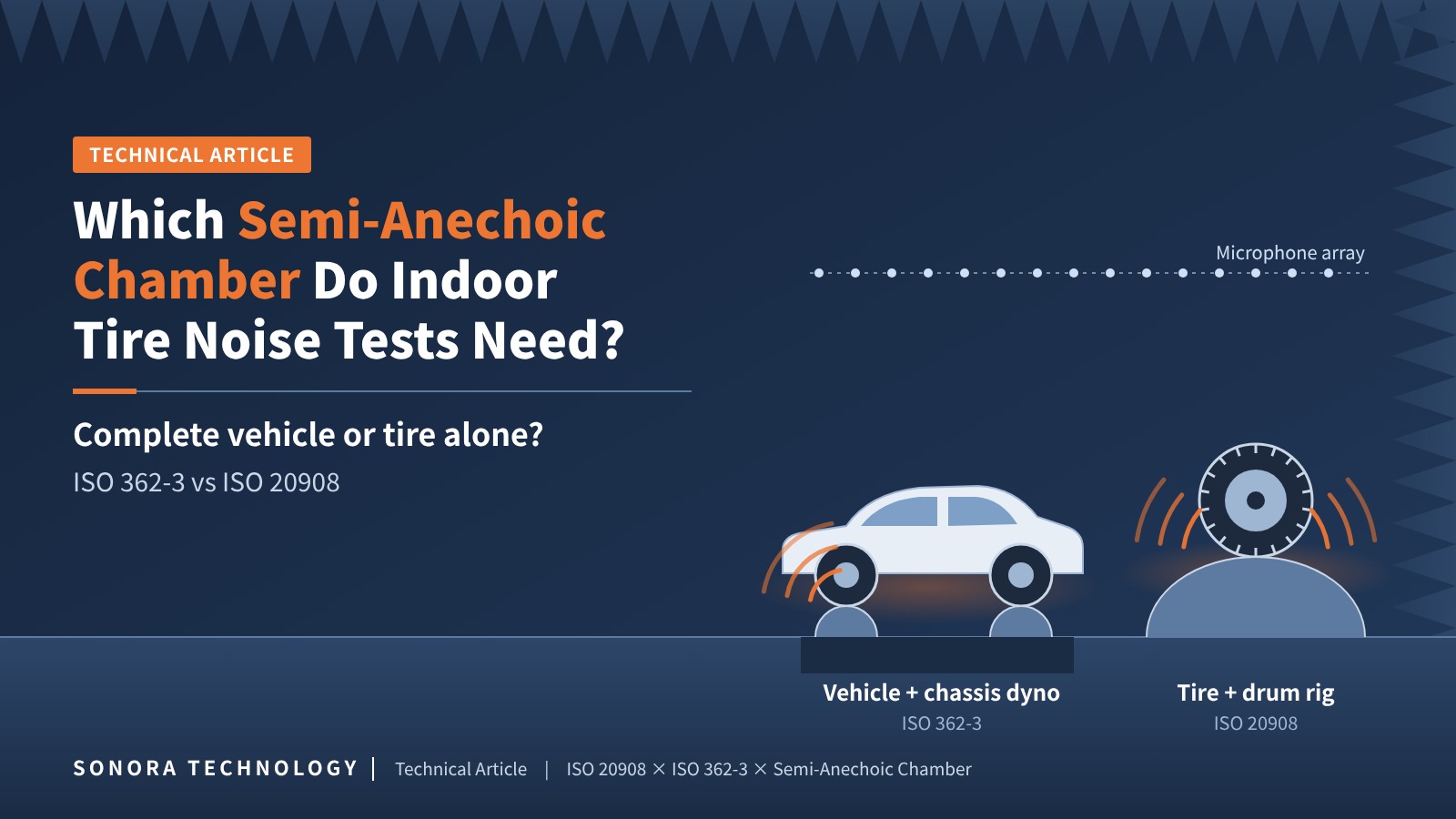
Since then, we have been asked a practical follow-up question: what kind of semi-anechoic chamber does this actually require? To answer it, the first thing we confirm is simple. Will the chamber hold a complete vehicle, or a tire alone?
If you drive a complete vehicle, the governing standard is ISO 362-3:2022. If you run a tire alone on a drum, it is ISO 20908:2023. The choice changes both the size of the chamber and the equipment it needs. This article walks through the chamber requirements for each of these two paths.
1. Both standards bring an outdoor test indoors
Vehicle and tire noise have traditionally been measured outdoors on a test track. ISO 362-1 is the outdoor method for accelerating vehicle noise, and ISO 13325 is the outdoor coast-by method for tire noise. In both, microphones are placed 7.5 m from the centerline of the track at a height of 1.2 m, and they record the sound as the vehicle passes.
Outdoor tests depend on weather, temperature and wind, so the number of usable test days is limited. ISO 362-3 and ISO 20908 were developed to obtain the same results inside a semi-anechoic chamber. Both standards require the chamber to reproduce the sound propagation of an open space above a reflecting surface, which is the road.
| Item | Complete vehicle | Tire alone |
|---|---|---|
| Indoor standard | ISO 362-3:2022 | ISO 20908:2023 |
| Corresponding outdoor standard | ISO 362-1 (accelerating vehicle noise) | ISO 13325:2019 (tire coast-by noise) |
| Test object | Category M and N vehicles (passenger cars, buses, trucks, etc.) | Passenger car and light commercial vehicle tires |
| How driving is reproduced | The vehicle runs on the rollers of a chassis dynamometer | The tire is pressed against a rotating drum and rolls freely, with no drive torque |
| Microphone distance | 7.5 m from the vehicle centerline. Measuring closer and correcting is not permitted | Measured at a far-field distance and corrected to the 7.5 m reference distance |
| Main factors that set the chamber size | 20 m test section, vehicle length, 7.5 m distance, absorber depth, cut-off frequency | Array distance and length, size of the drum test rig, cut-off frequency |
2. Path A: testing a complete vehicle (ISO 362-3)
ISO 362-3 covers road vehicles of categories M and N driven on a chassis dynamometer installed in a semi-anechoic chamber. Its purpose is to obtain results that correlate with the outdoor accelerating pass-by test of ISO 362-1.
Chamber length and width
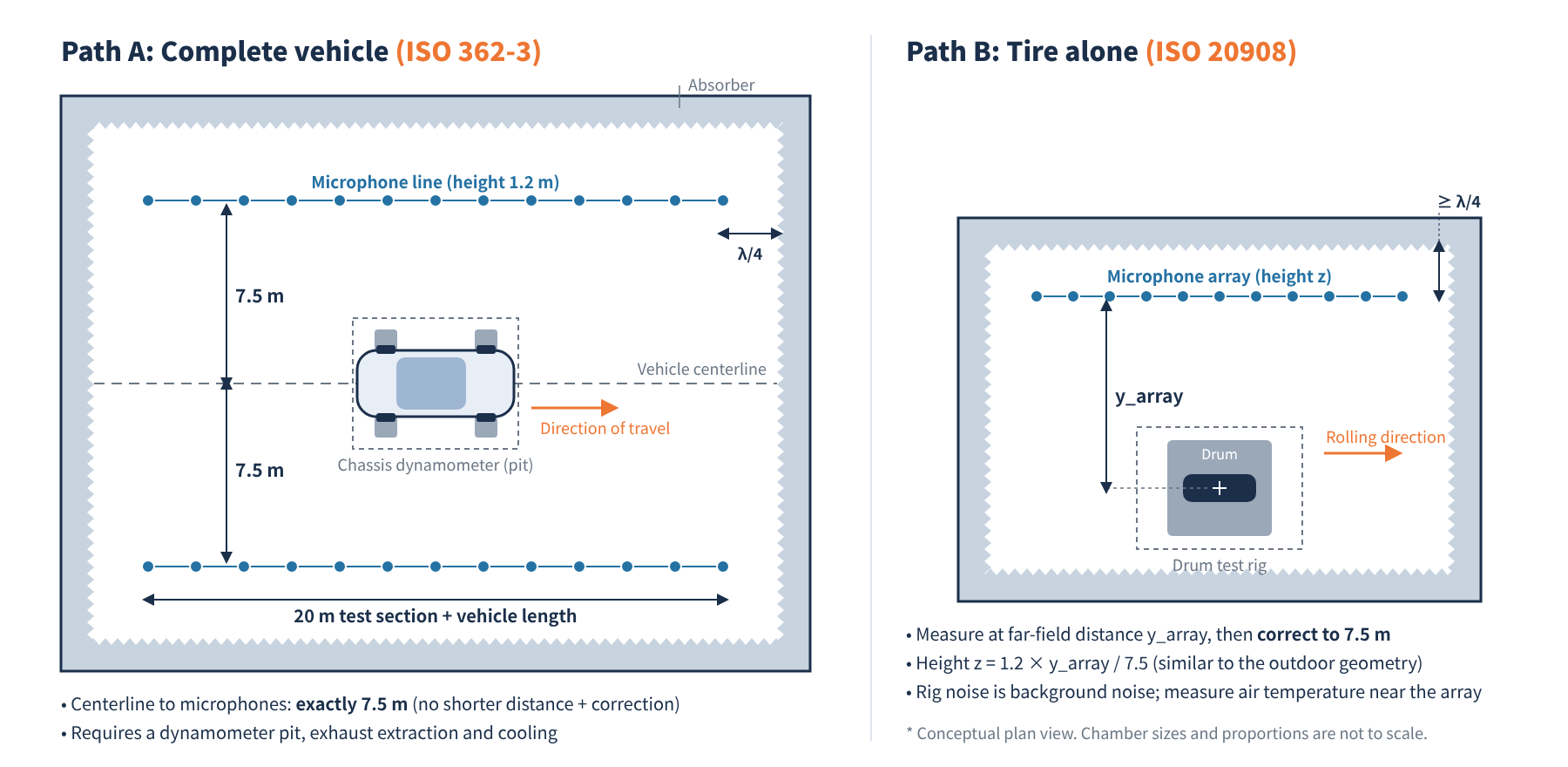
ISO 362-3 recommends a minimum chamber length built up from the following elements:
- 20 m, corresponding to the test section of the outdoor test
- The length of the vehicle to be tested (the longest vehicle for M1, M2 up to 3.5 t and N1; 5 m for M2 over 3.5 t, M3, N2 and N3)
- The thickness of the absorbers at both ends
- A clearance of one quarter wavelength at the cut-off frequency between each end microphone and the absorbing surface (at both ends)
For the width, the standard requires the distance from the vehicle centerline to the microphone line to be exactly 7.5 m. The required width therefore depends on whether the facility measures on one side or on both sides.
As an example, assume a cut-off frequency of 100 Hz (a quarter wavelength of about 0.86 m), a vehicle length of 5 m and an absorber thickness of 0.6 m. The chamber length is then roughly 20 + 5 + 0.6 × 2 + 0.86 × 2 ≈ 27.9 m. For two-sided measurement, the width is about 17.9 m: 7.5 m on each side plus the absorber thickness and the quarter wavelength (a rough estimate that leaves out terms related to vehicle width). The standard also states that when measurements must cover a distance longer than the test track plus the vehicle length, additional microphones, additional signal processing, or both are required.
Equipment specific to vehicle testing
| Chassis dynamometer | a pit is needed to set the rollers into the floor. Noise from the rollers and the drive system must be kept from becoming background noise in the measurement. |
| Exhaust extraction and cooling | running a combustion vehicle indoors requires exhaust extraction, ventilation and cooling air for the vehicle. ISO 362-3 also treats cooling, ventilation, air temperature and exhaust gas management as conditions of the test facility. |
| Handling of tire noise | the roller surface differs from a test track surface, so tire/road noise is handled separately from powertrain noise. ISO 362-3 provides a method for determining tire/road noise indoors (Annex B, normative) and a method that uses tire/road noise data obtained outdoors (Annex D, informative). |
As a reference, our standard design for an indoor pass-by semi-anechoic chamber has internal dimensions of W20 m × L25 m × H7 m, a lower limit frequency of 100 Hz and background noise of 20 dB(A) or less. As described above, we adapt this flexibly to one-sided measurement or to space limitations at the installation site.
3. Path B: testing a tire alone (ISO 20908)
ISO 20908 specifies a method in which a test rig combining a rotating drum and a tire is installed in a semi-anechoic chamber, and tire/road noise is measured while the tire rolls freely without drive torque. The aim is to obtain indoor results that correlate with the outdoor coast-by test of ISO 13325. It applies to passenger car and light commercial vehicle tires, and it is not intended for evaluating the noise of torqued tires or traffic noise at a specific location.
What sets the chamber size
In ISO 20908, a linear microphone array is placed at a distance yarray from the tire. This distance is chosen so that every microphone is in the far field, and the measured levels are corrected to the outdoor reference distance of 7.5 m. The microphone height follows the outdoor ratio of 1.2 m to 7.5 m (z = 1.2 × yarray / 7.5). A circular array is also specified as an option.
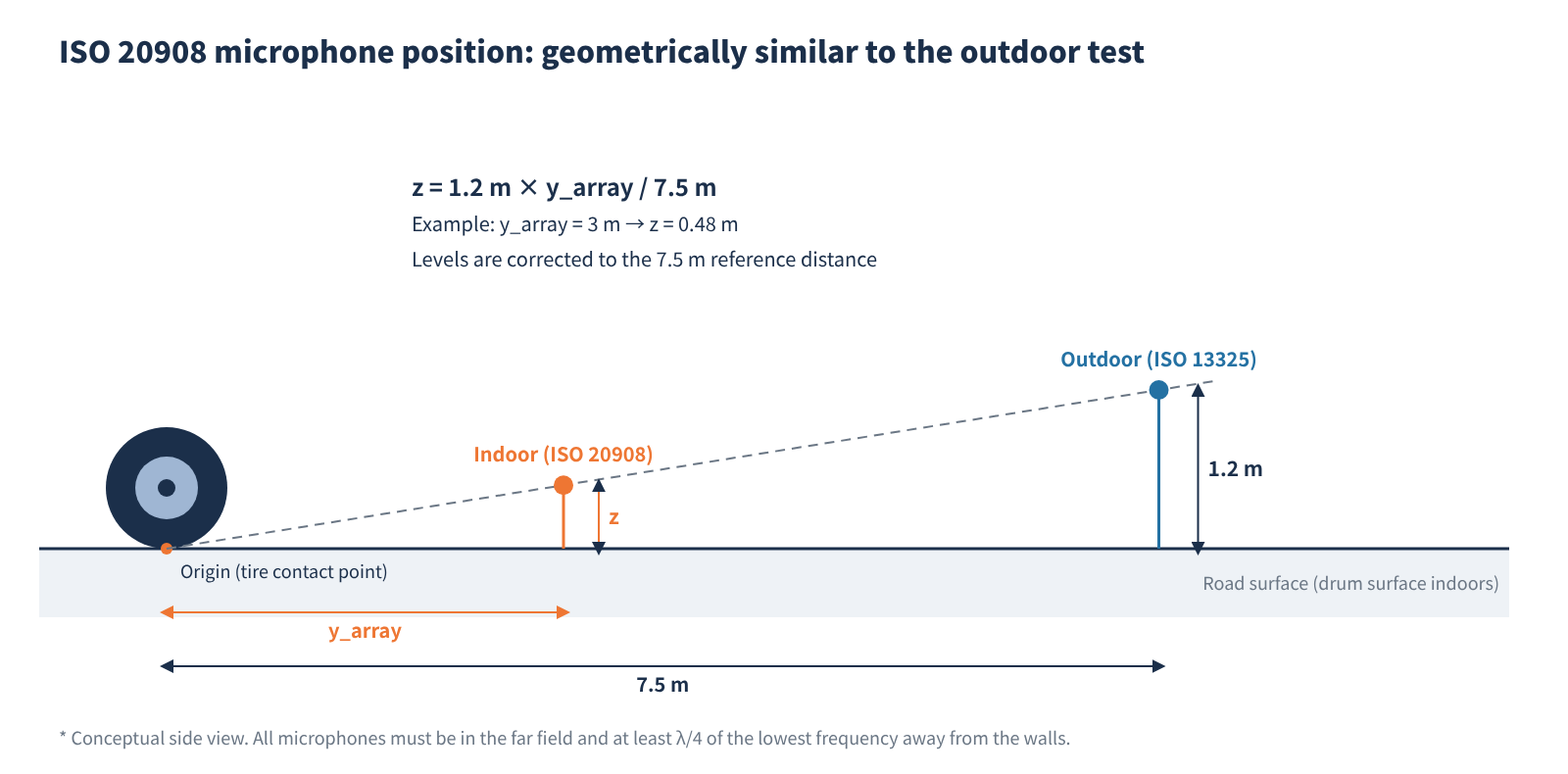
Unlike ISO 362-3, which requires the 7.5 m distance inside the chamber, ISO 20908 allows a shorter array distance. The chamber size is therefore set by the chosen array distance and array length, the dimensions of the drum test rig and the cut-off frequency. The microphones must still be at least a quarter wavelength of the lowest measurement frequency away from the walls.
Conditions specific to tire testing
| Free-field verification | the inverse square law must hold both along the line from the source center to each microphone and across the whole array. ISO 26101-1 (qualification of free-field environments) and ISO 3745 are cited as verification methods. |
| Drum | drum diameter, width, height above the floor, rotational speed and surface are all specified items. The surface reproduces characteristics close to those of the test track. |
| Rig noise | noise from the drum drive motor and bearings is background noise when measuring the tire. Background noise must be checked with the rig included. |
| Temperature | tire noise varies with temperature, so the chamber temperature is controlled and air temperature is measured near the array, at or below the array height. The room temperature must be held at 23 °C ± 3 °C, and the tires to be tested must be conditioned in the same temperature range before the test. |
| Alignment with the outdoor test | the same tires are also measured outdoors (ISO 13325), and a regression line links the indoor and outdoor results. The standard also requires checks that the chamber results do not drift over time. |
4. Which semi-anechoic chamber to choose
| Goal | Path | Chamber concept |
|---|---|---|
| Develop and evaluate accelerating noise of complete vehicles | Complete vehicle (ISO 362-3) | A large facility on the order of 20 m in both length and width, including a chassis dynamometer, exhaust extraction and cooling |
| Develop and compare tire noise | Tire alone (ISO 20908) | Sized around the drum test rig and the array distance; often smaller than a vehicle chamber |
| Evaluate both vehicles and tires indoors | Both | Either use the indoor tire/road noise method of ISO 362-3 Annex B in the vehicle chamber, or have a separate chamber for tire-alone testing |
On either path, the key points to examine are the chamber size, its acoustic performance and its ancillary equipment. Is the chamber large enough for the measurements you plan? Reducing the background noise of the chamber itself matters, but has the background noise been evaluated with the sound sources inside it included, such as the chassis dynamometer or the test rig? And does the environment as a whole, including that equipment and the air conditioning, provide what is needed without excess? These factors have to be considered together.
5. How chamber performance is verified
ISO 362-3 and ISO 20908 both require propagation characteristics equivalent to the outdoor test. Whether a chamber meets this condition is evaluated by measuring the sound pressure level at increasing distances from a source toward the microphones and checking the deviation from the inverse square law (a 6 dB drop for each doubling of distance). The methods are specified in ISO 26101-1 and in the annexes of ISO 3745:2012 (including Amendment 1:2017).
At Sonora Technology, we define the measurement range and the lower limit frequency at the design stage and confirm performance by verifying the inverse square law after completion.
6. Frequently asked questions
Q. Can a vehicle semi-anechoic chamber also be used for tire-alone testing?
Yes, if a drum test rig can be installed and the free-field conditions and array arrangement of ISO 20908 can be met. The layout must be planned at the design stage so that the rig can coexist with the chassis dynamometer pit and the exhaust equipment.
Q. Does a tire-alone chamber not need the 7.5 m distance?
In ISO 20908, measurements are made at a far-field distance and corrected to 7.5 m. This is not simply a matter of skipping the correction if a 7.5 m distance happens to be available. The final goal is the noise level in the far field that the regulations refer to, at 7.5 m over a flat road. Measuring directly at 7.5 m in an indoor facility is not practical, because noise from ancillary equipment such as the drive motor degrades the signal-to-noise ratio. The microphone array is therefore placed close to the tire, at a distance that keeps a good signal-to-noise ratio while still being in the far field. Correction calculations based on that data simulate the distance attenuation and the effect of the drum curvature, producing the pure tire noise at 7.5 m over a flat road with the equipment noise excluded. Because a 7.5 m distance is not required, measuring at 7.5 m is only needed for purposes outside the regulatory assessment, such as validating the calculation algorithm or subjective evaluation.
Q. Is outdoor testing no longer needed?
ISO 20908 defines a procedure that links indoor results to the outdoor test (ISO 13325). Outdoor testing does not disappear entirely, but weather-independent indoor testing makes it possible to run evaluations during development much more efficiently.
Summary
The semi-anechoic chamber needed for indoor tire noise testing depends heavily on whether it will hold a complete vehicle or a tire alone. For a complete vehicle, ISO 362-3 calls for a large facility that fits the 7.5 m distance and the 20 m test section inside the chamber. For a tire alone, ISO 20908 calls for a facility sized around the drum test rig and the array distance. In both cases, deciding the frequency range you need to measure and the background noise target first is the starting point that determines the chamber size and cost.
Sonora Technology proposes chamber dimensions, absorber specifications and ancillary equipment after reviewing your test object, the applicable standards and the required measurement range.
Related information
- VSAC: Vehicle Semi-Anechoic Chamber
- MSAC: Modular Semi-Anechoic Chamber
- Measurable Range in Anechoic and Hemi-Anechoic Chambers
- Design Requirements for Anechoic and Hemi-Anechoic Chambers
- Contact us
References
- ISO 20908:2023, Tyre sound emission test – Methods of drum. ISO
- ISO 362-3:2022, Acoustics – Measurement of noise emitted by accelerating road vehicles – Engineering method – Part 3: Indoor testing M and N categories.
- ISO 13325:2019, Tyres – Coast-by methods for measurement of tyre-to-road sound emission.
- ISO 10844:2021, Acoustics – Specification of test tracks for measuring sound emitted by road vehicles and their tyres.
- ISO 26101-1:2021, Acoustics – Test methods for the qualification of the acoustic environment – Part 1: Qualification of free-field environments.
- ISO 3745:2012/Amd 1:2017, Acoustics – Determination of sound power levels and sound energy levels of noise sources using sound pressure – Precision methods for anechoic rooms and hemi-anechoic rooms.