
[For a Certain Manufacturer] Prefabricated Full Anechoic Chamber for Product Acoustic Measurement (Absorbing Wedge BFW-T-500 Specifications)
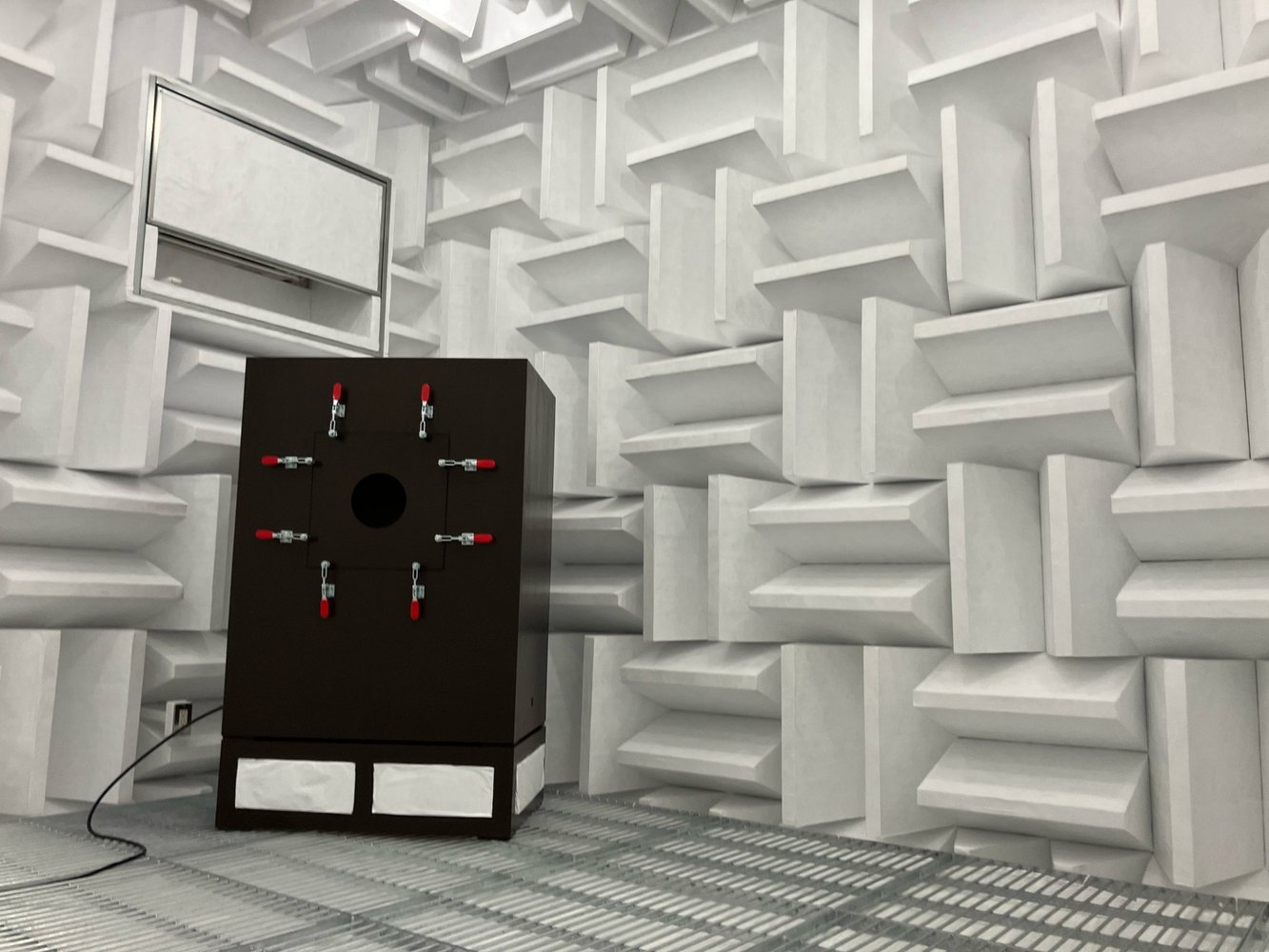
MFAC
We delivered a prefabricated full anechoic chamber to be installed inside an existing building for a certain manufacturer.
This facility is a full anechoic chamber for measuring and evaluating noise generated from products in an environment that suppresses the effects of ambient noise and indoor reflected sound.
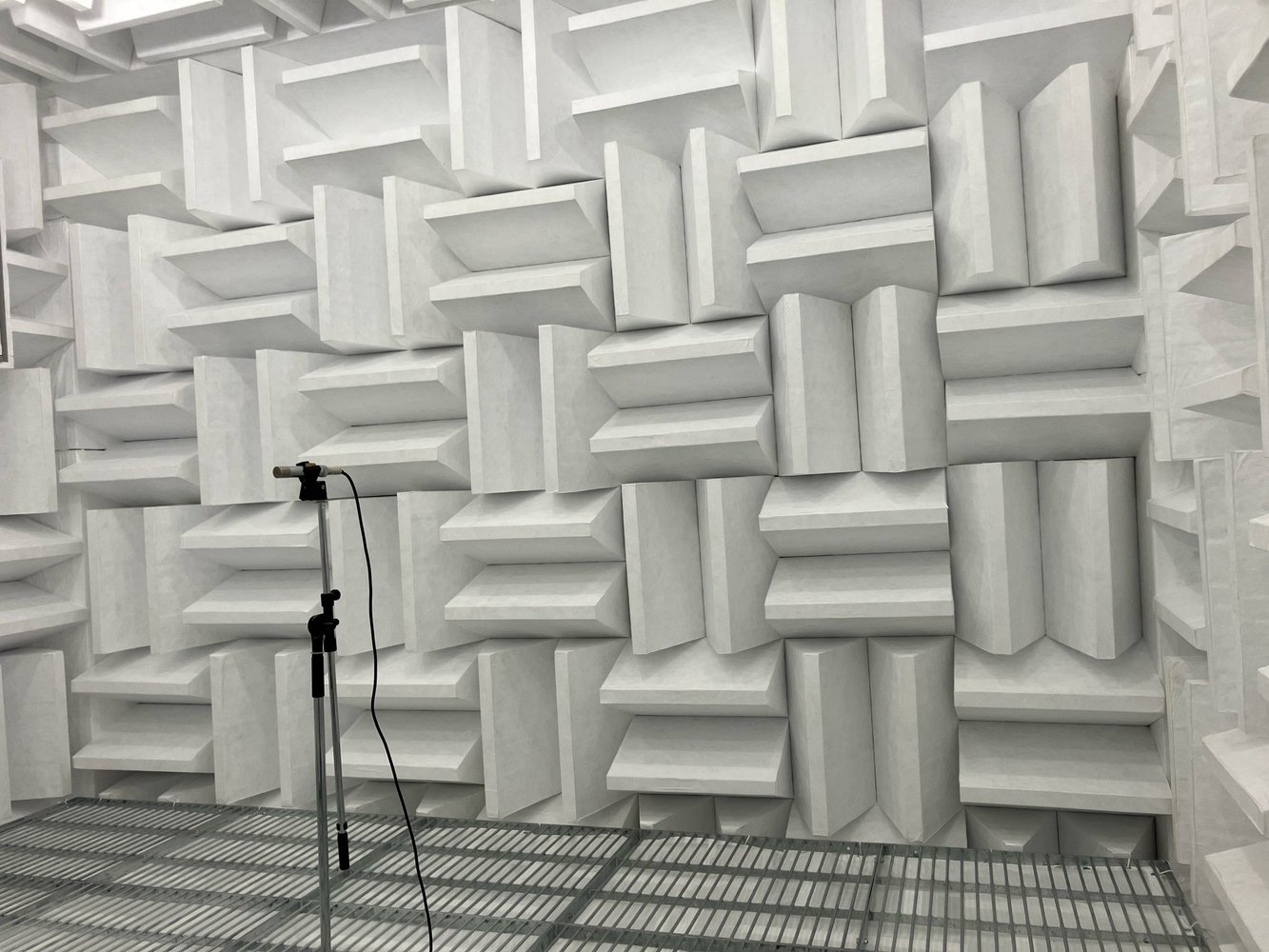
500 mm deep sound-absorbing wedges (BFW-T-500) are arranged on six surfaces (ceiling, walls, and floor), securing a measurement space of approximately 4,000 × 4,200 mm between the tips of the wedges. An anti-vibration layer is provided under the floor to suppress the influence of vibration transmitted from the building.
Summary of Delivered Equipment
| Item | Specifications |
|---|---|
| Client | A Certain Manufacturer |
| Equipment Name | Prefabricated Anechoic Chamber (Full Anechoic Chamber) |
| Chamber Type | Full anechoic chamber with sound absorption treatment on floor, walls, and ceiling |
| Main Application | Measurement and evaluation of noise generated from products |
| Installation Type | Indoor installation / Prefabricated with floor |
External Dimensions
| Item | Dimensions |
|---|---|
| External Dimensions | Approx. W5,400 × D5,200 × H4,280 mm |
| Dimensions Between Wedge Tips | Approx. W4,200 × D4,000 × H3,000 mm |
| Soundproof Door | Single swing (Effective opening: 1,800 mm) |
With a depth of over 4 m between the wedge tips, there is ample space for measuring larger products or for measurements requiring distance between the sound source and the microphone.
Wall and Ceiling Structure
Exterior
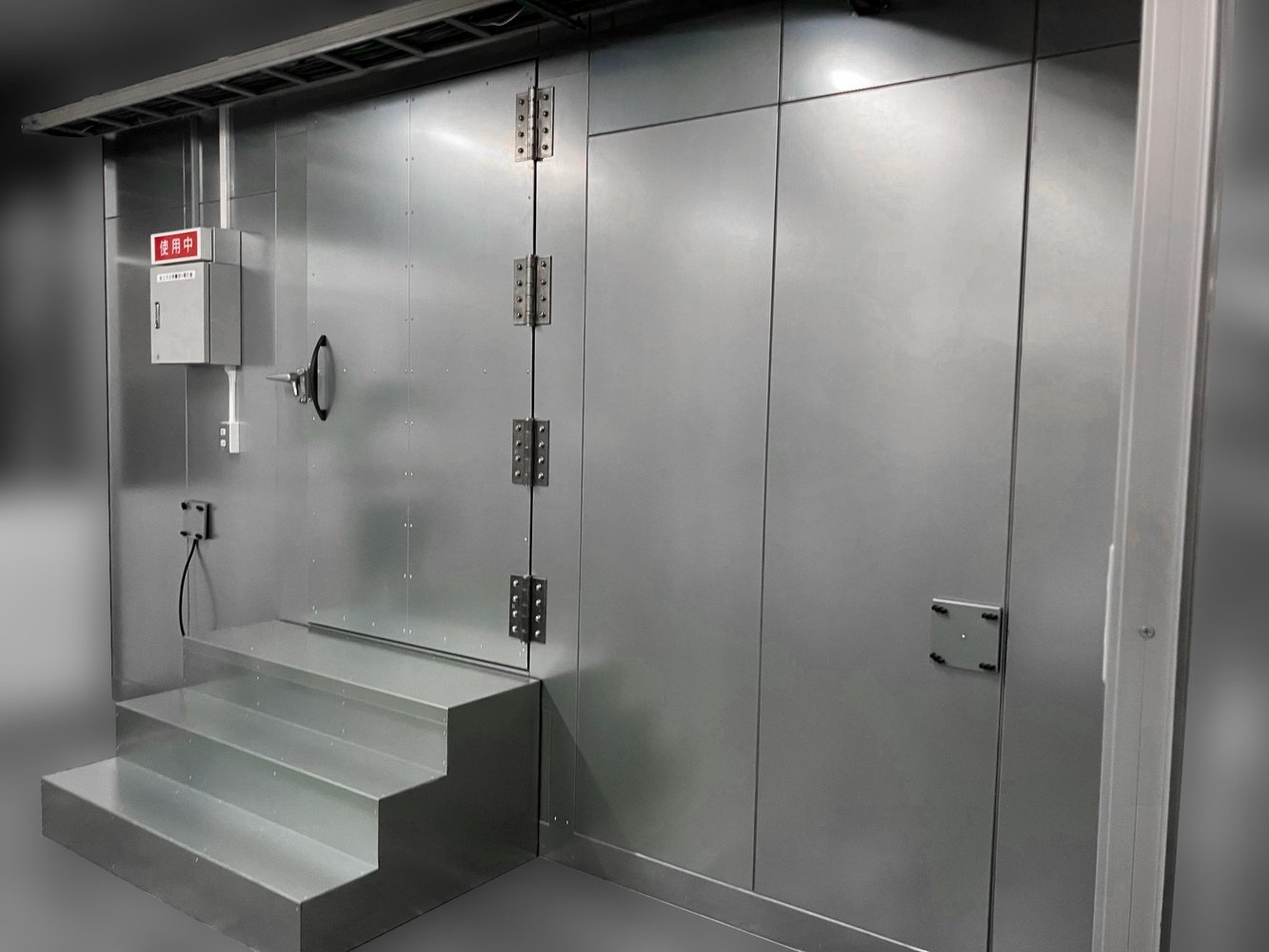
- Steel sound-insulating panels
Interior
- Sound-absorbing wedges BFW-T-500 (Depth: 500 mm)
Steel sound-insulating panels block external noise, while sound-absorbing wedges on the interior reduce reflections of the sound emitted from the test object.
Longer sound-absorbing wedges can absorb sound down to lower frequencies. This facility uses 500 mm deep wedges to create a low-reflection measurement space down to lower frequency bands.
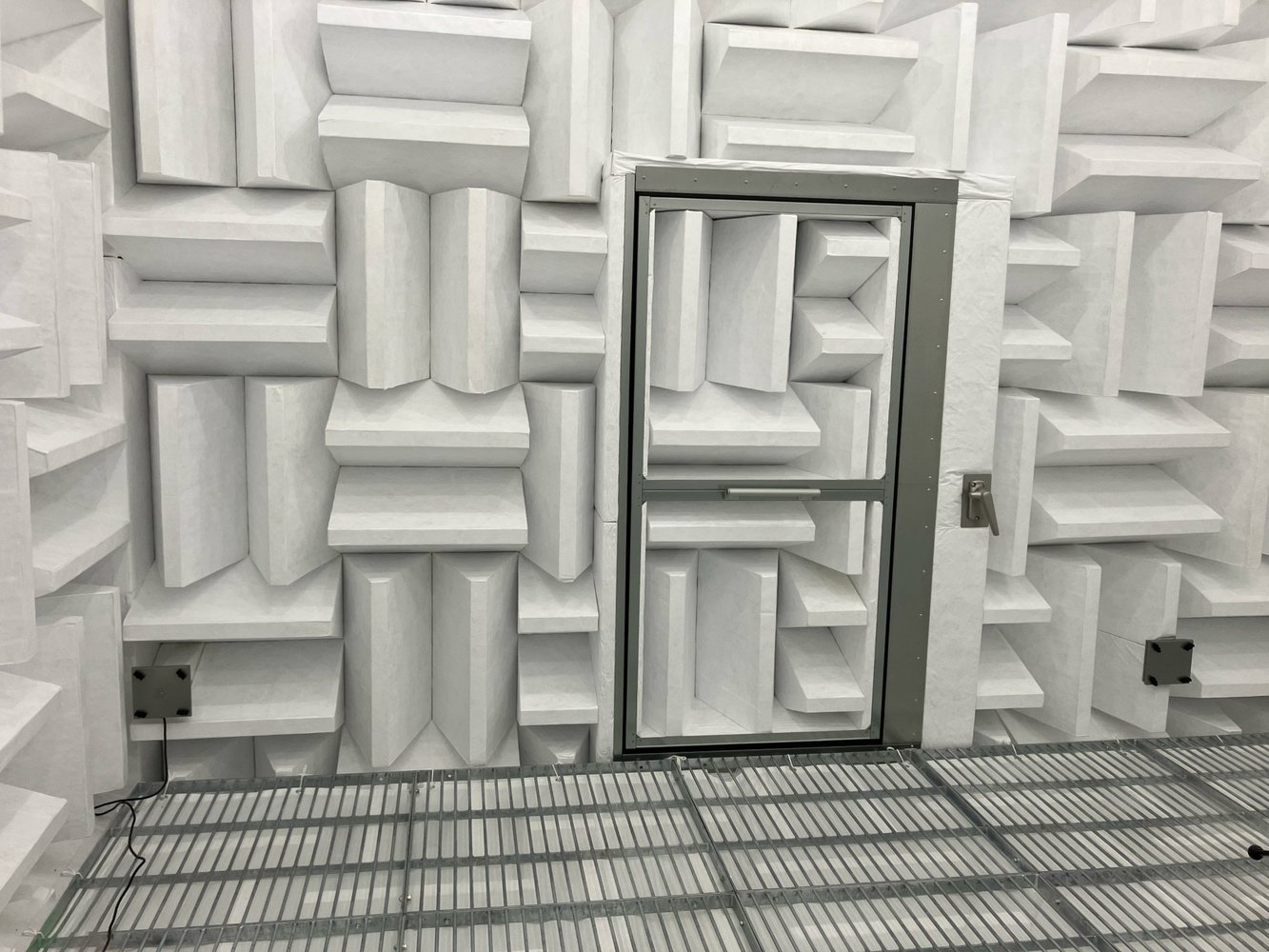
Sound Absorption Treatment of Soundproof Door
Sound-absorbing wedges are also placed on the inside of the soundproof door, matching the interior walls. When the door is closed, its inner surface provides the same sound absorption conditions as the walls.
The door is supported by four hinges and secured with a clamping handle to ensure airtightness. Since the interior floor is raised by the height of the wedges, steel steps are installed at the entrance.
Floor Structure
The floor consists of the following layers from bottom to top:
- Anti-vibration layer
- Steel sound-insulating panel
- Sound-absorbing wedge BFW-T-500
- Grating
Sound-absorbing wedges are also installed on the floor surface, making it a full anechoic chamber with 6-surface sound absorption. By installing walkable grating above the wedges, floor reflection is minimized while allowing personnel entry and test setup.
The anti-vibration layer beneath the floor panels isolates vibrations transmitted from the building floor. This prevents vibrations from nearby equipment or foot traffic from entering measurements as structure-borne noise.
Main Ancillary Equipment
- LED lights × 9 units
- Ceiling eye nuts × 6 locations (for suspending microphones or test objects)
- 100V power outlets × 2 sockets
- Cable patch panel (interior/exterior)
- Wall-mounted air conditioner × 1 unit
- “In Use” indicator light (interlocked with light switch) × 1 unit
- Distribution board
- Entrance steps
- Fire alarm sensor (client-specified product)
- JIS box W940 × L640 × H1,530 mm × 1 unit
The interior and exterior cable patch panels allow wiring for microphones and test objects to be routed without opening the door. The “In Use” indicator light interlocks with the light switch to prevent accidental entry during testing.
Designed Sound Insulation and Performance Guarantee
Design sound insulation values are specified based on JIS A 1417:2000.
| Frequency | 63 Hz | 125 Hz | 250 Hz | 500 Hz | 1 kHz | 2 kHz | 4 kHz | 8 kHz |
|---|---|---|---|---|---|---|---|---|
| Sound Insulation Value | (32) dB | 40 dB | 46 dB | 50 dB | 56 dB | 60 dB | 62 dB | 61 dB |
If performance testing upon completion reveals that the specified guaranteed values have not been achieved, secondary measures will be implemented free of charge until the guaranteed values are met.
Key Features of This Facility
- Custom-designed for a specific manufacturer
- Supports measurement and evaluation of product noise
- Measurement space of approx. 4,000 × 4,200 mm between wedge tips
- Full anechoic chamber structure with sound absorption on walls, ceiling, and floor
- 500 mm deep sound-absorbing wedges (BFW-T-500) installed on all surfaces
- Sound absorption treatment applied to the interior of the soundproof door
- Underfloor anti-vibration layer isolates building vibrations
- Equipped with cable patch panel and 6 ceiling eye nuts
- Prefabricated structure allows future dismantling and relocation
At Sonora Technology, we custom-design anechoic chamber specifications based on measurement targets, required sound insulation performance, measurement distance, available installation dimensions, and other factors.
If you are considering measurement environments for operating noise measurement, abnormal noise inspection, or quietness evaluation of home appliances, electronic devices, precision machinery, automotive parts, etc., please feel free to contact us.
Frequently Asked Questions
Q. What is the difference between a full anechoic chamber and a hemi-anechoic chamber?
A. A full anechoic chamber applies sound absorption treatment to all six surfaces, including the floor, creating a reflection-free free-field environment. A hemi-anechoic chamber leaves the floor as a reflective surface, creating a free field over a reflecting plane. Hemi-anechoic chambers are suitable for objects placed directly on the floor during measurement, such as heavy machinery or vehicles. ISO 3745:2012 (JIS Z 8732) specifies precision methods for measuring sound power levels in both types of rooms.
Q. In a full anechoic chamber where the floor is also sound-absorbing, where do people and products stand?
A. People walk and test objects are placed on grating (a grid-like floor) supported over the floor’s sound-absorbing wedges. This facility uses the same structure.
Q. What determines the length of the sound-absorbing wedges?
A. It is determined by the lowest frequency you wish to measure. Longer wedges absorb lower frequencies, so applications requiring low-frequency sound measurement need longer wedges, which reduces the internal measurement space for the same external dimensions. This facility utilizes 500 mm deep wedges.
Q. Can it be installed inside an existing building?
A. Yes, it can. Since prefabricated chambers are constructed by assembling factory-manufactured components on site, they are well-suited for installation inside existing buildings. This facility was also installed within an existing building. It can also be dismantled and relocated in the future.