
Noise Control Measures for Factory Equipment
06/24/2026
Others / SOLAMETA Panel & AS / BFW / Soundproof Partition
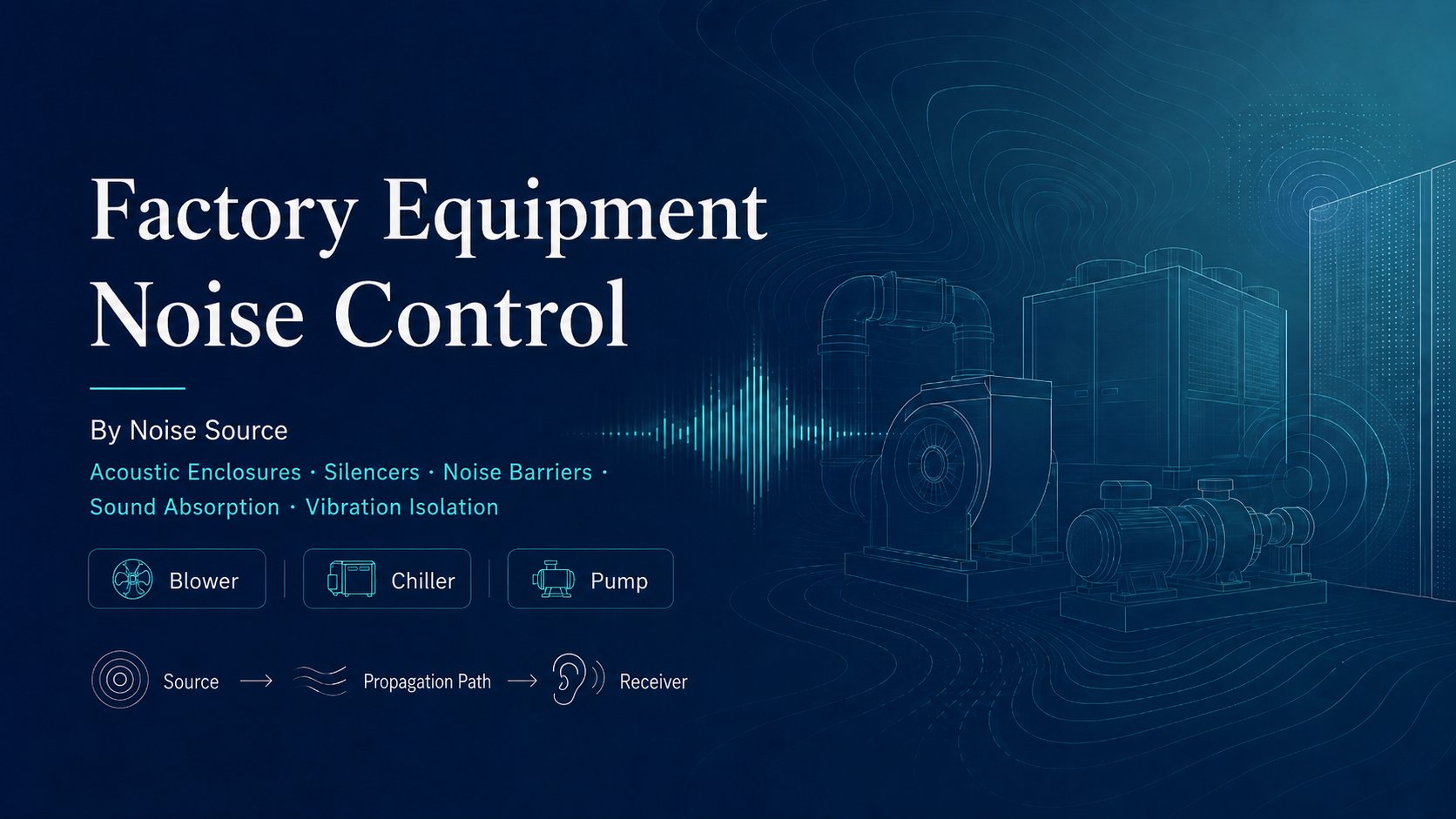
Source-by-source guide to acoustic enclosures, silencers, noise barriers, sound absorption, and vibration isolation
In factory equipment noise control, simply “enclosing the noisy equipment,” “applying sound-absorbing material,” or “erecting a noise barrier” does not always deliver sufficient results.
Noise always follows this chain:
Source → Transmission path → Receiver
In other words, noise control begins by clarifying:
- Which piece of equipment is producing the sound
- Whether it travels through the air, or through the floor or piping
- Where the problem actually occurs — at the operator’s position, the site boundary, an adjacent building, etc.
We provide measures that combine acoustic enclosures, silencers, noise barriers, sound-insulation and sound-absorption work, and vibration-isolation work for a wide range of sources, including factory production lines, blowers, cooling towers, compressors, presses, blowers, piping, turbines, blast equipment, chiller units, ducts, motors, crushers, hydraulic units, pumps, generators, interior-wall reverberant noise, machine tools, conveyors, and vibration test rigs.
What to confirm first in factory noise control
In factory equipment noise control, rather than immediately choosing a product or construction method, you first organize the objective and the current conditions.
Clarify the objective of the noise control
Even for the same factory noise, the appropriate measures change depending on the objective.
| Objective | Approach |
|---|---|
| Improve the working environment | Prioritize noise reduction at the operator’s position |
| Improve the management classification | Confirm the conditions for measurement points and working-environment measurement |
| Reduce noise to neighbors / site boundary | Confirm outdoor propagation, noise barriers, opening directions, and equipment layout |
| Quieten only a specific piece of equipment | Consider acoustic enclosures, silencers, and vibration isolation |
| Suppress reverberation inside the factory | Consider interior-wall sound-absorption work, ceiling absorption, and soundproof partitions |
At the stage of “the equipment is noisy, so we want to soundproof it,” there is still insufficient information to decide on measures. We confirm whether the goal is improving the working environment, addressing the neighborhood, or reducing the noise of a single piece of equipment, and then organize the direction of the measures accordingly.
Understand the current noise levels
In noise control, it is important to confirm not only the subjective sense that something is “noisy,” but also where and how many dB the noise is.
The items to confirm are as follows.
| Item to confirm | Content |
|---|---|
| Noise level | Measure at the operator’s position, near the equipment, at the site boundary, etc. |
| Frequency characteristics | Confirm whether the problem is in the low, mid, or high frequency range |
| Operating conditions | Confirm continuous operation, intermittent operation, startup, loaded operation, etc. |
| Source location | Separate the main body, intake, exhaust, piping, floor, wall reflection, etc. |
| Transmission path | Confirm whether it is airborne, structure-borne, or transmitted via ducts/piping |
| Work conditions | Confirm door opening/closing, loading/unloading, inspection frequency, and maintenance space |
Sonora’s technical information likewise holds that, in factory equipment noise control, it is important to understand the objective, noise values, equipment dimensions, workability, and budget before implementing measures.
Main types of noise control measures
Factory equipment noise control combines methods such as the following.
| Measure | Content | Main applications |
|---|---|---|
| Acoustic enclosure | Surround the noise source with soundproof panels | Blowers, pumps, compressors, machine tools |
| Silencer | Reduce intake, exhaust, and duct noise | Blowers, fans, generators, HVAC equipment |
| Noise barrier | Block the path between source and receiver | Outdoor equipment, site boundaries, factory zones |
| Soundproof room | Enclose the entire piece of equipment or work area | Crushers, presses, test rigs, large equipment |
| Sound-absorption work | Suppress reflected sound from walls, ceilings, etc. | Factory reverberation, working-environment improvement |
| Soundproof partition | Provide insulation/absorption on the operator side or in a local area | Workspaces, between equipment, local measures |
| Vibration-isolation work | Suppress vibration transmission to floors, frames, and piping | Pumps, compressors, generators |
| Vibration-damping work | Suppress resonance of panels and casings | Ducts, steel-plate covers, machine casings |
These are sometimes used on their own, but in practice they are often combined.
For a blower, for example, a candidate combination is:
Acoustic enclosure + intake silencer + exhaust silencer + vibration isolation
For a chiller unit, you might combine:
Noise barrier + silencing of the intake/exhaust paths + vibration isolation
For reverberant noise inside a factory, the following can be effective:
Interior-wall sound-absorption work + ceiling absorption + soundproof partitions
Example measure combinations by source
In factory noise control, the effective measures change with the type of source.
The table below gives example combinations of representative sources and measures.
| Source | Main noise characteristics | Examples of effective measures |
|---|---|---|
| Blowers / fans | Rotational noise, aerodynamic noise, intake noise, exhaust noise | Acoustic enclosure, intake silencer, exhaust silencer, vibration isolation |
| Compressors | Mechanical noise, discharge noise, low-frequency noise, vibration noise | Acoustic enclosure, soundproof room, vibration-isolation mounts, piping vibration isolation, silencer |
| Pumps | Motor noise, fluid noise, piping vibration | Acoustic enclosure, vibration-isolation rubber, flexible joints, improved piping support |
| Chiller units / refrigeration units | Fan noise, compressor noise, low-frequency noise | Noise barrier, acoustic enclosure, intake/exhaust silencers, vibration isolation |
| Cooling towers | Fan noise, water noise, motor noise | Noise barrier, sound-absorbing louvers, low-noise fans, vibration isolation |
| Ducts / exhaust outlets | In-duct propagated noise, wind noise | Duct silencer, silencing chamber, sound-absorbing interior lining |
| Motors | Rotational noise, electromagnetic noise, bearing noise | Acoustic enclosure, local cover, vibration damping, vibration isolation |
| Press machines | Impact noise, structural vibration, floor-borne noise | Soundproof room, acoustic enclosure, vibration isolation, vibration damping |
| Shears / cutting machines | Impact noise, processing noise, high-frequency noise | Acoustic enclosure, soundproof room, local absorption, soundproof partition |
| Forging machines | Large impact noise, low-frequency vibration | Soundproof room, noise barrier, vibration-isolating foundation, vibration damping |
| Crushers / chippers | High-level noise, impact noise, friction noise | Soundproof room, acoustic enclosure, interior absorption, vibration isolation |
| Blast equipment | Jet noise, impact noise, exhaust noise | Soundproof room, acoustic enclosure, exhaust silencer, sound-absorption work |
| Machine tools | Motor noise, cutting noise, processing noise | Acoustic enclosure, local absorption, soundproof partition |
| Conveyors | Motor noise, roller noise, contact noise | Local acoustic enclosure, soundproof partition, vibration damping, vibration isolation |
| Hydraulic units | Pump noise, motor noise, piping vibration | Acoustic enclosure, vibration isolation, improved piping support, interior absorption |
| Generators / cogeneration | Engine noise, exhaust noise, cooling-fan noise | Acoustic enclosure, exhaust silencer, intake/exhaust silencers, vibration-isolation mounts |
| Turbines | High-frequency noise, rotational noise, piping-borne noise | Acoustic enclosure, soundproof room, piping vibration isolation, sound-absorption work |
| Vibrators | Excitation noise, structure-borne noise, floor vibration | Soundproof room, vibration-isolation mounts, floating floor, vibration damping |
| Dynamometers / various test rigs | Drive noise, cooling noise, test-piece noise | Soundproof room, acoustic enclosure, intake/exhaust silencers, vibration isolation |
| Factory production lines | Mix of multiple sources, reflected sound | Soundproof partitions, noise barrier, local covers, interior-wall absorption work |
| Interior-wall reverberant noise | Indoor reflection, reverberation, noisiness | Interior-wall absorption work, BFB sound-absorbing panels, soundproof partitions |
| Plant equipment | Multiple units, piping, outdoor propagation | Noise barrier, acoustic enclosure, silencer, vibration isolation, sound-absorption work |
| Looms | Mechanical noise, impact noise, periodic noise | Acoustic enclosure, soundproof partition, sound-absorption work, vibration isolation |
This table shows representative combinations only. In practice, the optimal measure changes with the equipment’s shape, installation location, operating conditions, ventilation/heat exhaust, workability, and required reduction.
Example measures for representative sources
Noise control for blowers and fans
For blowers and fans, not only the main body’s mechanical noise but also intake noise, exhaust noise, and duct-borne noise can become problems.
| Point of generation | Example measure |
|---|---|
| Blower main body | Acoustic enclosure, interior absorption |
| Intake | Intake silencer |
| Exhaust | Exhaust silencer |
| Duct | Duct silencer, sound-absorbing interior lining |
| Frame / floor | Vibration-isolation rubber, vibration-isolation mounts |
| Piping/duct connections | Flexible joints |
When enclosing a blower in an acoustic enclosure, ventilation and heat exhaust must be secured. Excessive sealing can raise equipment temperatures and degrade intake/exhaust performance, so silencers are incorporated into the supply and exhaust paths to balance cooling and acoustic performance.
Noise control for chiller units and cooling towers
Chiller units and cooling towers are often installed outdoors, making their effect on the site boundary and neighboring buildings prone to becoming a problem.
| Point of generation | Example measure |
|---|---|
| Fan noise | Noise barrier, sound-absorbing louvers, low-noise fan |
| Compressor noise | Acoustic enclosure, vibration isolation |
| Intake/exhaust paths | Silencer, adjustment of opening direction |
| Frame / foundation | Vibration-isolation rubber, vibration-isolation mounts |
| Propagation toward neighbors | Noise barrier, layout change |
| Reflection off building walls | Sound-absorption treatment, review of noise-barrier placement |
For outdoor measures, you must consider not only acoustic performance but also rain, wind, weather resistance, drainage, maintenance space, and structural safety.
Noise control for compressors and pumps
In compressors and pumps, main-body noise and vibration transmission can become problems simultaneously.
| Point of generation | Example measure |
|---|---|
| Main-body mechanical noise | Acoustic enclosure, soundproof room |
| Motor noise | Interior absorption, local cover |
| Discharge / fluid noise | Silencer, review of piping route |
| Floor vibration | Vibration-isolation rubber, vibration-isolation mounts |
| Piping vibration | Flexible joints, improved piping support |
| Reflection inside the cover | Interior absorption using BFB sound-absorbing panels, etc. |
For pumps and compressors, attention must be paid not only to airborne sound but also to structure-borne sound transmitted through floors and piping. If an acoustic enclosure alone is insufficient, vibration isolation and improved piping support are used in combination.
Noise control for presses, shears, and crushers
Press machines, shears, crushers, and similar equipment produce large impact and processing noise, so enclosure by acoustic enclosures or soundproof rooms is effective.
| Point of generation | Example measure |
|---|---|
| Main-body impact noise | Soundproof room, acoustic enclosure |
| Processing section | Local cover, interior absorption |
| Inlet / outlet | Sound-insulating hood, absorption treatment |
| Floor vibration | Vibration-isolating foundation, vibration-isolation mounts |
| Direct sound to the operator side | Soundproof partition, noise barrier |
| Indoor reverberation | Interior-wall absorption work, ceiling absorption |
For this type of equipment, material loading, product unloading, inspection, cleaning, and integration with safety devices are important. If workability worsens even after the noise is reduced, the equipment becomes difficult to use in actual operation.
Noise control for production lines and multiple pieces of equipment
When there are multiple pieces of equipment in a factory, addressing only the loudest source may not reduce the overall noise as much as expected.
| Situation | Example measure |
|---|---|
| Multiple units operating simultaneously | Confirm the noise contribution of each source |
| A specific unit is dominant | Acoustic enclosure, local acoustic enclosure |
| Want to reduce only on the operator side | Soundproof partition, noise barrier |
| The whole factory reverberates | Interior-wall absorption work, ceiling absorption |
| Only part of the line is noisy | Local cover, vibration damping, vibration isolation |
| Layout change is possible | Adjust the distance and orientation between source and operator |
When there are multiple sources, prioritization is important. Rather than addressing only the “loudest piece of equipment,” it is effective to confirm the source dominant at the operator’s position and then implement measures in stages.
Measures for indoor reverberation and interior-wall reverberant noise
Inside a factory, sound emitted from equipment reflects off walls, ceilings, floors, and machinery, and the entire space can become noisy.
In this case, enclosing just one source may not yield sufficient improvement.
| Problem | Example measure |
|---|---|
| The whole factory is noisy | Interior-wall absorption work, ceiling absorption |
| Conversation is difficult | BFB sound-absorbing panels, soundproof partitions |
| Reflected sound makes the source location unclear | Sound-absorption work, layout adjustment |
| Want to improve only the operator side | Soundproof partition, local absorption |
| There is also sound leakage to the outside | Sound-insulation reinforcement, noise barrier, soundproof door |
Sound-absorption work does not directly stop sound leakage to the outside. Its main purpose is to suppress reflected sound inside the room and improve noisiness and intelligibility within the factory. If you want to reduce sound leakage to the outside, you must also use sound-insulation measures, noise barriers, soundproof doors, opening treatments, and the like in combination.
Points to note when selecting measures
An acoustic enclosure is not just “enclose it and you’re done”
An acoustic enclosure is effective as a noise-control measure for a single piece of equipment, but merely enclosing it is insufficient.
The items to confirm are as follows.
| Item to confirm | Content |
|---|---|
| Ventilation | Secure the airflow needed to cool the equipment |
| Heat exhaust | Prevent internal temperature rise |
| Openings | Suppress sound leakage from intakes, exhausts, and inspection ports |
| Workability | Enable operation, inspection, cleaning, and parts replacement |
| Maintainability | Provide doors, removable panels, and inspection windows |
| Vibration | Prevent vibration from being transmitted to the cover itself |
| Safety | Consider emergency stops, interlocks, and observation windows |
In particular, ventilation and heat exhaust are important for blowers, compressors, generators, hydraulic units, and similar equipment. The higher the sound-insulation performance, the greater the airtightness — so it becomes necessary to balance this with cooling and maintenance.
For silencers, also consider airflow and pressure loss
Silencers are effective for reducing intake, exhaust, and duct noise. However, you must confirm not only silencing performance but also airflow, pressure loss, installation space, and maintainability.
| Item to confirm | Content |
|---|---|
| Required airflow | Secure the airflow needed to operate the equipment |
| Pressure loss | Keep it within a range that does not affect equipment performance |
| Frequency | Select a silencing structure suited to the problematic frequency |
| Cleanability | Consider maintenance where there is dust or oil |
| Installation space | Confirm integration with the duct route and surrounding equipment |
For noise barriers, height, position, and flanking are important
A noise barrier blocks the path between source and receiver. However, since sound diffracts around the top and sides of the barrier, erecting a wall does not necessarily guarantee sufficient reduction.
| Item to confirm | Content |
|---|---|
| Source height | Confirm the height of the fan, exhaust outlet, and machine body |
| Receiver height | Confirm the operator’s ear position, site boundary, and neighboring window positions |
| Barrier height | Set it with diffraction taken into account |
| Barrier position | The effect changes depending on whether it is near the source or near the receiver |
| Reflection | Confirm that reflected sound does not redirect in another direction |
| Foundation | Outdoors, wind loading and foundation design are also necessary |
The procedure for advancing noise control
Step 1. Decide the objective
First, clarify what you want to improve.
- Reduce noise at the operator’s ear
- Reduce site-boundary noise
- Reduce the noise of a single piece of equipment
- Suppress reverberation inside the factory
- Improve the management classification
- Resolve complaints from neighbors
Step 2. Identify the source
Next, confirm which equipment and which part is the dominant source.
- The blower main body?
- The intake/exhaust?
- The duct?
- The piping?
- The motor?
- Vibration of the floor or frame?
- Reflected sound inside the factory?
Step 3. Confirm the transmission path
Confirm by which path the sound is transmitted.
| Transmission path | Example |
|---|---|
| Airborne sound | Sound radiated into the air from the machine body |
| Structure-borne sound | Sound transmitted through the floor, frame, or piping that becomes audible elsewhere |
| Duct-borne sound | Fan and exhaust noise transmitted within ducts |
| Opening leakage | Sound leaking from doors, windows, ventilation openings, and inspection ports |
| Reflected sound | Sound amplified by reflection off walls, ceilings, and floors |
Step 4. Combine the measures
Representative combinations are as follows.
| Objective | Example combination |
|---|---|
| Reduce blower noise | Acoustic enclosure + intake silencer + exhaust silencer + vibration isolation |
| Reduce pump noise | Acoustic enclosure + vibration-isolation rubber + flexible joints |
| Reduce chiller noise | Noise barrier + intake/exhaust silencing + vibration isolation |
| Reduce press noise | Soundproof room + vibration isolation + vibration damping + local absorption |
| Protect the operator side | Soundproof partition + local absorption |
| Reduce factory reverberation | Interior-wall absorption work + ceiling absorption + BFB sound-absorbing panels |
| Address neighbors for outdoor equipment | Noise barrier + acoustic enclosure + silencer + opening-direction adjustment |
Step 5. Confirm after the measures
After implementing measures, measure to confirm the effect.
- Noise levels before and after the measures
- Reduction by frequency band
- Improvement at the operator’s position
- Improvement at the site boundary
- Presence or absence of leakage points
- The state of ventilation and heat exhaust
- Workability and maintainability
- Ease of safety verification
Noise control does not end with installation. It is important to verify under actual operating conditions after the measures are in place.
Summary
In factory equipment noise control, the effective measures change with the type of source.
For blowers and fans, a combination of an acoustic enclosure and intake/exhaust silencers is effective. For chiller units and cooling towers, noise barriers, sound-absorbing louvers, and silencing of the intake/exhaust paths become important. For pumps and compressors, not only acoustic enclosures but also vibration isolation and improved piping support may be necessary. Where factory reverberation is the problem, interior-wall absorption work and soundproof partitions are effective.
The important thing is not to decide on a product from the outset.
- Where is the source?
- By what path is the sound transmitted?
- Where, and by how much, do you want to reduce it?
Organizing these three points first, and then combining acoustic enclosures, silencers, noise barriers, sound-absorption work, and vibration-isolation work, is the first step toward noise control that does not fail.
We propose noise control suited to the specific site after confirming the type of noise source, the noise value, the dominant frequencies, the installation environment, ventilation, heat exhaust, workability, and maintainability.