
Sealing Around Cable Shapes — Sound Insulation Using EPDM Rubber
05/13/2026
Others
Cable Ports Can Easily Become Weak Points in Sound Insulation Design
Anechoic rooms, semi-anechoic rooms, anechoic boxes, and soundproof rooms are equipped with cable ports for routing power cables and signal cables from the outside to the inside.
These cables serve many purposes, including power supply for measuring instruments, sensor cables for microphones and accelerometers, and drive signals for devices under test. In relatively compact measurement spaces such as anechoic boxes, the number of cables tends to be large in proportion to the size of the test object and measuring equipment installed inside. For this reason, the treatment of cable ports becomes especially important in securing sound insulation performance.
However, any penetration through a sound-insulating wall can become a weak point in acoustic isolation.
In general, sound insulation performance depends on the surface density of the wall structure. However, even a small penetration or gap in part of the wall can become the dominant weak point and significantly reduce the overall transmission loss of the wall.
Even if a heavy 100 mm-thick wall is used, a gap of only 1 mm around a cable can become a sound leakage path and limit the sound insulation performance of the entire room.
Therefore, what is required of a cable port is not merely that “cables can pass through it,” but that after the cables have passed through, the opening can be sealed without leaving any gaps.
The Challenge of Sealing Cables with Different Shapes Without Gaps
The difficulty of cable ports lies in the fact that the number, thickness, and arrangement of cables vary from site to site.
There may be thick cables, or there may be extremely thin coaxial cables for measurement.
Sometimes only one cable is routed through the port; in other cases, multiple cables are bundled together.
Additional cables may also need to be added or replaced later.
Fixed-shape covers or highly rigid sealing materials cannot accommodate all of these situations.
What is required is a material that deforms and adheres closely to the actual shape of the cables being routed through the port.
Seal Material Used: INOAC EPDM Rubber Sponge E-4070
For the cable ports used in Sonora Technology’s anechoic rooms, anechoic boxes, and soundproof rooms, we use E-4070, an EPDM rubber sponge manufactured by INOAC Corporation, as the sealing material.
EPDM, or ethylene propylene diene rubber, is a material with excellent weather resistance, cold resistance, ozone resistance, aging resistance, and solvent resistance. It also has good rebound resilience and electrical properties, and is widely used as a sealing and gasket material in the automotive, industrial, and architectural fields.
E-4070 is a closed-cell sponge made by foaming EPDM. Its key features are low hardness and high deformation-following capability.
Representative physical properties are as follows.
| Item | Value |
|---|---|
| Material | EPDM sponge, closed-cell type |
| Hardness | 5 ± 3, Type C |
| Apparent density | 0.10 ± 0.03 g/cm³ |
| 25% compression load | 9.8 to 39.2 kPa |
| Tensile strength | 0.25 MPa or more |
| Elongation | 200% or more |
| Compression set | 40% or less |
| Color | Black |
Manufacturer’s test values
A Type C hardness of 5 ± 3 places this material in the category of a low-hardness sponge that deforms significantly under light pressure.
The 25% compression load is also low, starting from around 10 kPa. This indicates that when a cable is pressed into the material, the rubber can easily deform along the cable’s outer diameter.
How the Material Follows Cable Shapes and Creates a Seal
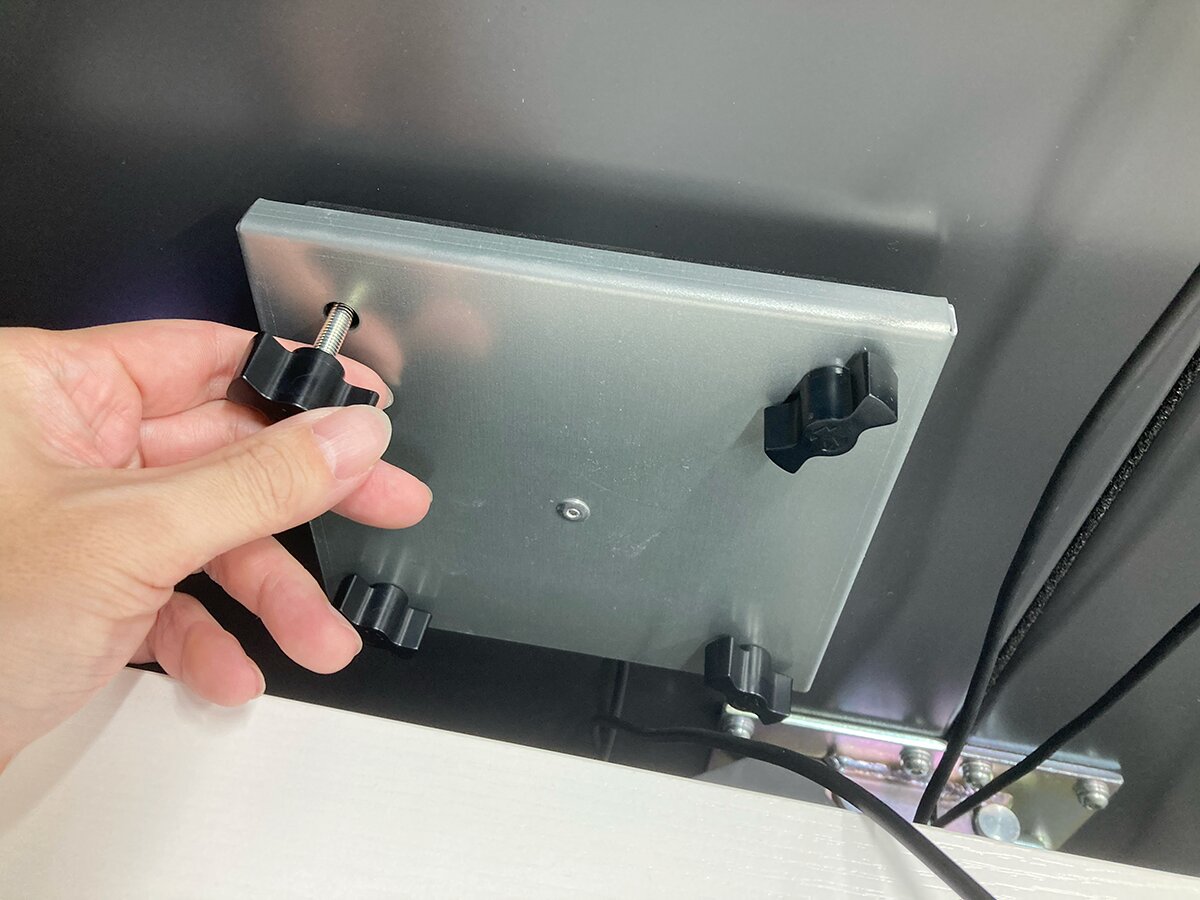
After cables are routed through the cable port, they are pressed down using a rubber plate.
At this point, the properties of E-4070 produce the following behavior.
For cables of different diameters, the rubber compresses and deforms individually to fit closely around each cable.
When multiple cables are routed side by side, the sponge enters the gaps between the cables.
Because it has a closed-cell structure, it suppresses long-term water absorption and air permeability, making it easier to maintain a sealed condition.
Because of its rebound resilience, the material tends to return to its original shape even after cables are inserted or removed, making it suitable for repeated use.
In other words, E-4070 functions as if it were forming a custom gasket around each individual cable.
By physically filling the geometric gaps around the cables, it blocks the sound leakage paths that could otherwise occur through the cable port.
Why Use Low-Hardness EPDM Sponge Instead of Solid Rubber or High-Hardness Seals?
Possible sealing materials include solid rubber, silicone rubber, and urethane foam. Each has its own advantages, but EPDM sponge is selected for cable port applications for the following reasons.
Low Hardness Means High Shape Conformability
Solid rubber may not deform sufficiently around thin cables, making it easier for gaps to remain.
Closed-Cell Structure Suppresses Water Absorption and Air Leakage
Open-cell urethane foam has air permeability, which makes it disadvantageous as a sealing material.
EPDM Provides Long-Term Stability
EPDM has excellent weather resistance, ozone resistance, and aging resistance. Even in indoor environments, its performance is less likely to deteriorate over long-term use.
Proven Track Record as an Architectural and Industrial Sealing Material
EPDM sponge has a long record of use in sealing applications such as window sash and door gaskets, various duct seals, and lamp gaskets.
Conclusion
The sound insulation performance of anechoic rooms, anechoic boxes, and soundproof rooms is determined not only by the performance of the wall structure itself, but also by how penetrations such as cable ports are treated.
In many cases, penetrations become the bottleneck that determines the actual sound insulation performance on site.
At Sonora Technology, we use low-hardness EPDM sponge, specifically E-4070 manufactured by INOAC Corporation, to achieve flexible sealing that conforms to the shape of each individual cable.
From the material selection stage, our design is based on the assumption that cables may vary on site, and that the port must still be sealed without gaps.
The aim is to prevent the cable port from becoming a weak point in sound insulation performance.
This is Sonora’s fundamental approach to penetration treatment, shared across our anechoic rooms, anechoic boxes, and soundproof rooms.