
Measurement Accuracy in Architectural Acoustics Depends on the Room, Not the Equipment
04/20/2026
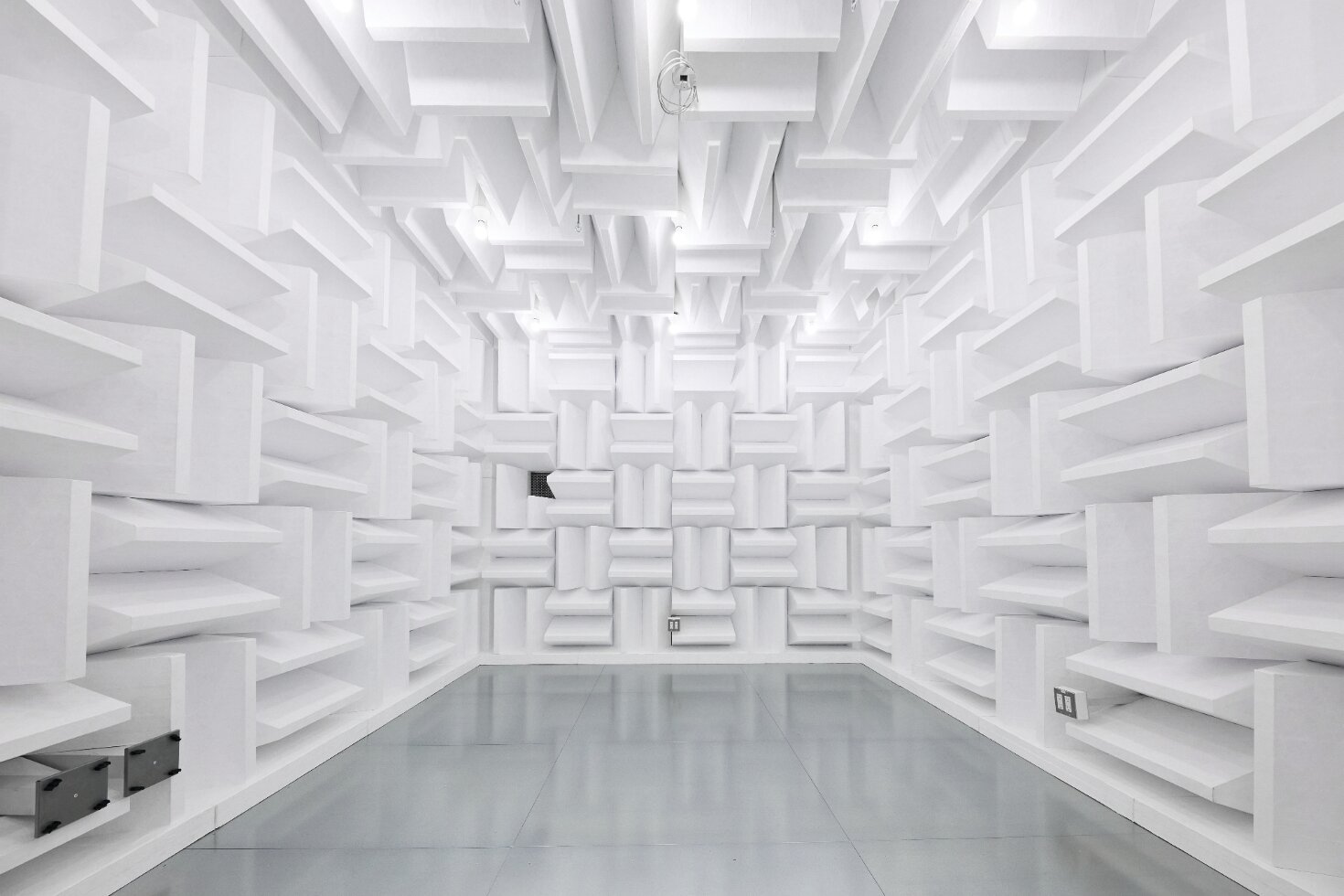
What you need is not just a room where measurement is possible, but a room that enables measurement to the required standard.
When it comes to architectural acoustic measurements, attention tends to focus on the instruments themselves — sound level meters, sound sources, and analysis software. These are, of course, essential. However, measurement accuracy is determined by more than just equipment performance.
The reliability of results depends directly on whether the measurement space satisfies the acoustic field conditions required by the relevant standards. In a room with strong reflections from walls or ceilings, the measured values will include not only the target sound but also the influence of surrounding reflections — making interpretation significantly more difficult.
The Inverse Square Law: Key Indicator of Free-Field Conditions
In acoustic measurement, the inverse square law serves as the fundamental indicator for assessing how closely a free field has been achieved. In a free field, sound radiated from a point source attenuates in inverse proportion to the square of the distance. When the distance doubles, the sound pressure level decreases by approximately 6 dB.
| When distance doubles | When the law breaks down |
|---|---|
| −6 dB Drop in sound pressure level in a free field | Reflections From walls, floors, ceilings, and supports |
If this relationship holds in the measurement space, the influence of reflections is considered small and the environment is judged to approximate a free field. Conversely, if the relationship breaks down, reflections from walls, floors, ceilings, or structural supports cannot be ignored, and the precision of the measurement environment may be compromised.
ISO 3745:2012: Performance Over Specification
Earlier standards and design practices placed strong emphasis on specifications such as absorption coefficients and wedge dimensions. However, ISO 3745:2012 consolidates the detailed design guidelines found in previous editions, and the degree to which the inverse square law is satisfied has become the more fundamental criterion.
What matters is not the adoption of specific materials or geometries, but whether the required free-field conditions can be achieved across the necessary frequency range. This performance-based approach broadens design flexibility in selecting sound-absorbing structures, while at the same time increasing the importance of verifying performance through actual measurement.
Environmental Correction Factor K₂ and Accuracy Grades
Another critical parameter for evaluating measurement space suitability is the environmental correction factor K₂. K₂ indicates how far the test room deviates from an ideal free field due to reflections and other acoustic influences. The smaller the value, the better the measurement environment.
| Standard | Sound Field Type | Accuracy Grade | K₂ Limit |
|---|---|---|---|
| ISO 3745:2012 | Free field (anechoic / hemi-anechoic) | Grade 1 (Precision) | ≤ 0.5 dB |
| ISO 3745:2012 | Free field (anechoic / hemi-anechoic) | Grade 2 | ≤ 1.0 dB |
| ISO 3744 | Reverberant field (quasi-free field) | Grade 1 | ≤ 2.0 dB |
| ISO 3744 | Reverberant field (quasi-free field) | Grade 2 | ≤ 4.0 dB |
POINT
The higher the required accuracy grade, the more demanding the performance requirements on the test space. K₂ limits must always be assessed in conjunction with the applicable standard and accuracy grade.
Why Accurate Measurement Is Difficult in Ordinary Rooms
In a general-purpose room without acoustic treatment, reflections from walls and ceilings are significant, and the inverse square law is particularly difficult to satisfy near room boundaries. While conditions may be somewhat better toward the center of the room, achieving a stable free field throughout the entire space is far from straightforward.
Measurement results will vary considerably depending on position, and residual uncertainty due to reflections will remain in the evaluation data. This problem cannot be solved simply by upgrading to higher-performance instruments. What is required is a space that creates the appropriate acoustic field for the measurement objective.
Sonora’s Design Approach
At Sonora, our anechoic and hemi-anechoic room designs focus not on simply increasing the thickness of absorptive materials, but on how to achieve the required free-field conditions within the target frequency range. During the design phase, we assess the size of the test object, measurement distances, evaluation objectives, and applicable standard requirements, then combine the optimal sound-absorbing structure with the appropriate spatial specifications.
What matters is not catalog-listed material performance alone. How much distance attenuation can be achieved in the actual test space? How far can K₂ be suppressed? Can the required conditions be satisfied across the entire measurement surface? Placing this kind of measurement validity at the center of our design process is what leads to reliable acoustic evaluation.
SUMMARY
- Measurement accuracy in architectural acoustics depends not only on instrument performance, but on the acoustic field conditions of the measurement space.
- Free-field conditions are verified using the inverse square law (distance doubles → approx. 6 dB drop).
- ISO 3745:2012 is a performance-based standard that prioritizes compliance with the inverse square law over specification-driven design.
- The environmental correction factor K₂ must always be evaluated together with the applicable standard and accuracy grade.
- High-precision measurement in ordinary rooms is not feasible; a purpose-built space conforming to the relevant standard is essential.