
What is a Wing-Door Soundproof Box? | Advantages of Upward-Opening Doors & Acoustic Design Points
10/21/2026
Others
Introduction | The Ease of Use of a Soundproof Box is Decided by its “Door”
Soundproof boxes used for noise testing and inspection of motors, pumps, gear units, etc., require the measurement object to be loaded and unloaded for every test. On job sites where doors are opened and closed dozens of times a day, the way the door opens significantly affects both work time and the operator’s physical burden.
On the other hand, the door is also what most affects the sound insulation performance of a soundproof box. The easier it is to open, the easier gaps form, resulting in insufficient sealing when closed.
In this article, taking the “wing-door type (upward-opening type) soundproof box” that our company has delivered to pump manufacturers and other clients as an example, we explain the advantages of upward-opening doors and key design points for achieving both workability and sound insulation performance.
1. What is a Wing-Door Soundproof Box?
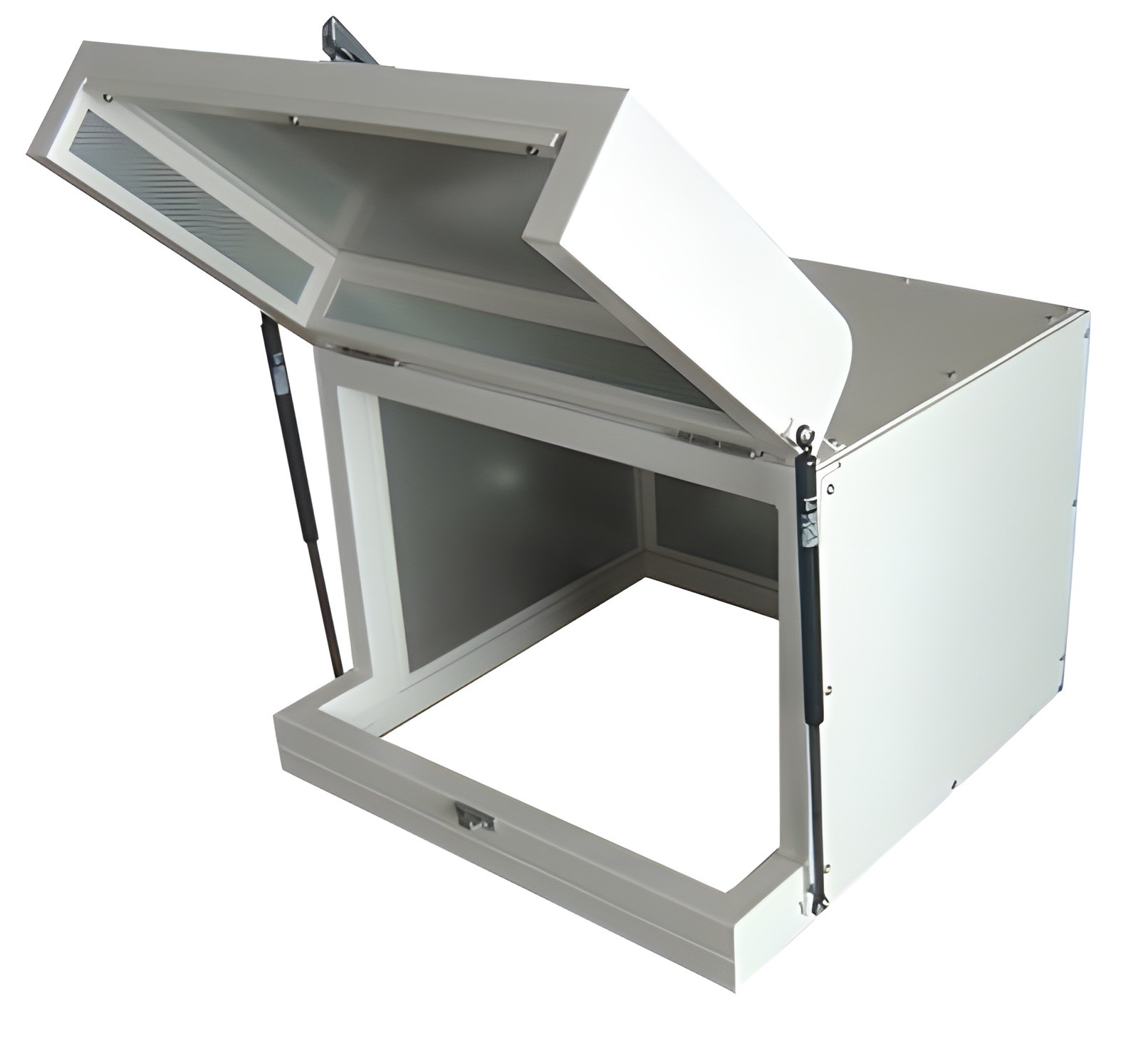
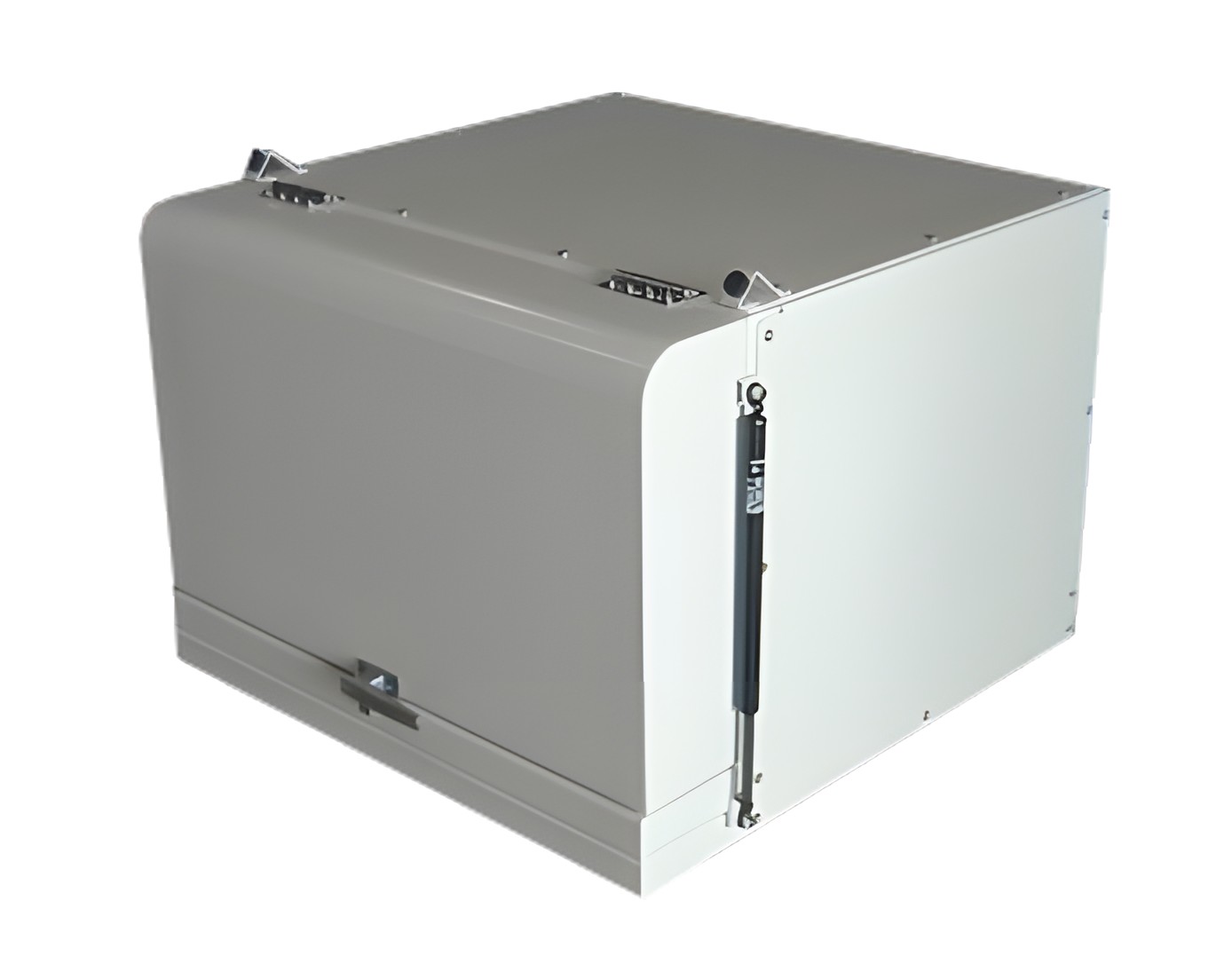
The wing-door type features a structure where the door, extending from the top to the front surface, flips upward pivoting on hinges at the rear. When the door is opened, both the top and front of the box open widely at the same time in two directions.
2. Reasons for Choosing an Upward-Opening Type
Doors for soundproof boxes primarily come in three types: hinged doors, sliding doors, and upward-opening doors (wing doors). Each is suited for different applications.
| Door Mechanism | Opening Direction | Required Space for Door | Suitable Applications | Points of Caution |
|---|---|---|---|---|
| Hinged Door | Front only | Swing radius in front of the box | General testing where objects are loaded/unloaded manually from the front | Creates a dead zone in front of the door where operators cannot stand |
| Sliding Door | Front or Side | Lateral clearance space to slide the door | Large items, loading via carts or conveyors | Requires design effort to achieve both smooth door sliding and airtightness |
| Upward-Opening Door (Wing Door) | Top and Front (2 directions) | Vertical clearance above the box | Overhead crane loading, frequent manual loading/unloading, rewiring | Potential interference with ceilings or overhead structures; pinching risks during operation |
The biggest advantage of the upward-opening type is that the opening expands in two directions: top and front. Small test specimens can be placed inside manually by an operator from the front, while heavy specimens can be lowered from above using hoists or cranes. Because the opened door does not stick out in front of the operator, work can continue seamlessly while standing right in front of the box—a huge benefit in inspection workflows.
On the other hand, since the door opens upward, it is necessary to check ceiling height at the installation site and verify potential interference with overhead ducts or lighting in advance.
3. Mechanisms for Smooth and Safe Door Operation
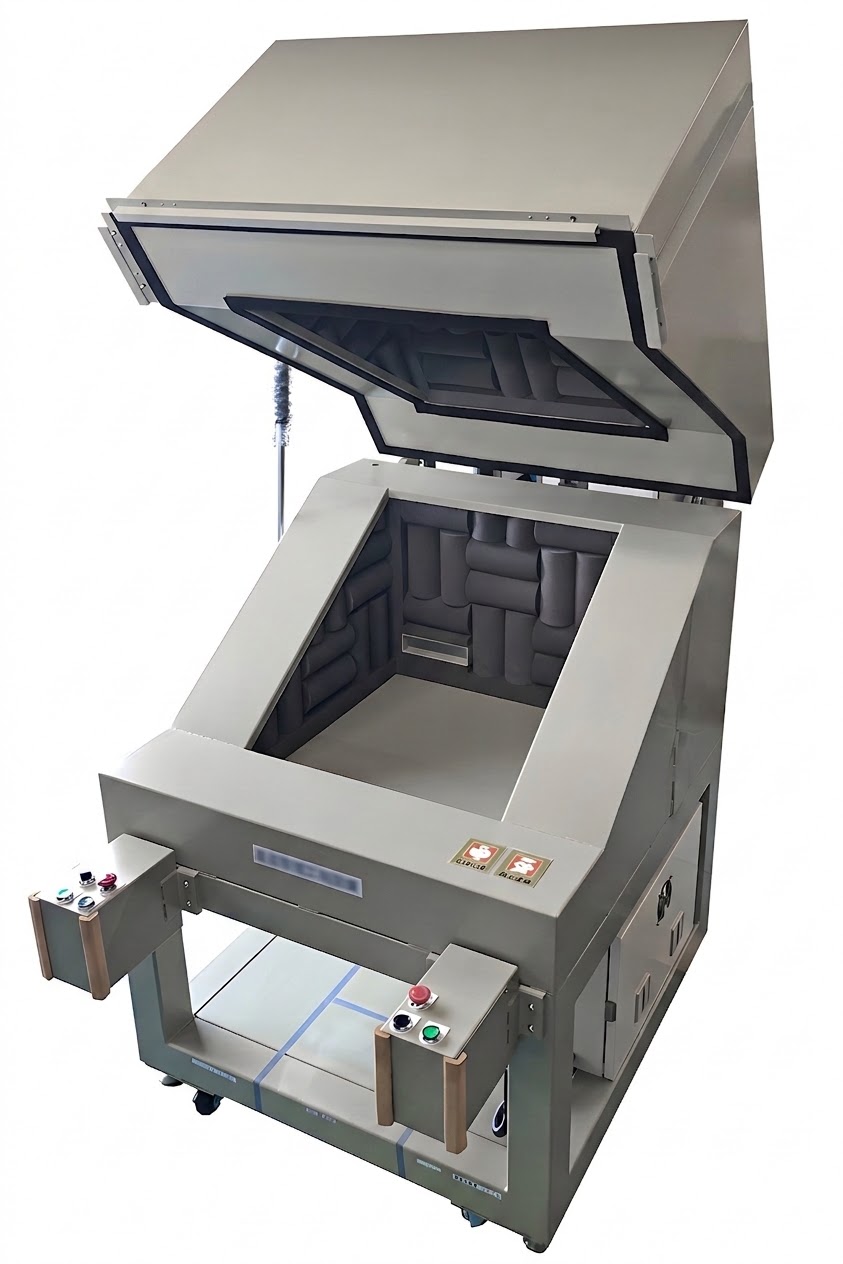
Doors for soundproof boxes are constructed from heavy materials like steel plates to achieve sound insulation. Therefore, how the weight of the door is supported significantly impacts usability. Opening and closing mechanisms are broadly categorized into manual and automated systems.
| Type | Main Components | Characteristics | Design Verification Items |
|---|---|---|---|
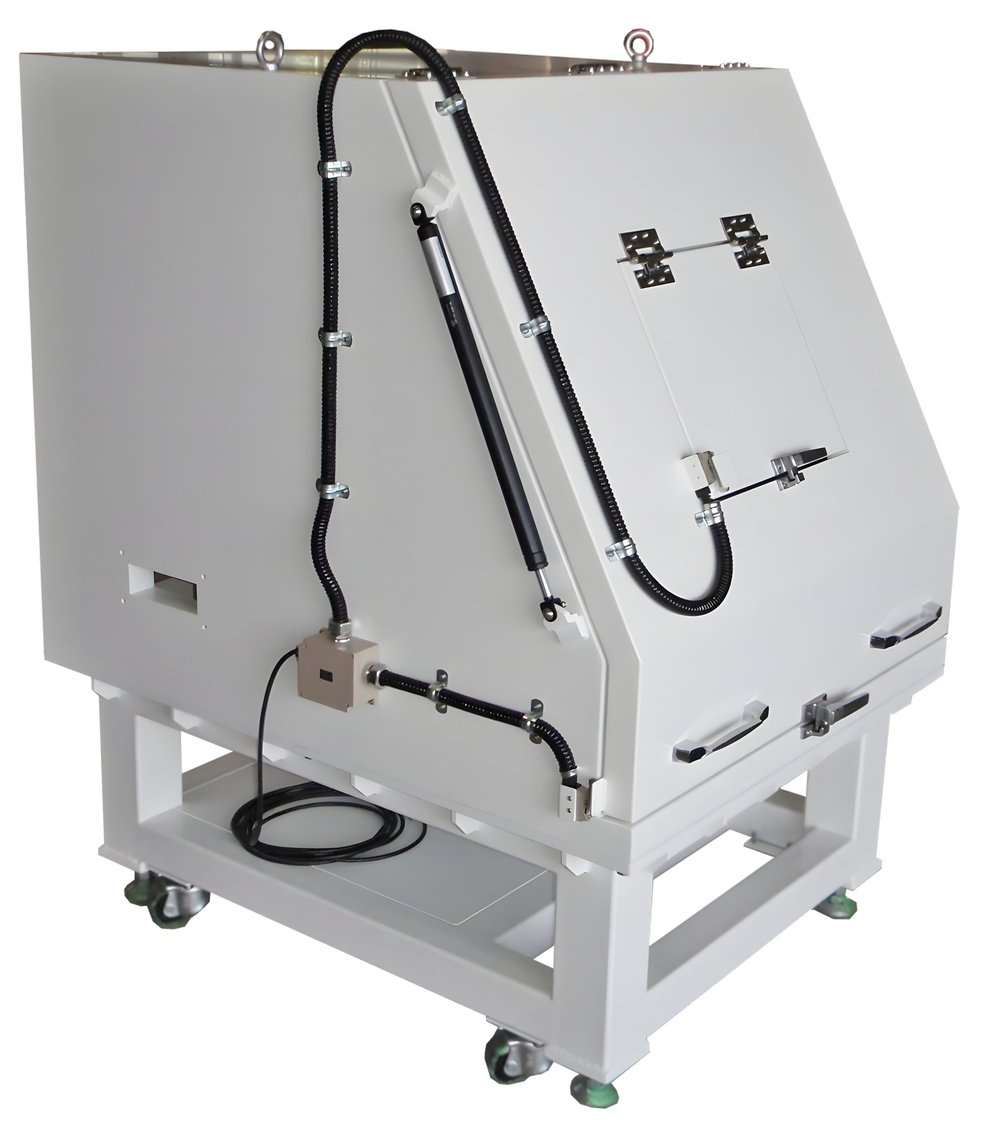
| Manual | Gas dampers (gas springs), torque hinges | Gas dampers counterbalance the door weight, allowing operation with minimal force. Torque hinges hold the door open at any desired angle. | Selection of reaction force matching door weight and center of gravity, reaction force changes due to temperature or aging, periodic maintenance. |
| Automated | Electric actuators, pneumatic cylinders | Can be operated via push buttons or signals from facility equipment, enabling integration into mass-production inspection lines. | Safety features like pinch protection; for pneumatic drives, compressed air supply and positioning to ensure exhaust and solenoid valve noises do not affect measurements. |
Because gas dampers continuously apply force to push the door upward, the door may float slightly even when closed. If left as is, a gap remains between the door and the main body of the box. Therefore, latches or clamps are used to pull the door tight, compressing the gasket evenly to form a seal. This “tight clamping when closed” directly impacts the sound insulation performance described next.
4. Sound Insulation Performance is Determined by “How the Door Closes”
The sound insulation performance of a soundproof box is not determined solely by the wall material. If there are minor gaps around the door, sound leaks through them, causing the overall performance of the box to bottleneck at those gaps.
This effect can be demonstrated through simple calculations that average the sound transmission rate per area. Assuming the acoustic transmission loss of the wall is TLw [dB], the ratio of gap area to total surface area is r, and assuming sound passes completely through the gaps (transmission rate 1), the overall transmission loss can be expressed by the following guideline formula:
TL = −10 log10{(1 − r) × 10−TLw/10 + r}
| Transmission Loss of Wall | Gap Ratio: 1% | 0.1% | 0.01% |
|---|---|---|---|
| 30 dB | 19.6 dB | 27.0 dB | 29.6 dB |
| 40 dB | 20.0 dB | 29.6 dB | 37.0 dB |
| 50 dB | 20.0 dB | 30.0 dB | 39.6 dB |
For example, in a cubic box measuring 0.6 m on a side (surface area 2.16 m²), if a gap of 0.5 mm width remains along a 3 m door seam, the gap ratio is approximately 0.07%. Even if the transmission loss of the wall itself is 50 dB, the overall performance drops to around 31.5 dB. No matter how thick and heavy you make the walls, performance will not improve unless the gaps are sealed.
Because actual sound leakage through gaps varies depending on gap geometry and frequency, the values above are simplified calculations meant to capture general trends. Nevertheless, the conclusion that door sealing dictates overall performance remains unchanged. The same applies to cable penetration points (refer also to “Sealing Treatments for Penetrations in Soundproof Walls“).
Design Considerations to Prevent Gaps in Wing Doors
| Ensure continuous gaskets around the entire door perimeter | If gaskets break at bends or corners between top and front surfaces, those points become gaps. |
| Ensure uniform clamping force | Determine the quantity and placement of latches/clamps so that pressure is not biased between the hinge side and latch side. |
| Maintain structural rigidity of the door and body | If the door flexes, gasket compression depth will vary across different locations. |
| Incorporate internal sound absorption | When sound repeatedly reflects inside the box, internal sound levels build up, increasing leakage to the outside. The perforated metal plates in Photo 2 and the sound-absorbing baffles in Photo 3 serve to suppress internal reflections. |
5. Essential Safety Design for Automated Doors
When automating door opening and closing, the primary concern is preventing pinching accidents. If hands or objects enter while a heavy door is closing, serious accidents can occur. Machine safety design relies on risk assessment procedures defined by ISO 12100 (JIS B 9700) to identify hazards and determine appropriate countermeasures.
Typical measures include emergency stops for immediate halting (ISO 13850), two-hand controls that only operate while both hands press buttons (ISO 13851), and sensors that detect people or objects near the closing edge. The specific combination of countermeasures depends on factors such as door weight, speed, operator position, and integration with production lines.
6. Main Applications for Wing-Door Soundproof Boxes
- Noise and abnormal sound inspection for pumps, motors, fans, gear units, etc.
- Noise measurement during product development and comparative testing before/after noise countermeasures.
- 100% inline inspection on mass-production lines (often combined with automated door operation).
- Use as soundproof enclosures to isolate noisy machinery from the workshop area.
An example where loading, measurement, and pass/fail evaluation were fully automated on a mass-production line is introduced in “Delivery Example of Automated-Door Anechoic Box“.
7. Key Checkpoints Prior to Implementation
- Dimensions and weight of measurement targets, loading/unloading methods (manual, hoist, robot, conveyor).
- Daily opening/closing frequency and duration per test cycle.
- Required sound attenuation level (how many dB reduction is needed) and target frequency bands.
- Whether an internal anechoic environment is required (testing/measurement use vs. noise containment use).
- Locations and quantities of pass-throughs for power lines, signal cables, piping, air tubes, etc.
- Ventilation and cooling requirements when housing heat-generating equipment.
- Installation site ceiling height, overhead equipment interference, and floor load capacity.
At Sonora Technology, we custom-design door opening styles, drive mechanisms, and soundproofing/absorption specifications after reviewing these operating conditions. Please reach out to us if off-the-shelf dimensions are unsuitable or if you want to explore specialized door configurations.
8. Frequently Asked Questions
Q. Aren’t upward-opening doors heavy and difficult to open?
Because gas dampers offset the weight of the door, even manual doors can be opened and closed with light force. Selecting a reaction force tailored to the door’s weight and center of gravity is key. Automated opening mechanisms are also available for high-frequency operations or very large, heavy doors.
Q. Doesn’t an easy-to-open design compromise sound insulation performance?
Ease of opening itself does not lower performance; rather, tight sealing when closed dictates overall performance. By using continuous gaskets around the entire perimeter and clamping evenly with latches or clamps, required sound insulation levels can be fully maintained even with upward-opening doors.
Q. Can existing soundproof boxes be retrofitted into a wing-door style?
Feasibility depends on the structure and dimensions of the existing unit. We can evaluate your current box using drawings or photos to recommend either modifications or new construction.
Summary | Balancing Ease of Opening with High Tightness
Wing-door soundproof boxes open wide across two directions (top and front), making them ideal for frequent loading/unloading and overhead hoist access. Utilizing gas dampers, torque hinges, electric actuators, or pneumatic drives allows even heavy doors to open and close easily.
However, the soundproofing performance of the box depends on sealing when closed. By designing with continuous perimeter gaskets, uniform clamping, and internal sound absorption, both operational efficiency and high acoustic insulation performance can be achieved.
Related Products & Delivery Records
- Small Soundproof Boxes (Product Introduction)
- Wing-Door Soundproof Boxes (Delivery Track Record)
- Soundproof Boxes (Customized Specifications)
- Automated-Door Anechoic Boxes (Delivery Track Record)
- [Factory & Machinery Noise Measures] Summary of Noise Control Types and Installation Case Studies
References
- ISO 15667:2000, Acoustics – Guidelines for noise control by enclosures and cabins.
- ISO 11546-1:1995, Acoustics – Determination of sound insulation performances of enclosures – Part 1: Measurements under laboratory conditions (for declaration purposes).
- ISO 11546-2:1995, Acoustics – Determination of sound insulation performances of enclosures – Part 2: Measurements in situ (for acceptance and verification purposes).
- ISO 12100:2010, Safety of machinery – General principles for design – Risk assessment and risk reduction (JIS B 9700).
- ISO 13850:2015, Safety of machinery – Emergency stop function – Principles for design.
- ISO 13851:2019, Safety of machinery – Two-hand control devices – Principles for design and selection.
- D. A. Bies, C. H. Hansen, C. Q. Howard, Engineering Noise Control, 5th ed., CRC Press, 2017.