
Why Does Your Voice Sound Strange in an Anechoic Chamber? Explained via Reflected Sound & Bone Conduction
10/07/2026
MFAC / MSAC
Conclusion of This Article
In an anechoic chamber, your voice itself doesn’t actually change. Instead, the drastic reduction in reflected sound that normally returns to your ears in a standard room alters the balance between direct sound, bone conduction, and ambient sound. As a result, your voice may feel “dry,” as if it’s “ringing inside your head,” or like it’s being “sucked away.”
When you step into an anechoic chamber and speak, you might feel that “your voice sounds different than usual,” “it feels like your voice is only ringing inside your head,” or “your voice sounds strangely close and dry.”
This isn’t just your imagination. In an anechoic chamber, because there is almost no returning sound reflected off walls or ceilings as in a normal room, the way you perceive your own voice changes significantly. Furthermore, humans hear their own voice not only through airborne sound entering the ears, but also through “bone conduction” transmitted through the skull and body.
In short, inside an anechoic chamber, the process unfolds as: “Reflected sound almost disappears → The balance between airborne sound and bone conduction sound shifts from normal → You feel a sense of discomfort with your own voice.” In this article, we will explain from an acoustic perspective why your voice sounds strange inside an anechoic chamber.
What is an Anechoic Chamber in the First Place?
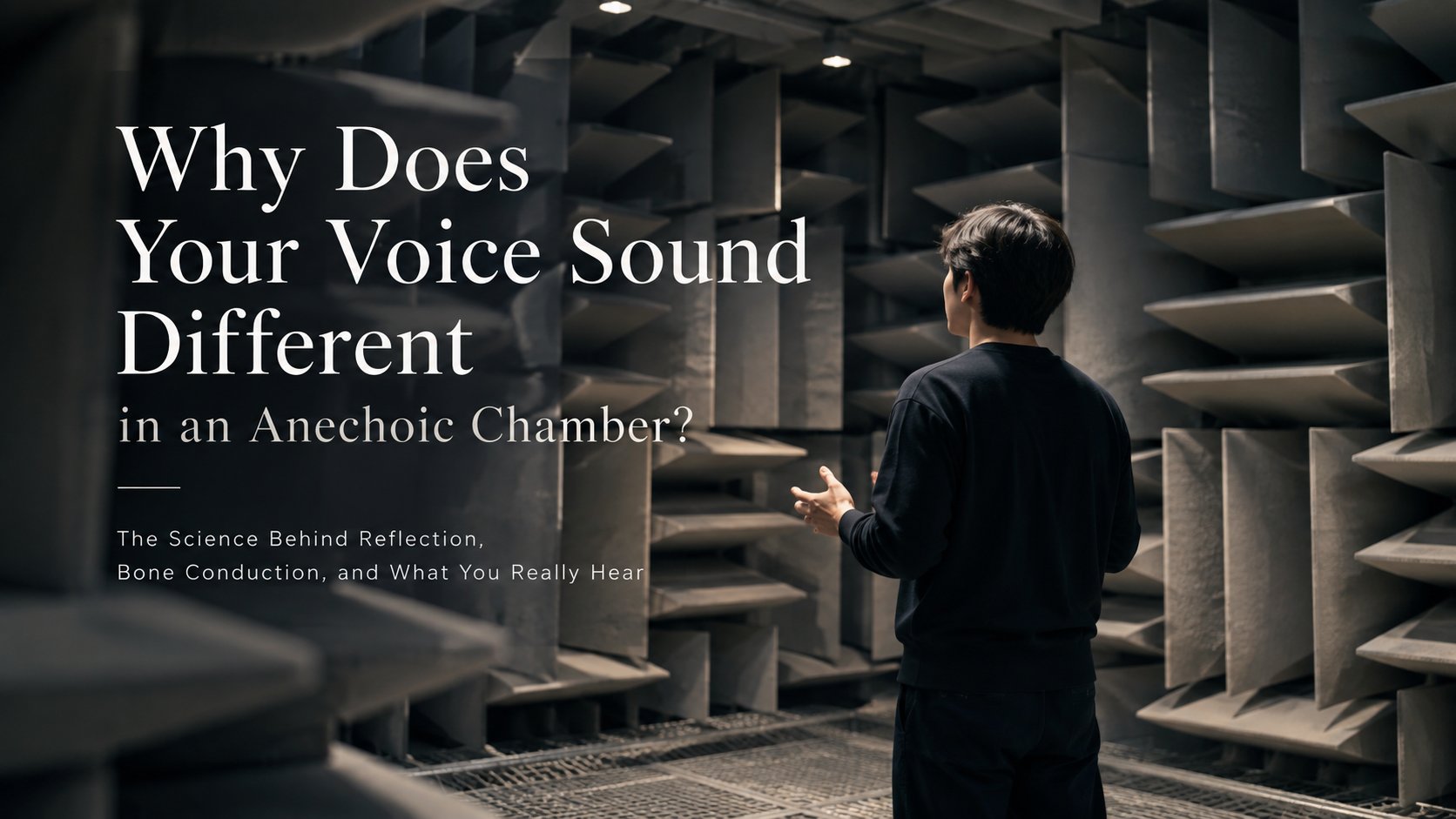
An anechoic chamber is an acoustic measurement space designed to minimize sound reflections from walls, ceilings, floors, and other surfaces as much as possible. When you speak in a typical room, the sound emitted from your mouth doesn’t just reach your ears directly. It bounces off walls, floors, ceilings, desks, and equipment, returning to your ears through multiple reflections.
We normally perceive this combination of “direct sound + reflected sound” together as the sound of that environment. However, in an anechoic chamber, high-performance sound-absorbing structures installed on surfaces drastically suppress reflections. This creates an environment close to a free field, where sound radiated from a source travels virtually unaffected by reflections.
Key Point
The purpose of an anechoic chamber is not to “eliminate all sound.” The crucial goal is to avoid adding room reflections to the sound generated by the measurement target.
We Hear Our Own Voice Through Three Paths
1. “Direct Sound” Reaching Ears From the Mouth
Sound produced by the vocal cords is radiated into the air through the mouth and nose. A portion of it reaches your own ears directly. This is your voice heard through the air.
2. “Reflected Sound” Returning From Walls and Ceilings
Voice coming from your mouth hits surrounding walls, ceilings, and floors, and the reflected sound reaches your ears. This reflected sound influences how you perceive volume, tone, distance, spatial size, and vocal resonance. Even if we aren’t conscious of it, we always hear our own voice including these reflections.
3. “Bone Conduction Sound” Transmitted Through Head and Body
Your voice has another important path: bone conduction. When you vocalize, part of the vibrations generated near the vocal cords and oral cavity travel through bones and soft tissues directly to the inner ear.
You may have listened to a recording of your voice on a smartphone or other device and thought, “Is this really what I sound like?” Recorded sound lacks the bone conduction components that you perceive while speaking, which is why it feels different from the voice you normally hear.
“Reflected Sound” Almost Disappears in an Anechoic Chamber
This is the single biggest factor behind why your voice sounds strange in an anechoic chamber.
| Typical Indoor Room | Anechoic Chamber |
|---|---|
| Direct sound + Reflected sound + Bone conduction sound | Close to Direct sound + Bone conduction sound |
| Sound returns from the room | Reflected sound is significantly suppressed |
Because reflections from room surfaces become extremely minimal, it’s not that the sound produced by your vocal cords or mouth changes, but rather the combination of sounds reaching your ears shifts. As a result, depending on the person, feelings of discomfort such as the following may arise:
- Feeling like your voice is ringing only inside your head
- Lacking resonance, sounding dry
- Perceiving your voice as extremely close
- Feeling that the contours of your voice are stronger than usual
- Feeling like your voice sounds muffled
Why Does It Feel Like “Your Voice Is Being Sucked Away”?
One common sensation reported by people entering an anechoic chamber is the feeling that “voice is being sucked away.” This also stems from the lack of reflected sound.
When speaking in a standard room, sound returns from walls and ceilings—something especially noticeable in large halls or bathrooms. In contrast, inside an anechoic chamber, most emitted sound is absorbed by sound-absorbing surfaces. Consequently, it creates a state where “you speak, but no sound returns.”
Analogy
Sensory-wise, it is somewhat similar to throwing a ball at a wall, only for it not to bounce back. Our brain normally relies unconsciously on reflected sound to gauge surrounding space, so when that information suddenly disappears, a unique sense of strange discomfort arises.
The Presence of Bone Conduction Sound Becomes Relatively Larger
Entering an anechoic chamber does not mean that bone conduction itself becomes stronger. The key point is that it “becomes relatively more prominent.”
In a normal room, we hear many sounds simultaneously: direct sound, numerous reflections, air conditioning noise, machinery noise, and voices of others. But in an anechoic chamber, external intrusive noise and room reflections are extremely low. As a result, among the components making up your voice, the proportion of bone conduction sound increases relatively, leading to the sensation that “your voice is ringing inside your head.”
Can You Even Hear Body Sounds in an Anechoic Chamber?
When reading about anechoic chambers, you might see claims like “you can hear your heartbeat” or “you can even hear blood flowing.” In an extremely quiet environment, body-derived sounds that are usually masked by environmental noise indeed become easier to notice.
- Breathing sounds
- Clothing rustling sound
- Swallowing sound
- Sounds from joints or body movements
- Footsteps
Important to note here is that the sounds produced by your body are not actually amplified by the anechoic chamber. Because surrounding ambient sound is so low, quiet sounds normally hidden by other noises become noticeable.
In acoustics, the phenomenon where one sound makes another harder to hear is called “masking.” In an anechoic chamber, because there is less ambient sound to cause masking, faint sounds generated by yourself become easier to perceive.
An Anechoic Chamber is Not a “Completely Silent Room”
“Anechoic chamber” does not mean a room where no sound exists. The “anechoic” part means primarily minimizing the effects of reverberation and reflections.
If a person speaks inside the room, that voice obviously exists. If equipment is operated, equipment sound is generated. The essential factor is avoiding adding the “room”s own reflected sound” to those sounds. That is precisely why the sound emitted from a measurement target can be accurately evaluated.
Why Is It Necessary to Suppress Reflected Sound in Acoustic Measurements?
For example, suppose you are measuring noise from a motor. In a standard room, a microphone captures not only the sound traveling directly from the motor, but also motor sound reflected off the walls.
As a result, the measured values reflect not only the “characteristics of the motor itself” but also the “acoustic characteristics of that room.” Measuring the same product in different rooms could yield different results.
Therefore, an anechoic chamber minimizes reflection impacts to build an environment where sound radiated directly from the sound source can be evaluated. Feeling that your own voice sounds “strange” due to the lack of reflection means you are experiencing firsthand a specialized acoustic field designed for measurement.
Hearing Perception Is Slightly Different in a Hemi-Anechoic Chamber
A facility similar to an anechoic chamber is the “hemi-anechoic chamber.” Standard full anechoic chambers treat all six surfaces—walls, ceiling, and floor—as sound-absorbing surfaces. In contrast, hemi-anechoic chambers typically leave the floor reflective while treating the walls and ceiling as sound-absorbing.
Consequently, compared to a fully anechoic chamber, floor reflections are present. When a person stands and speaks, reflections from the floor occur, making the sound perception different from a full anechoic chamber. Full or hemi-anechoic chambers are chosen based on measurement targets, standards, and actual product usage environments.
That “Discomfort” Is Precisely the Characteristic of an Anechoic Chamber
Many people experience a strange sensation when entering an anechoic chamber for the first time. However, there are clear acoustic reasons behind that discomfort.
In everyday spaces, we simultaneously hear “direct sound + reflected sound + bone conduction sound + ambient environment noise.” In an anechoic chamber, reflected sound and ambient noise drop significantly. As a result, you hear your own voice in an unaccustomed ratio.
We normally hear our voice including the “sound of the room.” Entering an anechoic chamber reveals how much the unseen “presence of the room” actually impacts how sound is perceived.
Summary | Voices Sound Strange in Anechoic Chambers Because the “Acoustic Field” Changes, Not the “Voice”
The main reason your voice sounds strange in an anechoic chamber is the drastic reduction in room reflections. Normally, you hear your voice as “direct sound + reflected sound + bone conduction sound,” but in an anechoic chamber, reflections almost vanish, leaving a relatively higher proportion of “direct sound + bone conduction sound.”
Furthermore, in an environment with low background noise, faint sounds like breathing or clothes rustling become noticeably apparent. In other words, your voice itself doesn’t change when entering an anechoic chamber; rather, the acoustic environment through which you hear your voice changes significantly.
Takeaway
Feeling that “your voice sounds strange” is a clear example of experiencing firsthand the unique acoustic field created when an anechoic chamber suppresses reflected sound.
Frequently Asked Questions (FAQ)
Q. Does your voice become inaudible in an anechoic chamber?
A. No. The direct sound of your voice reaches your ears, so your voice does not become inaudible. However, because returning reflections from walls and ceilings are extremely low, it sounds noticeably different than usual.
Q. Is bone conduction the reason your voice changes in an anechoic chamber?
A. Bone conduction is not the sole cause. People normally hear their voice as a combination of airborne direct sound, room reflections, and bone conduction sound. The main reason for the change in an anechoic chamber is the significant shift in this balance due to suppressed reflections.
Q. Why does it feel like your voice is being sucked away in an anechoic chamber?
A. Because virtually no reflected sound returns from walls or ceilings when you speak. The sudden absence of the “returning sound from the room” that we unconsciously hear every day creates the sensation that your voice is being absorbed and vanishing.
Q. Is an anechoic chamber completely silent?
A. It is not completely silent. An anechoic chamber is a space designed to minimize reflections and incoming external noise as much as possible. Voices spoken by people or sounds generated by measurement objects naturally exist.
Q. What is the difference between an anechoic chamber and a soundproof room?
A. A soundproof room primarily aims to suppress sound entering or leaving the room. An anechoic chamber, in addition to sound insulation performance, focuses on suppressing internal reflections to create a measurement environment close to a free field.