
Why Do Low-Frequency Sounds Travel Farther? Low-Frequency Noise Characteristics & Misconceptions about Distance Attenuation
09/16/2026
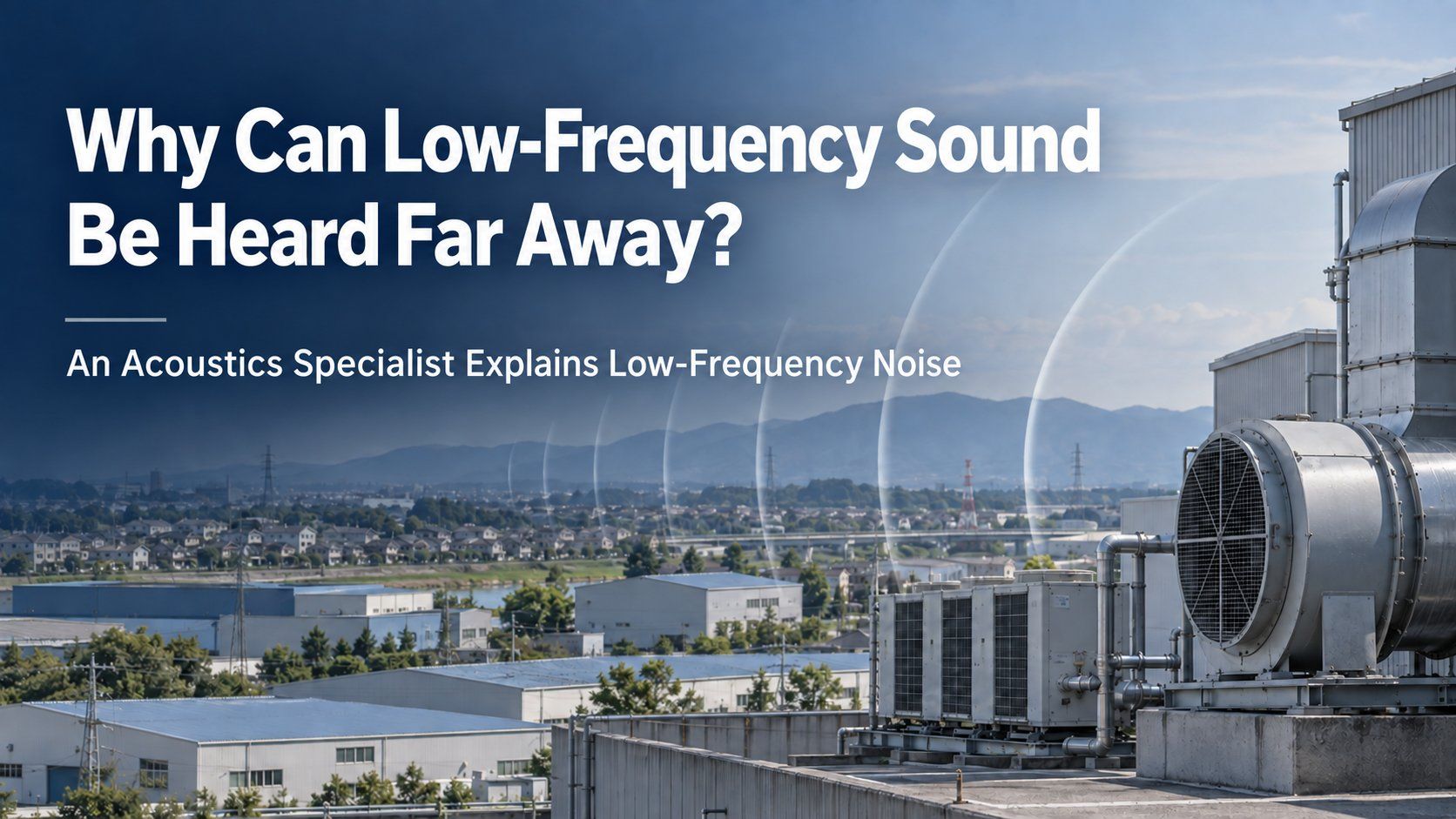
Why Do Low-Frequency Sounds Travel Farther? Acoustic Experts Explain the Characteristics of Low-Frequency Noise
Regarding noise generated from factory blowers, compressors, generators, and HVAC equipment, we often receive inquiries such as, “It isn’t very noticeable nearby, but at a distance, only a low buzzing sound can be heard.”
It is commonly said that “low sounds travel far,” but this explanation requires caution. In fact, the basic formula for distance attenuation of sound does not include frequency.
Why, then, do lower sounds actually tend to be heard farther away? This article explains the nature of low-frequency sound from three perspectives: distance attenuation, atmospheric absorption, and diffraction.
Frequency Is Not Included in the Distance Attenuation Formula
First, let us review the basics. When sound spreads spherically from a point source, the attenuation of the sound pressure level with distance is expressed by the following formula:
ΔL = 20 log₁₀ (r₂ / r₁)
ΔL: Attenuation [dB] r₁: Reference distance [m] r₂: Target distance [m]
For example, a sound that is 80 dB at a distance of 1 m from the source will attenuate in a free field without reflections as follows:
| Distance from Sound Source | Sound Pressure Level |
|---|---|
| 1m | 80 dB |
| 2m | Approx. 74 dB |
| 4m | Approx. 68 dB |
| 8m | Approx. 62 dB |
Thus, the sound pressure level decreases by about 6 dB every time the distance doubles.
Please note that “frequency is not present anywhere in this formula”. Therefore, explaining that “low sounds travel far because they attenuate less with distance” is strictly speaking incorrect. The reasons why low-frequency sounds travel farther lie outside the distance attenuation formula.
Reason 1: Higher Frequencies Are Absorbed More by Air (Atmospheric Absorption)
In actual outdoor environments, in addition to geometrical divergence over distance, sound is absorbed by the air itself. This “atmospheric absorption” is frequency-dependent: higher frequencies experience greater attenuation, while lower frequencies experience less attenuation.
For example, if a machine emits both a high-pitched metallic noise and a low humming noise, the high-frequency components attenuate in the air as distance from the source increases. As a result, low-frequency components remain relatively stronger at greater distances.
A familiar example is distant thunder sounding like a low rumble rather than a sharp crack. Nearby lightning produces a sharp sound with high-frequency components, but for distant thunder, the high frequencies are absorbed by the air, leaving only the low frequencies to reach you.
Reason 2: Low-Frequency Sounds Bend Around Obstacles (Diffraction)
Another important factor is “diffraction.” Sound bends around edges when encountering obstacles such as walls or buildings. This diffraction occurs more easily for sounds with longer wavelengths (= lower frequencies).
Assuming the speed of sound is approximately 340 m/s, the wavelengths for various frequencies are as follows:
| Frequency | Wavelength |
|---|---|
| 100Hz | Approx. 3,400 mm (3.4 m) |
| 1,000Hz | Approx. 340 mm |
| 4,000Hz | Approx. 85 mm |
Consider a noise barrier about 2 m high. For a 4,000 Hz sound with a wavelength of 85 mm, this wall acts as a sufficient barrier. On the other hand, for a 100 Hz sound with a wavelength of 3.4 m, the wall height is smaller than its wavelength and does not function effectively as an obstacle. Low-frequency sound bends over the top and around the sides of the wall.
This explains why high-pitched sounds disappear while low-pitched sounds remain even after installing a noise barrier.
Note that in long-distance outdoor propagation, meteorological conditions such as wind direction and vertical temperature gradients (day/night temperature profiles) cause “refraction,” which also alters sound propagation. These atmospheric conditions contribute to low-frequency sounds being heard more clearly at night or downwind.
Low-Frequency Noise Is Also Difficult to Control
Low-frequency sound is not only persistent over long distances, but it is also inherently difficult to mitigate.
Sound absorption is less effective. While porous sound-absorbing materials work well for mid-to-high frequencies, absorbing low frequencies requires significantly greater material thickness or deeper rear air cavities.
Sound insulation requires mass and rigidity. Because wall sound insulation performance basically relies on the mass law and stiffness law, heavy walls and robust structural framing are required for low frequencies.
Structure-borne noise issues. In industrial equipment, noise is caused not only by air-transmitted sound, but also by mechanical vibrations traveling through floors and building structures to radiate as sound at distant locations (“structure-borne sound”).
Consequently, simply applying sound-absorbing materials or installing noise barriers often fails to resolve low-frequency noise issues. Effective low-frequency noise mitigation starts with identifying the specific frequencies through measurement and determining the propagation paths.
How Can Low-Frequency Noise Be Prevented?
This reaches into our specialized technical know-how, but the key lies in the characteristic mentioned earlier: diffraction (the property of sound bending around obstacles). We intentionally design specific acoustic paths into silencers and noise barrier structures. We will introduce this approach in detail in another article.
If you are experiencing issues with low-frequency or equipment noise, we provide comprehensive services ranging from acoustic measurement to mitigation proposal design. Please feel free to contact us.
Frequently Asked Questions (FAQ)
Q. Do low-frequency sounds attenuate less with distance?
A. No. Geometric spreading attenuation (approx. 6 dB decrease per doubling of distance) is the same regardless of frequency. Low-frequency sounds travel farther mainly because atmospheric absorption is smaller and they easily bend around obstacles due to diffraction.
Q. Will installing a noise barrier solve low-frequency noise issues?
A. While effective for high frequencies, low-frequency sounds have long wavelengths and bend around walls. Therefore, a noise barrier alone may not provide sufficient reduction. A combination of measures suited to the frequencies and transmission paths is necessary.
Q. What range of frequencies is considered “low-frequency sound”?
A. In Japan, sound at or below 100 Hz is generally categorized as “low-frequency sound,” and sound at or below 20 Hz is defined as “infrasound” (based on the Ministry of the Environment’s “Handbook on Low-Frequency Noise Problems”).
Q. What step should be taken first?
A. We recommend conducting acoustic measurement to assess the current condition. Once you determine which frequencies are arriving and via which path (airborne or structure-borne), optimal countermeasures can be selected without excess cost.
References
- ISO 9613-1:1993 Acoustics — Attenuation of sound during propagation outdoors — Part 1: Calculation of the absorption of sound by the atmosphere
- ISO 9613-2:1996 Acoustics — Attenuation of sound during propagation outdoors — Part 2: General method of calculation
- Ministry of the Environment, “Handbook on Low-Frequency Noise Problems” (2004)
- JIS Z 8731 “Acoustics — Description and measurement of environmental noise”