
Can You Noise-Cancel an Entire Room? ANC Explained
08/08/2026
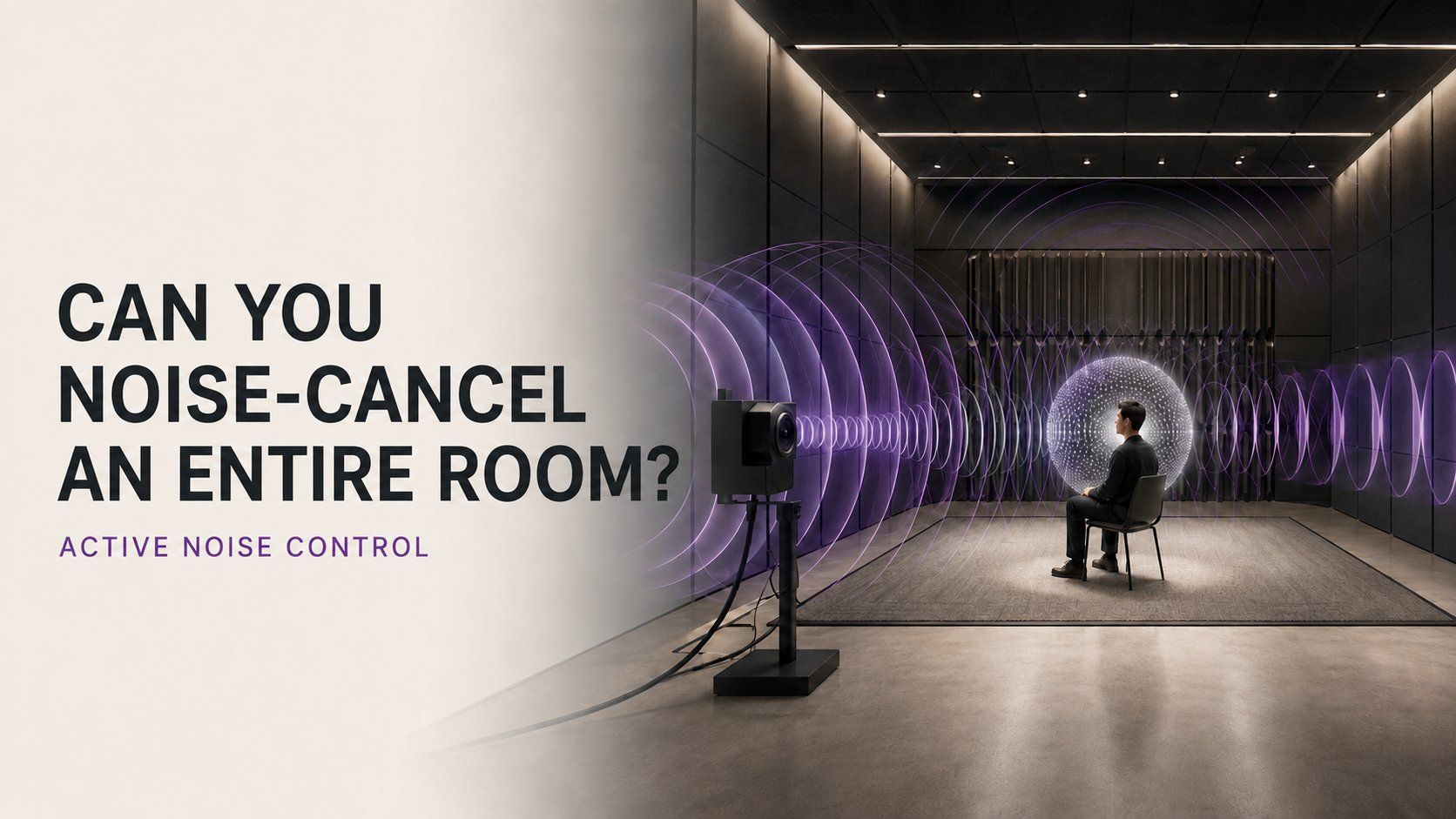
“Can You Noise-Cancel This Entire Room?” How Active Noise Control Works—and Where It Falls Short
When we discuss noise-control projects with customers, one question comes up from time to time:
“Noise-cancelling headphones are remarkably effective. Could the same technology be used to make an entire room quiet?”
It is a reasonable question. If active noise control could be applied throughout a room, perhaps there would be less need for heavy sound-insulating walls or thick sound absorbers.
The short answer is that ANC can reduce low-frequency noise in part of a room when the conditions are carefully controlled.
What remains extremely difficult is using it like a pair of headphones: creating uniform silence across a three-dimensional room in which people move around and speech, impacts and machinery generate sound over a wide frequency range.
The reason is not simply the size of the room. Wavelength, reflections, processing delay, listener position and changes in the noise source all matter.
What Active Noise Control Actually Does
Noise cancellation is more formally known as active noise control, or ANC.
The basic idea is to use a loudspeaker as a secondary sound source. It produces a control sound that interferes with the unwanted sound, reducing the sound pressure at the intended location.
For a single-frequency sine wave, this can be described as adding a wave of equal amplitude with a phase shift of 180 degrees. The peak of one wave meets the trough of the other, and the resulting sound pressure becomes smaller.
Real noise is more complicated. It normally contains many frequencies and changes over time. A practical ANC system therefore does more than reverse polarity. It must generate the right waveform while accounting for the propagation path and delay between the reference microphone, control loudspeaker and target location.
In audio production, two identical, time-aligned tracks may cancel when the polarity of one is reversed. ANC performs a related task in real time, but the signal has to travel through a physical acoustic space that is full of delays and reflections.
The system is not deleting noise data. The primary source and the secondary loudspeaker create a new sound field in which the pressure at selected points—or, in some designs, the acoustic energy or radiated power—is reduced.
The Principle Is Nearly a Century Old
ANC is not a recent invention. Paul Lueg’s U.S. patent, Process of Silencing Sound Oscillations, was granted in 1936. The application described detecting sound with a microphone and using a loudspeaker to produce a compensating sound, including an arrangement for controlling noise travelling through a duct.
That did not mean the technology of the 1930s could achieve what today’s headphones can do.
Noise and acoustic paths change, so the controller has to keep adapting. The development of adaptive filters, digital signal processing, microphones, loudspeakers and compact computing hardware greatly expanded the practical use of ANC, particularly from the 1980s onward.
Why Noise-Cancelling Headphones Work So Well
ANC headphones generally use one of three arrangements:
- A feedforward system detects external noise with a microphone on the outside.
- A feedback system monitors the residual sound with a microphone near the ear.
- A hybrid system uses both.
The details differ, but headphones provide several conditions that make active control much easier.
First, the target is very small and its position is predictable: the sound near the eardrum. The relative positions of the microphones, driver and ear do not change very much.
Second, the ear tips or earcups already block part of the sound physically. This is passive noise control. It is particularly useful at higher frequencies, leaving the ANC system to concentrate on the lower-frequency components that are easier to control.
Third, the acoustic paths are short and constrained. Continuous low-frequency noise, such as the rumble of an aircraft cabin or an HVAC system, is especially suitable.
In other words, noise-cancelling headphones are not purely active devices. They work through a well-balanced combination of passive isolation and electronic control.
In a Room, the “Same Sound” Changes from Place to Place
Inside headphones, the location to be controlled is almost fixed. In a room, people walk, turn their heads and sit in different positions.
The sound field is also much more complex. Sound from a machine reaches a listener directly and after reflecting from the walls, floor, ceiling, doors and installed equipment. Those arrivals have different delays, amplitudes and directions.
A controller may reduce the pressure at the error microphone, yet the relationship between the unwanted sound and the control sound changes only a short distance away. The same control signal therefore cannot produce the same cancellation everywhere in the room.
The Quiet Zone Shrinks as Frequency Rises
For local point control, a commonly cited rule of thumb is that the diameter of the region with more than about 10 dB of attenuation may be on the order of one-tenth of the acoustic wavelength.
Using a sound speed of 343 m/s:
| Frequency | Wavelength | Approximate quiet-zone diameter at one-tenth wavelength |
|---|---|---|
| 100 Hz | 3.43 m | 34 cm |
| 500 Hz | 0.686 m | 6.9 cm |
| 1,000 Hz | 0.343 m | 3.4 cm |
At 100 Hz, the controlled region may be large enough to cover part of a person’s head. At 1,000 Hz, the corresponding estimate is only a few centimetres. A small movement can take the listener out of the area where strong attenuation was achieved.
This is a rule of thumb for one type of local control, not a universal boundary. Multichannel systems using several microphones and loudspeakers can enlarge or reshape the target region. Research into virtual sensing also aims to estimate and control the sound where a physical microphone cannot be placed.
The underlying challenge remains: as frequency rises, wavelength becomes shorter and the sound-pressure pattern changes more rapidly across space.
Can ANC Make the Sound Louder Elsewhere?
It can.
If a controller is optimized only for one microphone, sound pressure may increase at another position. The result may be a room in which the microphone location is quieter but the occupant’s actual position is not.
It is not accurate, however, to say that the cancelled energy must always reappear somewhere else as an equal increase.
Depending on the placement of the secondary sources and the control objective, an ANC system may reduce the acoustic power radiated by the primary source or reduce acoustic energy across an enclosure. The outcome depends partly on what the system is designed to minimize: pressure at one point, an average across several points, total acoustic energy or radiated acoustic power.
Whole-Room ANC Is Not Impossible—but the Conditions Are Restrictive
It would be misleading to say that active control of a whole room is impossible in principle.
A wider area or a room mode may be a realistic target when:
- the unwanted sound is at low frequencies;
- the sound is tonal or periodic, such as motor rotation noise or mains hum;
- the source and room conditions remain stable;
- the listening area or seating position can be defined; and
- multiple microphones and secondary loudspeakers can be positioned and calibrated appropriately.
The situation changes when speech, impact noise, tools and several machines are present at the same time, while people and equipment also move. The sound field is then continually changing. As the bandwidth and target area increase, the number of sensors and loudspeakers, the processing load and the difficulty of maintaining stable control all increase.
Researchers have demonstrated methods for controlling room modes and reducing outgoing periodic sound fields over an extended region. These are important advances, but they do not yet amount to a general-purpose technology that can make any occupied room behave like a pair of noise-cancelling headphones.
Where ANC Is Most Effective
ANC can be highly effective when the application suits its strengths.
HVAC and Ventilation Ducts
At frequencies below the cut-on of higher-order duct modes, the sound field in a duct can often be approximated as a plane wave. A reference microphone can detect the upstream noise and a downstream loudspeaker can produce the control sound. Fan noise at low frequencies is a typical target.
Once multiple duct modes begin to propagate, the pressure distribution across the duct becomes more complex and additional sensors and secondary sources may be required.
Headphones, Headsets and Active Headrests
These applications target a defined region around the ears or head. Similar local-control concepts are used in vehicles and aircraft to reduce low-frequency engine, propeller and road noise around a seat.
Periodic Noise in Vehicles and Machinery
Noise tied to engine or motor speed is often a good candidate because a reference signal is available and the waveform is relatively predictable.
Close to the Noise Source
Where secondary sources can be placed near the machine, it may be possible to control a specific low-frequency or periodic component before it spreads through the room. This does not make all broadband machine noise disappear, but it can be more effective than trying to cancel the sound only at a distant listening point.
Whole-Room ANC Is Likely to Be Extremely Expensive
Beyond the technical difficulty, cost is a major practical barrier. Controlling one low-frequency tone in a duct or around a fixed seat is very different from controlling a three-dimensional room in which people move. Whole-room control may require multiple—and in some cases many—microphones, secondary loudspeakers, multichannel real-time controllers and purpose-designed control software.
The equipment alone is not enough. A project may also require on-site acoustic measurement, system modelling, sensor and loudspeaker placement, commissioning, stability validation and detailed tuning. Changes to the room layout, machinery or occupied positions may require retuning and ongoing maintenance.
As a result, whole-room, broadband ANC is not an off-the-shelf product that can simply be installed. It becomes a custom-engineered system and is likely to be extremely expensive. A design may be technically possible yet still be commercially impractical.
Sonora Technology Does Not Supply ANC Systems
Sonora Technology does not design, manufacture, sell or install active noise control systems. We therefore cannot provide quotations or implementation services for ANC equipment. We can assist with acoustic measurement and investigation, as well as passive solutions based on sound absorption and sound insulation.
Active and Passive Noise Control Are Partners
Passive measures such as sound absorption and sound insulation and active noise control have different strengths.
| Method | Best suited to | Main constraints |
|---|---|---|
| Passive absorption and sound insulation | Broad frequency ranges, large spaces and changing noise conditions | Low-frequency control often requires greater depth, mass and installation space |
| Active noise control | Low-frequency, tonal or periodic noise along a defined path or within a fixed target area | Requires power, sensors, loudspeakers and tuning; broad high-frequency control over a large 3D space is difficult |
Blocking low-frequency sound with walls alone can require considerable mass and stiffness. ANC, on the other hand, is rarely a practical replacement for all sound insulation or broadband absorption.
A hybrid design can be more effective: use passive construction for broadband and higher-frequency noise, then consider ANC for a remaining low-frequency tonal component.
For more on passive design, see Walls That Stop Sound: Fundamentals and Misconceptions of Sound Insulation and Absorption Wedges vs. Flat Absorbers.
Start by Measuring the Frequency and Transmission Path
The question “Can this room be noise-cancelled?” cannot be answered from the room dimensions alone.
The first points to establish are:
- Which frequencies dominate?
- Is the sound continuous, periodic, fluctuating or impulsive?
- Do the source and receiving positions move?
- Can the required quiet area be restricted?
- Does the sound pass through walls, floors and ceilings, or through openings and ducts?
- How many decibels of reduction are required?
A fan tone around 100 Hz heard at a fixed seat may justify investigating local ANC or control within the duct.
In a factory where workers move around and the noise includes presses, impacts, tools, speech and several machines, passive measures such as acoustic enclosures, soundproof rooms, absorption treatment, barriers and opening treatments will normally provide the foundation.
Sonora Technology does not design, manufacture, sell or install active noise control systems. Our work covers on-site acoustic measurement and investigation, as well as the design and manufacture of anechoic chambers, soundproof enclosures, sound absorption systems and sound-insulating structures. Our sound insulation and absorption structures and soundproof partitions can be configured to suit the source, frequency range and site conditions.
We cannot provide quotations or implementation services for ANC equipment. If you need acoustic measurement, investigation or a passive alternative, please contact Sonora Technology.
Summary
Whole room noise cancellation is not completely impossible. It is, however, very different from controlling sound in the small, fixed space inside a pair of headphones.
ANC is most effective for low-frequency, tonal or periodic sound; a defined transmission path such as a duct; or a fixed target area around a seat or listener. In a large space, over a broad frequency range and under changing conditions, passive absorption and sound insulation remain the main tools of noise control.
The practical question is not whether active or passive technology is “better.” It is which combination is appropriate after the noise spectrum, transmission paths, target area and required reduction have been measured.
Sonora Technology does not supply or install ANC systems. We can assist with noise measurement and passive solutions, including soundproof rooms, enclosures, sound absorption and sound insulation.
Frequently Asked Questions
Can I noise-cancel a room with ordinary home speakers?
No—not simply by recording the noise and playing it back in reverse. A stable ANC system needs microphones, a real-time controller and a model or adaptive estimate of the delays and propagation paths from the source and control loudspeakers to the target area.
Does ANC work at high frequencies?
ANC generally becomes more difficult as frequency rises because the wavelength becomes shorter and small changes in position produce larger changes in pressure and phase. There is no single universal upper frequency; it depends on the system geometry, processing delay, target area and type of noise.
Can ANC remove only human speech?
Research systems can reduce speech under restricted conditions or at selected points, but uniformly cancelling conversations throughout a room in which several people move is extremely difficult. A practical design must also avoid interfering with alarms and necessary announcements.
Would adding ANC make a soundproof room even quieter?
Potentially, if the remaining problem is a stable low-frequency tonal or periodic component and the sources, receivers and propagation paths are sufficiently predictable. The benefit and cost should be assessed after frequency analysis and on-site investigation.
Can Sonora Technology Supply or Install an ANC System?
No. Sonora Technology does not design, manufacture, sell or install active noise control systems, and we cannot provide quotations for ANC equipment. We can assist with on-site acoustic measurement and passive measures such as soundproof rooms, acoustic enclosures, absorption and sound insulation.
References
- Paul Lueg, “Process of Silencing Sound Oscillations,” U.S. Patent No. 2,043,416, granted June 9, 1936.
- S. M. Kuo and D. R. Morgan, “Active Noise Control: A Tutorial Review,” Proceedings of the IEEE, Vol. 87, No. 6, pp. 943–973, 1999. DOI: 10.1109/5.763310.
- B. Lam et al., “Ten Questions Concerning Active Noise Control in the Built Environment,” Building and Environment, Vol. 200, 107928, 2021. DOI: 10.1016/j.buildenv.2021.107928.
- F. Ma, W. Zhang and T. D. Abhayapala, “Active Control of Outgoing Noise Fields in Rooms,” The Journal of the Acoustical Society of America, Vol. 144, pp. 1589–1599, 2018. DOI: 10.1121/1.5055217.