
What Happens If You Undertake Construction Work of 5 Million Yen or More Without a Construction Business License? – Penalties for Violating the Construction Business Act –
05/22/2026
In our previous article, “Is a Construction Business License Required for Installing Anechoic Chambers and Soundproof Rooms?”, we explained that the installation of anechoic chambers and soundproof rooms generally constitutes construction work, that a construction business license is required to undertake work of 5 million yen or more including tax, and that the same rule applies even to distributors.
So what happens if you undertake construction work of 5 million yen or more without obtaining a construction business license? This article explains what a “violation of the Construction Business Act” entails, namely penalties and supervisory dispositions.
Violations of the Construction Business Act Fall Into Two Categories: Criminal Penalties and Supervisory Dispositions
Sanctions for violating the Construction Business Act are broadly divided into two categories.
- Criminal penalties: penalties imposed by a court, such as imprisonment, fines, or civil fines
- Supervisory dispositions: administrative dispositions imposed by the Minister of Land, Infrastructure, Transport and Tourism or a prefectural governor, such as instructions, business suspension, or license revocation
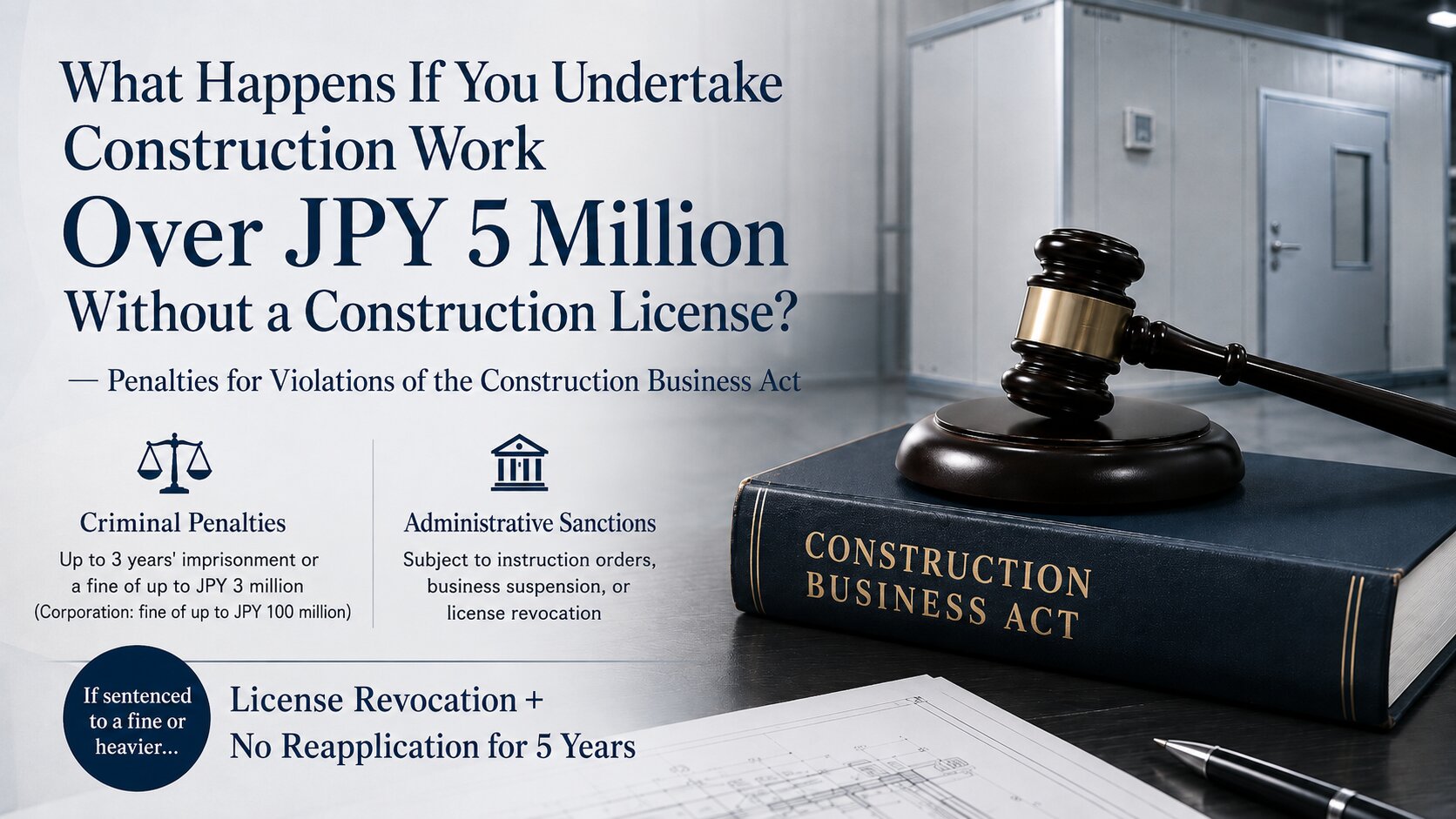
These are separate systems, and both may be imposed at the same time for the same violation. For example, a company found to be operating without a license may face the criminal penalty of “imprisonment for up to three years or a fine of up to 3 million yen,” while also being subject to a business suspension order by the administrative authority.
Criminal Penalties: Four Levels of Severity
Criminal penalties under the Construction Business Act are divided into the following four levels, in descending order of severity.
1. Imprisonment for up to Three Years or a Fine of up to 3 Million Yen (Article 47 of the Construction Business Act)
This is the most serious penalty and applies to the following five violations.
- Operating without a license, in violation of Article 3, Paragraph 1, such as undertaking construction work of 5 million yen or more without a license
- Concluding a subcontract without holding the required specified construction business license, in violation of Article 16
- Conducting business during a business suspension period
- Conducting business during a business prohibition period
- Obtaining a license by false or fraudulent means
In relation to the installation of anechoic chambers and soundproof rooms, the violations that require the most attention are items 1 and 2. Simply undertaking construction work of 5 million yen or more without a license is enough to trigger this most severe class of penalty.
Depending on the circumstances, imprisonment and a fine may be imposed together.
2. Imprisonment for up to Six Months or a Fine of up to 1 Million Yen (Article 50)
This applies, for example, when false statements are made in a license application or change notification.
3. Fine of up to 1 Million Yen (Article 52)
This applies, for example, when a chief engineer or supervising engineer is not assigned to the site, or when an inspection by the administrative authority is refused.
4. Civil Fine of up to 100,000 Yen (Article 55)
This applies, for example, when the required license sign is not posted at an office or construction site, or when required books and records are not kept. A civil fine is not a criminal penalty; it differs from items 1 through 3 in that it is an administrative penalty for maintaining order.
Corporations May Separately Face a Fine of up to 100 Million Yen Under the Dual Liability Provision
For violations such as Article 47, Item 1, the Act includes a dual liability provision under which not only the individual who committed the violation, such as a representative or employee, is punished, but the corporation itself may also be fined (Article 53 of the Construction Business Act). The maximum fine imposed on a corporation is 100 million yen.
In other words, when a company undertakes construction work of 5 million yen or more without a license:
- The individual responsible for the violation may face imprisonment for up to three years or a fine of up to 3 million yen.
- The corporation itself may face a fine of up to 100 million yen.
Both may be imposed at the same time.
Supervisory Dispositions: Increasing in Severity Across Three Levels
Separate from criminal penalties, supervisory dispositions are administrative dispositions imposed by the Minister of Land, Infrastructure, Transport and Tourism or a prefectural governor. They fall into the following three levels, from least to most severe.
- Instruction order: an order requiring specific corrective measures for violations or improper matters
- Business suspension order: an order suspending all or part of business operations for a specified period of up to one year
- License revocation: revocation of the construction business license itself
Normally, these measures increase in stages from item 1, but for malicious violations, item 3 may be imposed immediately without going through items 1 or 2.
A Fine or Heavier Penalty Means License Revocation and a Five-Year Bar on Reacquisition
This is probably the point with the most serious practical impact.
Under the Construction Business Act, if a person is sentenced to a fine or heavier penalty, they fall under the disqualification grounds for holding a construction business license (Article 8). Once the disqualification grounds apply, any current construction business license will be revoked. As a result:
- A new license cannot be obtained for five years from the revocation.
- During that period, the company cannot undertake anything other than minor construction work, meaning work under 5 million yen.
In practical terms, this means being forced out of the business of undertaking construction work of 5 million yen or more for five years. This is an extremely serious consequence that can make business continuity difficult after a single violation.
“We Are Only a Distributor” Is Not a Valid Defense
As discussed in the previous article:
End user -> Distributor A -> Distributor B -> Sonora
When anechoic chambers or soundproof rooms of 5 million yen or more are supplied through this transaction flow, Distributor A and Distributor B also need construction business licenses. The argument that “we are only selling it, and Sonora will perform the installation” does not work. Under the Construction Business Act, once a party becomes a party to a construction contract, that contracting party is required to hold a license.
Accordingly, the risks described above, including penalties, supervisory dispositions, and disqualification periods, apply equally not only to manufacturers but also to distributors and dealers.
The Monetary Thresholds for Specified Construction Business Were Changed in 2025
For reference, amendments that took effect on February 1, 2025 raised the subcontracting amount thresholds that trigger the need for a specified construction business license.
- Before the amendment: total subcontracting amount of 45 million yen or more, or 70 million yen or more for general building construction
- After the amendment, currently in effect: total subcontracting amount of 50 million yen or more, or 80 million yen or more for general building construction
If a company receives construction work as the prime contractor and the total amount subcontracted out exceeds these thresholds, it needs a specified construction business license rather than a general construction business license. Concluding an applicable subcontract without that license is subject to Article 47 described above, meaning imprisonment for up to three years or a fine of up to 3 million yen.
Summary
A construction business license is not merely something that is “nice to have.” It is legally required in order to undertake construction work of 5 million yen or more. The consequences of violation are severe:
- Imprisonment or fines for the responsible individual
- A corporate fine of up to 100 million yen
- Business suspension or license revocation by the administrative authority
- Inability to reacquire a license for five years after revocation
Each of these consequences can threaten the continuity of the business itself.
At Sonora Technology, we not only maintain our own licenses, but also ask distributors and dealers to establish transaction structures based on the premise that the appropriate licenses are held. To avoid situations where a party lacks the required license despite exceeding the scope of minor construction work, we encourage you to consult with us from the stage of designing the transaction flow.