
Why Interior Sound Absorbers in Soundproof and Anechoic Rooms Should Be Certified Non-Combustible Materials
05/18/2026
MFAC / MSAC
Introduction: Not legally mandatory in every case, but extremely important in practice
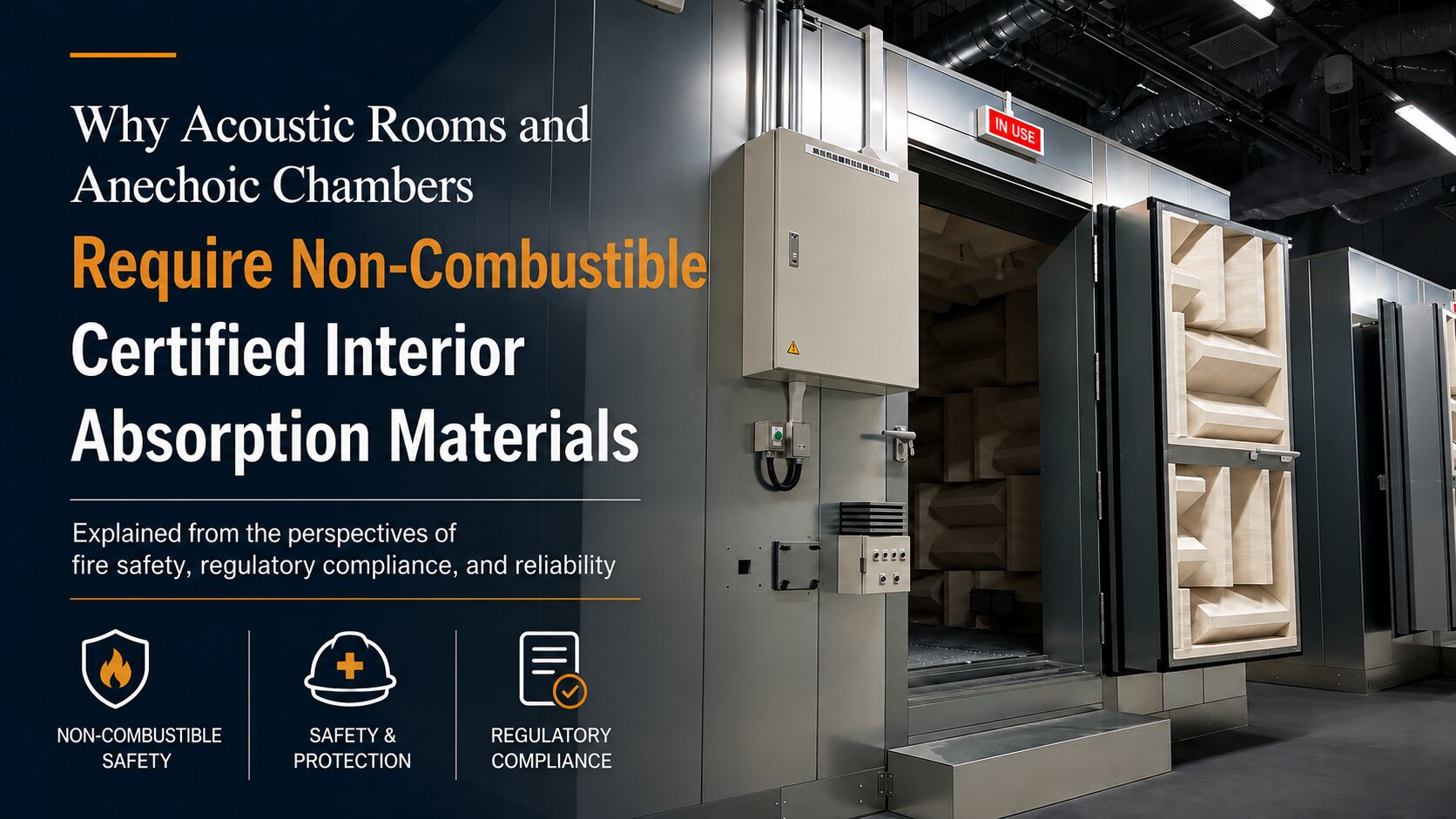
Interior sound absorbers used in soundproof rooms and anechoic rooms are required to provide not only high acoustic performance, but also fire safety.
However, it is important to first clarify one point. Under the Building Standards Act of Japan, whether non-combustible materials are legally required depends on the building use, scale, structure, installation location, designation as a fire prevention district, and how the room is used.
In other words, it is not true that “all soundproof rooms and anechoic rooms must always use non-combustible materials” simply because they are soundproof or anechoic rooms.
On the other hand, in practical projects involving research facilities, factories, universities, automotive facilities, and quality evaluation rooms, the use of certified non-combustible materials is often treated as a standard requirement from the perspectives of building confirmation, fire department consultation, internal safety review, and facility management standards.
This article explains why certified non-combustible materials are required for interior sound absorbers in soundproof and anechoic rooms, from both the regulatory and practical perspectives of acoustic test room design.
Main cases where non-combustible materials are required in buildings
In building design, non-combustible materials are typically required in the following three cases.
| Category | Main target | Relationship with soundproof and anechoic rooms |
|---|---|---|
| Interior finish restrictions | Walls and ceilings of special buildings, large buildings, windowless habitable rooms, rooms using fire, etc. | Directly relevant when sound absorbers are regarded as wall or ceiling finish materials |
| Fire-resistance requirements for the building itself | Principal structural parts, exterior walls, and parts within areas where fire spread is a concern in fire-resistant or quasi-fire-resistant buildings | Related to the structural and exterior conditions of the building |
| Structures and exterior installations | Rooftop signs, signs over 3 m high, advertising towers, etc. in fire prevention districts under Article 66 of the Building Standards Act | Generally outside the main scope of interior sound absorbers |
Among these, the topic most directly related to this article is interior finish restrictions. Fire-resistance requirements for the building structure and exterior structure regulations, such as those for signs, are somewhat separate from the issue of interior sound absorbers in soundproof and anechoic rooms. Therefore, this article focuses mainly on interior finish restrictions.
Under the Building Standards Act of Japan, a non-combustible material means a building material that satisfies the technical standards for non-combustibility and is either specified by the Minister of Land, Infrastructure, Transport and Tourism or certified by the Minister.
The required non-combustibility performance is defined as satisfying the following three conditions for 20 minutes after the start of heating under ordinary fire exposure, as stipulated in Article 108-2 of the Enforcement Order of the Building Standards Act:
- 1. The material must not burn.
- 2. The material must not cause harmful deformation, melting, cracking, or other damage from a fire safety perspective.
- 3. The material must not generate smoke or gas that is harmful to evacuation.
Walls and ceilings are the key areas under interior finish restrictions
The regulation most likely to affect soundproof rooms and anechoic rooms is the interior finish restriction under the Building Standards Act.
Interior finish restrictions are intended to suppress early-stage fire growth, delay flashover, and facilitate evacuation and firefighting activities by requiring the surfaces facing the room, such as walls and ceilings, to be finished with non-combustible, quasi-non-combustible, or fire-retardant materials.
Typical buildings or rooms that may be subject to interior finish restrictions include the following.
| Target | Description |
|---|---|
| Special buildings | Restaurants, hospitals, hotels, retail stores, exhibition halls, theaters, assembly halls, automobile garages, automobile repair shops, etc. |
| Basements and underground stores | Cases where underground spaces are used by an unspecified number of people |
| Windowless habitable rooms | Rooms lacking effective openings for daylighting, ventilation, or smoke exhaust |
| Rooms using fire | Kitchens, boiler rooms, workrooms using fire, etc. |
| Large buildings | Buildings subject to interior restrictions depending on the number of floors and total floor area |
On the other hand, a general office is not normally classified as a special building. Therefore, it cannot be said that “a soundproof room installed in an office is always subject to interior finish restrictions.”
However, caution is required in the following cases.
| Case requiring attention | Reason |
|---|---|
| The tenant building’s interior standards require non-combustible materials | Non-combustible materials may be required by building management rules or landlord specifications, separate from statutory requirements |
| The room is classified as a windowless habitable room | Interior restrictions become stricter due to smoke exhaust and evacuation limitations |
| Fire-using equipment or heat-generating equipment is installed | The room may be treated as a room using fire |
| The room also functions as a storage room, machinery room, or test equipment room | Individual confirmation may be required regarding the room use and fire department consultation |
| The room is installed in a factory, research facility, or automotive facility | The room may be affected by the overall building use, fire compartments, and evacuation planning |
For soundproof and anechoic rooms, it is important to determine whether the sound absorbers are merely equipment components or whether they form the interior finish of the walls and ceilings. If the absorbers cover a large portion of the interior surfaces and effectively constitute the wall and ceiling finish, their relationship with interior finish restrictions must be carefully reviewed.
Soundproof and anechoic rooms are structurally likely to become “windowless habitable rooms”
This is one of the most important points for soundproof and anechoic rooms.
To secure sound insulation performance, soundproof and anechoic rooms are often designed without windows in the surrounding walls or ceiling. At the same time, a room in which people continuously work may fall under the definition of a “habitable room” under Article 2, Item 4 of the Building Standards Act. In principle, habitable rooms are required to have openings for daylighting and ventilation under Article 28.
However, under former Ministry of Construction notice Ju-Shi-Hatsu No. 104, certain rooms that are unavoidable due to their use, such as broadcasting studios, hearing test rooms, and music practice rooms, may be treated as rooms that do not require openings for daylighting.
Regardless of whether this treatment applies, soundproof and anechoic rooms are often handled in practice as “windowless habitable rooms.” Once this classification applies, the following provisions become relevant.
| Provision | Requirement |
|---|---|
| Article 35-3 of the Act / Article 111 of the Enforcement Order | If the effective daylighting opening area is less than 1/20 of the floor area, or if the room does not have a window into which a circle of 1 m diameter can be inscribed, the principal structural parts must be fire-resistant, or the wall and ceiling substrates and finishes must be made of non-combustible materials |
| Article 128-3-2 of the Enforcement Order | If a habitable room has a floor area exceeding 50 m² and the area of openable openings is less than 1/50 of the floor area, the walls and ceilings must be finished with quasi-non-combustible materials or higher |
| Article 120 of the Enforcement Order | For windowless habitable rooms, an evacuation route must be secured within 30 m |
In other words, because of their acoustic requirements, soundproof and anechoic rooms are very likely to fall under interior finish restrictions. This is the main reason why people often say that interior sound absorbers “must be certified non-combustible materials.”
Sound absorbers cover a very large area in soundproof and anechoic rooms
Another key characteristic of soundproof and anechoic rooms is that sound absorbers cover a large portion of the interior surfaces.
In an ordinary meeting room or office, interior finishes usually consist mainly of wallpaper, boards, or ceiling materials. In contrast, anechoic rooms use sound-absorbing wedges or panels on the walls and ceiling, and fully anechoic rooms may also include sound-absorbing structures on the floor.
In such spaces, the sound absorbers themselves become the main interior finish material. If those absorbers are made of easily combustible materials, flames may spread across the interior surface in the event of a fire.
Soundproof and anechoic rooms also have the following characteristics.
| Characteristic | Fire safety concern |
|---|---|
| Highly airtight and highly sound-insulated structure | Smoke and heat may accumulate, and abnormalities may be difficult to detect from outside |
| Heavy doors or double doors | Evacuation may take more time |
| Air cavities behind sound absorbers | The movement of heat, smoke, and combustion products must be considered |
| Electrical equipment and measuring instruments are installed | Power supplies, wiring, and heat-generating equipment must be managed as potential ignition sources |
| A person may enter the room alone | Evacuation and emergency notification procedures are important |
Therefore, in soundproof and anechoic rooms, material selection should not be based only on minimum legal requirements. It should also incorporate an appropriate safety margin for the facility as a whole.
Certified non-combustible materials provide important evidence for building confirmation and fire department consultation
One of the major reasons for using certified non-combustible materials in soundproof and anechoic rooms is that they allow the fire performance of the materials to be clearly explained during building confirmation and fire department consultation.
Soundproof and anechoic rooms are often installed inside existing buildings after the building itself has already been constructed. For this reason, designers, confirmation inspection bodies, local fire departments, and facility managers may ask for confirmation of the following points.
| Item often checked | Description |
|---|---|
| Room use | Whether the room is a test room, research room, machinery room, storage room, workroom, or habitable room |
| Installation location | Whether it is on an above-ground floor, basement floor, windowless floor, or near an evacuation route |
| Fire performance of interior materials | Whether the material is non-combustible, quasi-non-combustible, fire-retardant, or flameproof |
| Certification number | Whether an NM, QM, RM, or equivalent certification number can be provided |
| Consistency with certified specification | Whether the surface material, core material, substrate, fixing method, and adhesive match the certified conditions |
| Relationship with fire protection systems | Whether smoke detectors, sprinklers, smoke exhaust systems, emergency broadcasting systems, etc. are affected |
When certified non-combustible materials are used, the explanation is not merely that “the material is difficult to burn.” Instead, it can be shown that the product has been officially evaluated as a building material.
This is especially important in anechoic rooms, where sound absorbers cover extensive wall and ceiling areas. The ability to objectively demonstrate the fire performance of these materials is a key factor in smooth regulatory and fire department discussions.
Risks of non-compliance
If interior finish restrictions are violated, the building owner or architect may be subject to imprisonment or fines under the Building Standards Act. Separate provisions may also apply under the Fire Service Act.
In practice, non-compliance may also cause the following problems:
- Building confirmation may not be granted, or the inspection certificate may not be issued.
- The building or room may become legally non-conforming, requiring corrective action during future renovations or extensions.
- In the event of a fire, the owner may be placed at a disadvantage in insurance or liability matters.
- The project may fail to meet the client’s or tenant’s internal compliance standards, causing rework after delivery.
Choosing uncertified materials simply to improve acoustic performance is not worthwhile from either a cost or legal risk perspective.
“Flameproof,” “fire-retardant,” “quasi-non-combustible,” and “non-combustible” do not mean the same thing
Catalogs for sound absorbers and interior materials sometimes use terms such as “flameproof,” “fire-retardant,” and “non-combustible.” These terms are not the same.
| Category | Performance duration | Main concept | Important note |
| Flameproof | — | A concept mainly under the Fire Service Act, often used for curtains, carpets, and fabrics | Different from non-combustible materials under the Building Standards Act |
| Fire-retardant material | 5 minutes after the start of heating | One type of fire-protective building material under the Building Standards Act | Certification number begins with RM |
| Quasi-non-combustible material | 10 minutes after the start of heating | Satisfies specified performance for a shorter duration than non-combustible materials | Certification number begins with QM. Often acceptable for interior finish restrictions |
| Non-combustible material | 20 minutes after the start of heating | Longest performance duration and generally the safest and easiest to explain | Certification number begins with NM |
It is important to note that, depending on the use and scale of the building, quasi-non-combustible materials may be legally sufficient. It is not always illegal unless non-combustible materials are used.
However, soundproof and anechoic rooms use a large area of sound absorbers, and evacuation safety and smoke generation must be considered. Therefore, even when quasi-non-combustible materials may be sufficient, prioritizing certified non-combustible materials is often the safer practical decision.
Another important point is that “glass wool or rock wool as a material is non-combustible” is not the same as saying that “a specific product has obtained non-combustible certification.”
For example, even if glass wool itself is classified as a non-combustible material by notification, if a decorative facing material is applied or if the adhesive contains a large amount of organic components, individual product-level certification, such as an NM number, may be required. The basic practice is to confirm whether the specific product has obtained certification from the Minister of Land, Infrastructure, Transport and Tourism.
Acoustic performance and non-combustibility can be achieved together
What matters in an anechoic room is not the type of sound absorber itself, but whether the required final sound field performance is achieved.
Anechoic and semi-anechoic rooms are test rooms designed to provide a free field or a free field over a reflecting plane. In performance evaluation, conformity to the inverse-square law is essential. In ISO 3745:2012, the absorber specification guidance included in the former ISO 3745:2003 was removed, and greater emphasis is placed on achieving sound field performance such as the inverse-square law.
The allowable range of the environmental correction factor also differs depending on the standard:
- ISO 3745: K2 ≤ 0.5 dB for high-precision sound power measurements
- ISO 3744: 0 ≤ K2 ≤ 4 dB for more practical semi-anechoic environments
This is also important from a fire safety design perspective. Instead of selecting materials only to maximize absorption, it is now possible to design the room so that it achieves the required free-field or hemi-free-field performance while also considering non-combustibility, durability, dust control, installability, cleanability, and replaceability.
At Sonora Technology, we believe it is important to comprehensively evaluate the target frequency range, internal room dimensions, sound insulation performance, regulatory requirements, and installation conditions in order to achieve both acoustic performance and safety.
Sonora’s approach: The BF Series
Sonora Technology uses products certified as non-combustible or quasi-non-combustible by the Minister of Land, Infrastructure, Transport and Tourism as standard specifications for interior sound absorbers used in anechoic rooms, anechoic boxes, and soundproof rooms.
The core product line is Sonora’s proprietary BF Series: BFW, BFB, and BFP.
All products in the series share a common structure: glass-fiber sound-absorbing material as the base material and DuPont™ Tyvek® as the surface material. Tyvek® is air-permeable, so it does not impair the acoustic absorption performance of the backing material. At the same time, it provides water resistance, scratch resistance, high whiteness, and low particle emission, and it eliminates the itchy sensation caused by fiber scattering.
| BFW | BFB | BFP | |
|---|---|---|---|
| Shape | Sound-absorbing wedge | Sound-absorbing board | Semi-cylindrical sound absorber |
| Application | Interior sound-absorbing layer for fully anechoic and semi-anechoic rooms | Soundproof rooms, machinery rooms, and various acoustic interior works | Soundproof rooms, machinery rooms, and various acoustic interior works |
| Features | High absorption from low to high frequencies | High absorption in the mid- to high-frequency range | One-touch installation and removal using a fitting method |
Among these products, the new BFB sound-absorbing board has obtained non-combustible certification from the Minister of Land, Infrastructure, Transport and Tourism under certification number NM-4938. It can legally be used as an interior sound absorber in cases involving both “windowless habitable room interior restrictions” and “special building interior restrictions” discussed above.
BFB is also available in a 96K cleanroom-compatible grade. Testing by the KAKEN Test Center confirmed particle emission below the ISO 14644-1 Class 5 criterion of 3,520 particles/m³ and below the Fed-Std-209E Class 100 criterion of 100 particles/ft³. This makes it applicable to acoustic treatment in cleanrooms for semiconductor, precision equipment, pharmaceutical, and related fields.
Sonora Technology combines the BF Series with other certified non-combustible sound-absorbing materials as appropriate for each project. Specifications are determined on a case-by-case basis to match the interior finish requirements, cleanliness requirements, and design requirements of the building in which the room is installed.
Design checklist
When selecting interior sound absorbers for soundproof and anechoic rooms, it is important to check the following items.
| Item | Checkpoint |
|---|---|
| Building use | Office, factory, research facility, school, hospital, store, automotive facility, etc. |
| Room use | Test room, research room, machinery room, storage room, workroom, or habitable room |
| Installation floor | Above-ground floor, basement floor, or windowless floor |
| Fire or heat-generating equipment | Presence of fire-using equipment, heat-generating devices, or power equipment |
| Interior finish restrictions | Whether restrictions apply to the walls and ceilings |
| Material classification | Non-combustible, quasi-non-combustible, fire-retardant, or flameproof |
| Certification number | Whether NM, QM, RM, or similar certification can be confirmed |
| Certified specification | Whether the substrate, adhesive, and fixing method match the certified specification, not only the material itself |
| Fire protection systems | Whether there is interference with detectors, sprinklers, emergency lighting, or smoke exhaust systems |
| Management standards | Whether the client, building manager, or internal safety standards require non-combustible materials |
Particular attention should be paid to the fact that even if the material itself is non-combustible, it may not be treated as a certified non-combustible specification if the actual installation configuration differs from the certified specification.
It is necessary to confirm not only the sound absorber itself, but also the surface material, backing material, substrate, adhesive, fixing hardware, and joint treatment.
Conclusion: Certified non-combustible materials are the safety foundation that supports acoustic performance
The reason certified non-combustible materials are required for interior sound absorbers in soundproof and anechoic rooms is not simply that they are difficult to burn.
The important points are the following three:
- 1. Regulatory compliance
Depending on building use, scale, installation location, windowless room classification, fire-using room classification, and other conditions, fire performance may be required for wall and ceiling interior materials. In particular, soundproof and anechoic rooms are structurally likely to become windowless habitable rooms and therefore are very likely to fall under interior finish restrictions. - 2. Fire safety
Since sound absorbers are used over large surface areas in soundproof and anechoic rooms, consideration must be given to flame spread, smoke, harmful gases, and evacuation safety. - 3. Consultation and review
By using certified non-combustible materials, the fire performance of the materials can be clearly explained during building confirmation, fire department consultation, internal safety review, and discussions with building managers.
Soundproof and anechoic rooms are important facilities that support precise acoustic measurement and research and development. At the same time, they are building spaces where people enter, operate equipment, and work over long periods.
Therefore, interior sound absorbers must provide not only high acoustic performance, but also fire safety, regulatory compliance, and maintainability.
A space designed to measure sound correctly must also be designed correctly for safety. That is why certified non-combustible interior sound absorbers are so important in soundproof and anechoic rooms.