
Can a Truly Silent Space Be Created on Earth?
01/29/2026
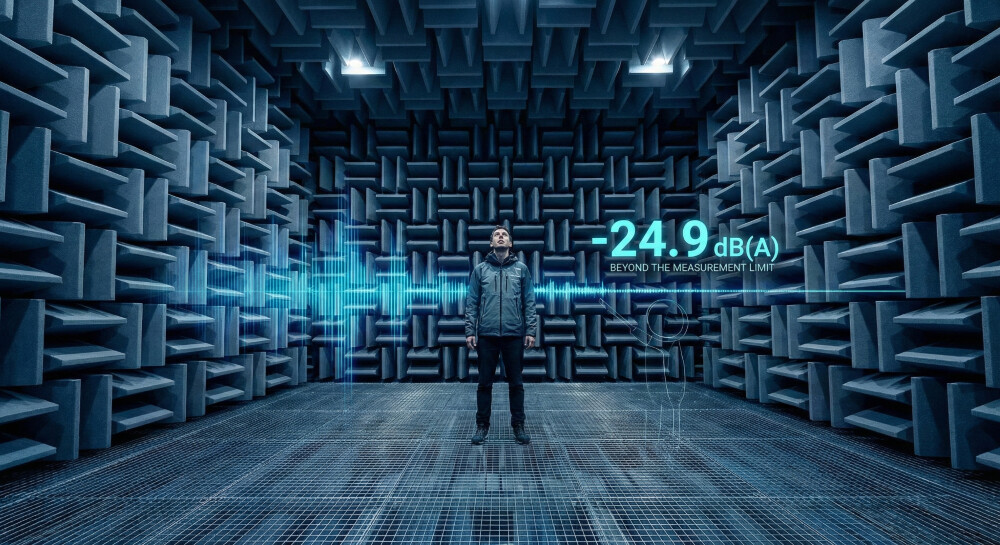
Have you ever wondered whether it is possible to create a truly silent space on Earth?
To explore this question, we begin by examining what is often referred to as the “(provisionally) quietest place in the world.”
Interpreting “Quietness” as Defined by Guinness World Records from an Acoustical Engineering Perspective
Official Description by Guinness World Records
According to Guinness World Records, the quietest place on Earth is the anechoic test chamber at Orfield Laboratories in Minneapolis, Minnesota, USA.
In tests conducted on November 19, 2021, the ambient sound level inside the chamber was evaluated as −24.9 dB(A).
The quietest place on Earth is the anechoic test chamber at Orfield Laboratories in Minneapolis, Minnesota, USA. In tests conducted on 19 November 2021, the ambient sound level inside the room was measured at −24.9 decibels.
(Source: Guinness World Records – https://www.guinnessworldrecords.com/world-records/quietest-place)
The value dB(A) shown here refers to an A-weighted sound level, an evaluation metric that reflects human auditory sensitivity.
Was −24.9 dB(A) Directly Measured?
A closer reading of the official description reveals an important point:
the ambient noise level inside this anechoic chamber is stated to be below the noise floor of even the most advanced scientific measurement instruments.
This means that the level lies beyond the range in which a numerical value can be read directly using conventional microphones or sound level meters with A-weighting.
In the actual measurement setup, two low-noise microphones were used, each connected to an independent preamplifier.
Electrical noise is inherently random and therefore uncorrelated between the two channels, whereas sound pressure fluctuations originating from the room itself appear identically in both microphones.
By exploiting this property, the measurement employed cross-correlation processing between the two signals to statistically reduce noise components intrinsic to the measurement system.
The resulting data were then evaluated using A-weighting, and the value −24.9 dB(A) was derived.
Therefore, −24.9 dB(A) is not a value obtained by directly reading the microphone output, but rather an evaluated result calculated from measurable data through analysis and conversion.
What Guinness World Records Does and Does Not Certify
It is essential to clearly distinguish what Guinness World Records certifies—and what it does not.
What Guinness World Records Certifies
- That the record was achieved in accordance with predefined rules
- That it represents an extreme (minimum) value under specific conditions
- That the achievement followed prescribed measurement and analysis procedures
What Guinness World Records Does Not Certify
- The validity of acoustic theory itself
- The academic or scientific validity of the measurement limits
- Whether the value −24.9 dB(A) has a physically measurable meaning
In other words, Guinness World Records certifies the title
“the quietest place in the world under A-weighted evaluation,”
but it does not provide an academic guarantee that
“−24.9 dB(A) is physically and directly measurable as a sound pressure level.”
Converting −24.9 dB(A) to Sound Pressure (Pa)
Although A-weighting involves frequency-dependent correction and is not a direct physical quantity, the value can be approximately converted for reference:
−24.9 dB(A)≒ 1.1 µPa (equivalent sound pressure)
What Does Approximately 1.1 µPa Mean in the Real World?
An equivalent sound pressure of 1.1 µPa corresponds to approximately 1/18 of the human hearing threshold
(0 dB SPL = 20 µPa).
For a person with normal hearing, this level is completely imperceptible.
From a physical standpoint, air molecules at room temperature and atmospheric pressure are constantly in thermal motion.
The resulting microscopic pressure fluctuations—thermal noise—reach the order of several micro-pascals.
Thus, a value of approximately 1.1 µPa lies within the range of unavoidable background fluctuations that exist as long as air is present.
In other words, −24.9 dB(A) does not represent a specific “sound” emitted by a source, but rather an evaluation metric that numerically expresses an extremely quiet environment based on human auditory perception.
Conclusion: −24.9 dB(A) Does Not Mean “Silence”
The value −24.9 dB(A) does not indicate that silence exists.
It represents the result of analytically evaluating a level of quietness that exceeds direct measurement limits, using A-weighted assessment within an extreme anechoic environment.
To correctly understand acoustic environments, what matters is not the magnitude of the number itself, but the assumptions, measurement methods, and analytical processes behind the evaluation metric used.
The realistic answer to the question “Does silence exist?” becomes clear only after recognizing these premises.
The Acoustical Definition of “Silence”
From an acoustical engineering perspective, “silence” may be defined as a state in which sound pressure is exactly zero—that is, 0 Pa.
Because sound is a pressure fluctuation in a medium such as air, a state with no pressure fluctuation whatsoever would theoretically correspond to the absence of sound.
However, creating a state of 0 Pa sound pressure on Earth is physically impossible, because pressure can never be perfectly static as long as air exists.
Can Silence Be Achieved Using a Vacuum?
If silence corresponds to 0 Pa, one might ask whether removing air entirely—creating a vacuum—could realize silence.
In theory, sound cannot propagate in a perfect vacuum because it requires a medium.
However, in practice, creating and maintaining a perfect vacuum on Earth is impossible.
Complete Removal of Molecules Is Impossible
Vacuum chambers can only create reduced-pressure environments; they can never eliminate molecules entirely.
Outgassing from material surfaces and minute external leaks ensure that residual gas molecules always remain.
As Long as Molecules Exist, Pressure Exists
Even in ultra-high vacuum conditions, molecules are extremely sparse but not absent.
As long as molecules exist, pressure and microscopic fluctuations necessarily exist.
Thus, a state of 0 Pa sound pressure is neither theoretically nor practically achievable.
The Apparatus Itself Becomes a Source of Vibration
Vacuum systems themselves generate vibration and noise.
Vacuum pumps, cooling systems, and ground-borne vibrations are transmitted through structural components, resulting in structure-borne sound and mechanical energy—even if airborne sound is eliminated.
Human Survival and Measurement Constraints
Moreover, humans cannot survive in a perfect vacuum, nor can measurement instruments operate under normal conditions.
An “acoustic environment” in which humans can exist and discuss sound therefore cannot be realized in a vacuum.
Summary
For all of these reasons, it is not possible to realize “silence = 0 Pa” as a physical space on Earth.
Silence remains a theoretical concept, while real acoustic environments always involve some degree of pressure fluctuation or vibration.
In conclusion, to the question posed in the title—
“Can a silent space be created on Earth?”
the answer is:
No, true silence cannot be created. However, it is possible to approach silence asymptotically through evaluation and engineering.