
From a PA Engineer’s Perspective, “A Room Should Be Well-Absorbed” — But Does That Work for Acoustic Measurement?
02/05/2026
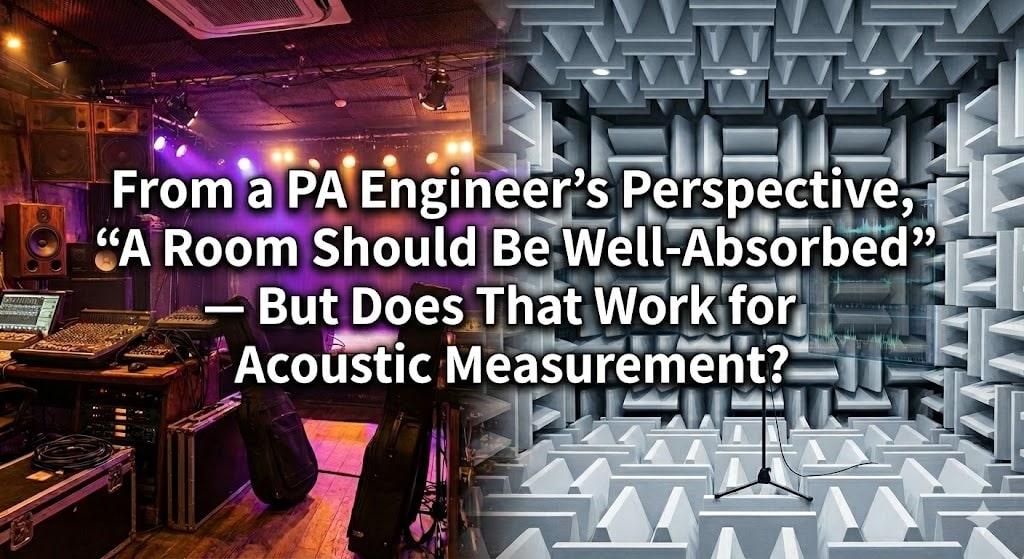
“Honestly, the more dead the room is, the better.”
This comment came from a seasoned PA engineer during a casual conversation.
For live sound, studios, and temporary PA setups, this idea is completely natural.
- Reflections cause feedback.
- Reflections blur localization.
- Reflections make mixing harder.
From a PA engineer’s point of view, a good room is one where sound disappears quickly.
But here is the key question:
Does the same logic apply to an anechoic chamber used for acoustic measurement?
What a “Good Room” Means in the PA World
In PA applications, the ideal room typically has:
- Minimal wall and ceiling reflections
- Short reverberation time
- Little sound returning to microphones
In other words, a room where sound stops as soon as it is produced.
This “deadness” is not just preference—it is a practical requirement for stable and controllable sound reinforcement.
From a listening and operational standpoint, this evaluation is absolutely correct.
Anechoic Chambers Are Not Designed to Be “Quiet”
An anechoic chamber is often described as:
- Extremely quiet
- Sound-absorbing
- Uncomfortable or “ear-ringing”
However, quietness is not the true objective of an anechoic chamber.
The real purpose is simple: To realize a free sound field.
A free field is a sound field where:
- Sound propagates without reflection
- Sound pressure decreases according to the inverse square law
- Distance doubling results in a 6 dB reduction
ISO 3745:2012 defines this requirement quantitatively using the environmental correction factor K₂ ≤ 0.5 dB.
“More Absorption” Does Not Automatically Mean “Better Measurement”
Here is where PA intuition and measurement reality begin to diverge.
A typical PA-oriented approach
There are reflections → add more absorption.
What sometimes happens in measurement spaces
- Absorption becomes uneven
- Directional reflection characteristics appear
- The sound field loses spatial uniformity
- The inverse square law no longer holds consistently
- K₂ increases instead of improving
As a result, the room may feel more dead, yet become worse as a measurement environment.
This is a critical point:
A room that sounds dead is not necessarily a room that measures correctly.
What Changed with ISO 3745:2012
Earlier standards (ISO 3745:2003) specified detailed construction rules, such as:
- Normal-incidence absorption coefficient ≥ 0.99
- Wedge length ≥ λ/4
These were design prescriptions.
In ISO 3745:2012, these annexes were removed.
The focus shifted decisively to one criterion:
Whether the inverse square law is satisfied.
In other words:
- Material type
- Absorber shape
- Visual “deadness”
are no longer the evaluation target.
Only the resulting sound field matters.
Sonora’s View: Absorption Is a Means, Not the Goal
At Sonora, we do not reject the PA engineer’s instinct to control reflections.
Instead, we redefine its role.
- Absorption is a tool, not an objective
- Quantity is less important than uniform effectiveness
- Spatial consistency of the sound field is essential
This philosophy underlies the design of Sonora’s Broadband Fractal (BF) absorber series, which emphasizes:
- Broadband and stable absorption
- Reduced directional reflection bias
- High sound-field uniformity
The goal is not simply to “kill sound,” but to ensure a verifiable free-field condition.
Bridging PA Intuition and Measurement Physics
The statement
“A room should be well absorbed”
is not wrong.
It is simply incomplete when applied to acoustic measurement.
In PA work, the question is:
“Does this room sound controllable?”
In anechoic design, the question becomes:
“Does this room obey acoustic physics correctly?”
An anechoic chamber is not a space designed to feel comfortable or impressive.
It is a space designed to be objectively correct.
Understanding this distinction is where PA experience and measurement engineering finally meet.
Key Takeaways
- PA environments favor strong absorption for practical control
- Anechoic chambers prioritize free-field validity
- Absorption amount alone does not guarantee good measurement
- ISO 3745:2012 evaluates inverse square law performance, not structure
- Sonora designs spaces where sound fields, not materials, are optimized