
How to Perform Acoustic Measurements Correctly — Differences Between Sound Level Meters, Measurement Microphones, and Anechoic Chambers —
12/26/2025
MFAC
Introduction: What Does It Mean to “Measure Sound”?
In acoustic measurement practice, we are often asked questions such as:
- What is the difference between a sound level meter and a measurement microphone?
- Why is an anechoic chamber required for certain measurements?
Although many devices appear similar, their purpose, accuracy, applicable standards, and required measurement environments differ significantly.
This article explains, from a practical engineering perspective:
- The differences between sound level meters and measurement microphones
- Why anechoic chambers are required
- How ISO standards define proper measurement environments
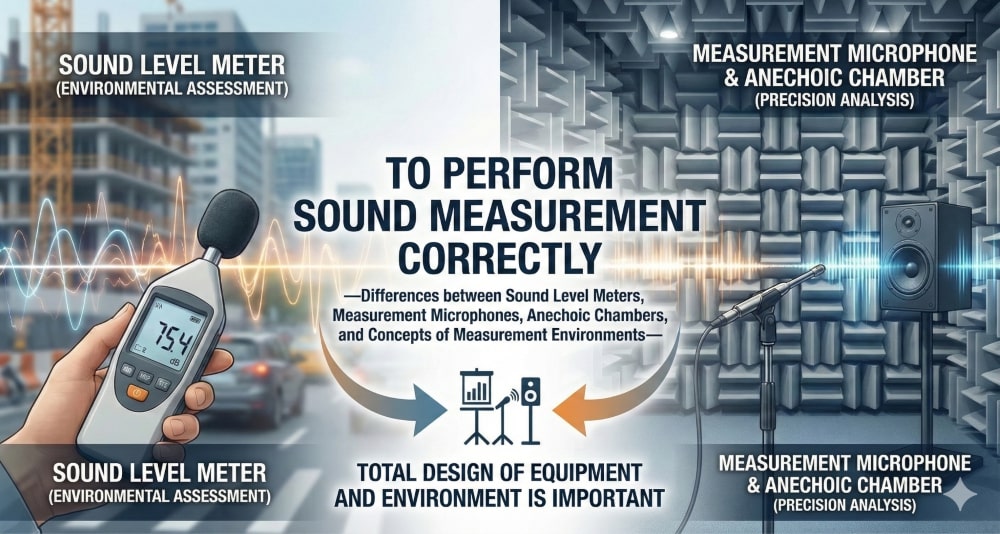
- Why acoustic measurement must be considered as a total system, including both instruments and test spaces
Sound Level Meters: Instruments for Environmental Noise Evaluation
A sound level meter (SLM) is a self-contained measuring instrument designed primarily for evaluating and documenting environmental and occupational noise.
Key Characteristics
- Integrated microphone, amplifier, signal processing, and display
- Typical measurement parameters include SPL, LAeq, and octave-band analysis
- Accuracy classes (Class 1 / Class 2) defined by IEC 61672
- Designed for compliance with regulations and environmental standards
Typical Applications
- Environmental noise measurements around construction sites
- Road and railway noise assessments
- Noise documentation for community or workplace complaints
Sound level meters prioritize ease of use, reproducibility, and legal validity, allowing consistent results regardless of the operator.
Measurement Microphones: Precision Acoustic Sensors
Measurement microphones are high-precision acoustic sensors used to analyze the physical characteristics of sound itself.
Key Characteristics
- Cannot operate independently; must be combined with signal conditioners (e.g., CCLD) and analyzers
- Extremely flat frequency and phase response over a wide bandwidth
- Classified under IEC 61094, with Class 1 microphones being typical for precision measurements
- Designed for laboratory testing, anechoic measurements, and advanced signal analysis
Typical Applications
- Loudspeaker frequency response measurements in anechoic chambers
- Sound power measurements according to ISO 3744
- Impulse response and time-domain / FFT analysis
Measurement microphones are essential where accuracy, repeatability, and spatial resolution are critical.
Summary of Key Differences
| Item | Sound Level Meter | Measurement Microphone |
|---|---|---|
| System configuration | Integrated, all-in-one | Modular (microphone + preamp + analyzer) |
| Main standards | IEC 61672 | IEC 61094 and related ISO standards |
| Measurement focus | Sound pressure level | Time, frequency, and spatial analysis |
| Typical use | Environmental / regulatory noise | Product testing, R&D, laboratory analysis |
| Operation | Relatively simple | Requires technical expertise |
Why Anechoic Chambers Are Required
Measurement microphones achieve their full performance only when a free-field condition is properly established.
For this reason, anechoic or semi-anechoic chambers are indispensable for sound source evaluation and sound power measurements.
Concept of ISO 3745:2012
ISO 3745:2012 evaluates anechoic chamber performance primarily based on verification of the inverse square law, rather than specific absorber materials or shapes.
Key requirements include:
- Sound pressure level decreases by approximately 6 dB when distance doubles
- Environmental correction factor K2 ≤ 0.5 dB
- Compliance confirms that a free-field condition is achieved
This approach enables greater design flexibility, allowing precise measurements while also improving operator comfort.
The Importance of Total System Optimization
Measurement accuracy depends on the combined performance of:
- Measurement microphones
- Signal conditioning and analysis systems
- Anechoic or semi-anechoic test environments
Even the most advanced instruments cannot deliver reliable results if the acoustic field of the test room is inadequate.
Therefore, acoustic measurement must be designed and evaluated as a complete system, not as individual components.
Related Information: Total Acoustic Measurement Solutions
Practical examples of integrated acoustic measurement systems, including both instrumentation and test environments, are introduced on the following page:
▶ Total Acoustic Measurement Solutions
https://acoustic-measurement.com/en/
(Handled by Moritani Shokai)
The page provides system configuration examples based on ISO 3744 and ISO 3745, as well as real-world approaches to anechoic measurement design.
Conclusion: Start with Purpose and Environment
- Sound level meters are tools for evaluating and documenting environmental noise
- Measurement microphones are sensors for scientific analysis of sound characteristics
- Anechoic chambers provide the acoustic foundation required for precision measurements
Successful acoustic measurement begins not with instrument selection, but with a clear understanding of
what needs to be measured, and under what environmental conditions.